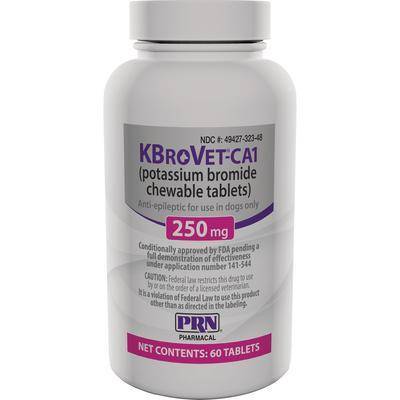
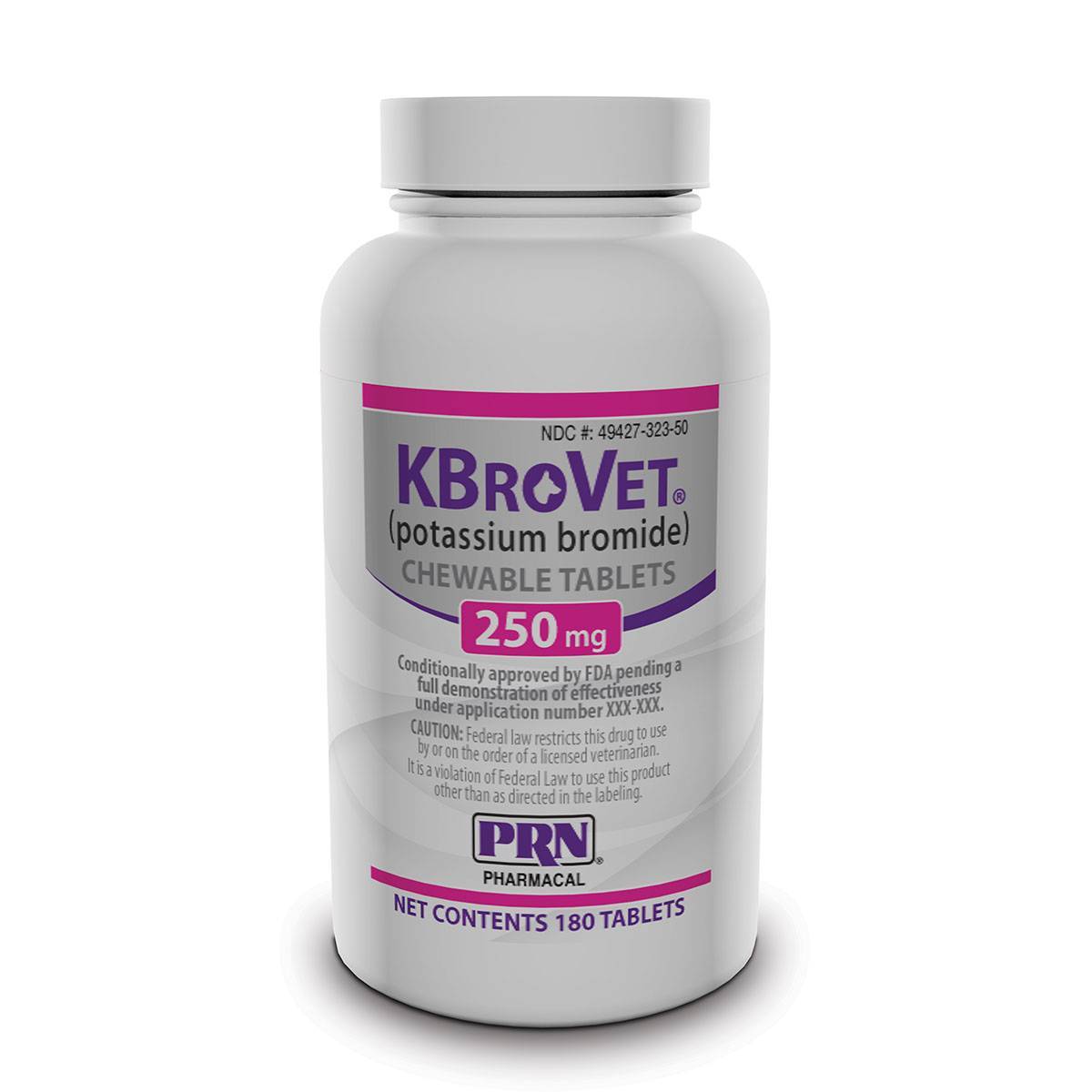
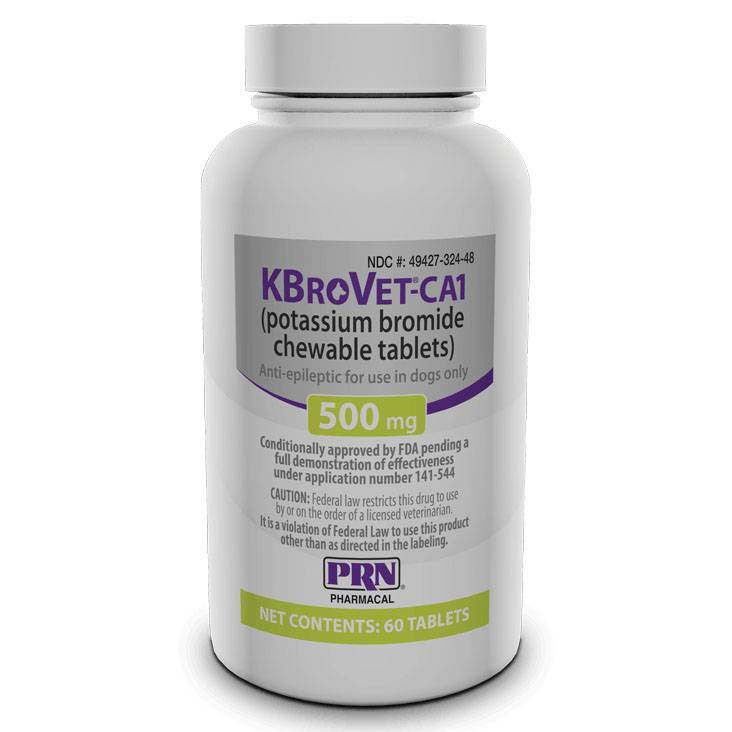
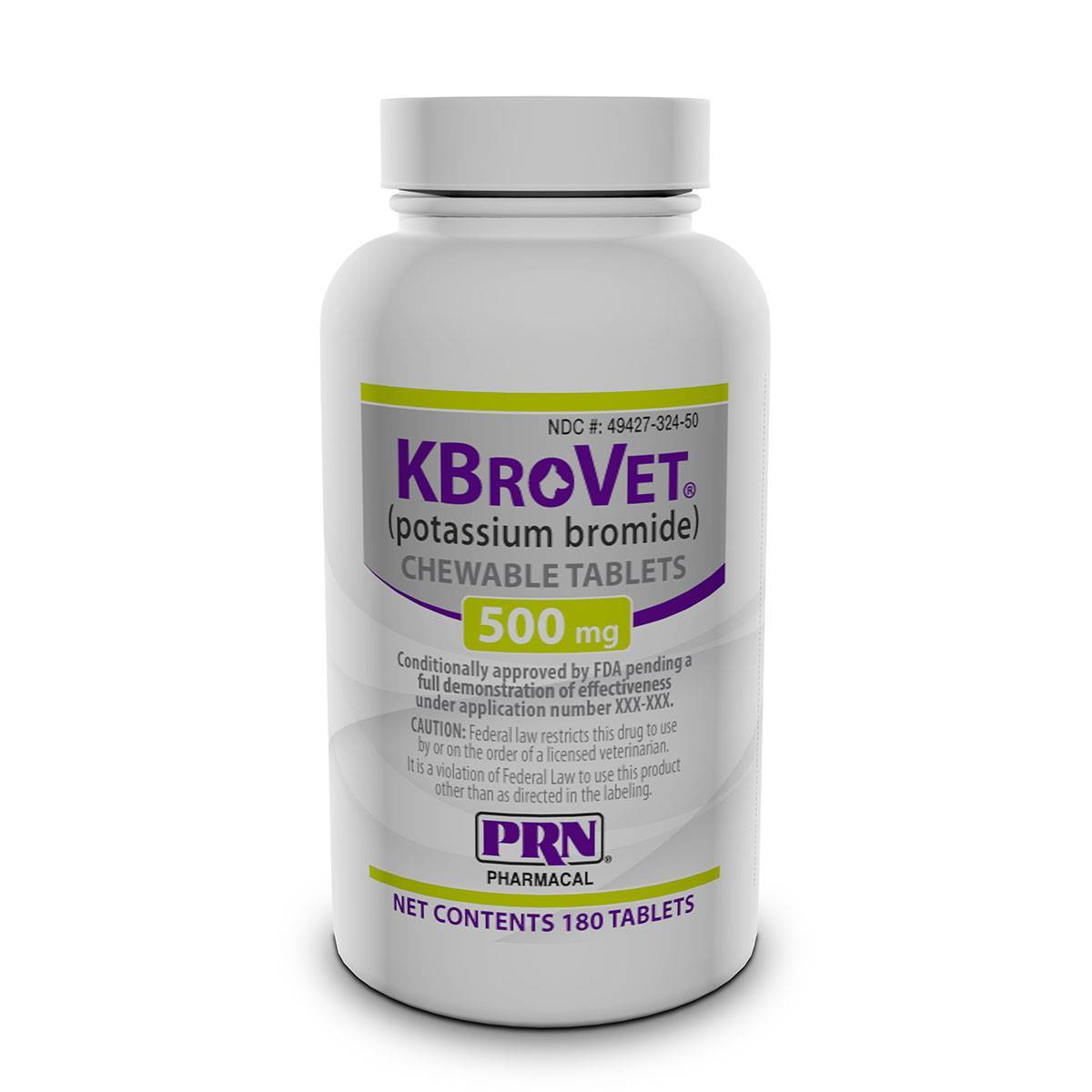

K-BroVet (Potassium Bromide) Rx
-
Guaranteed lowest authorized price. Learn more.
-
Guaranteed lowest authorized price. Learn more.
-
Guaranteed lowest authorized price. Learn more.
-
Guaranteed lowest authorized price. Learn more.
-
Guaranteed lowest authorized price. Learn more.
-
Guaranteed lowest authorized price. Learn more.
-
Usually ships the same weekday before 2pm CT with veterinary approval.
-
Requires veterinary authorization.
-
Your pet's veterinarian will provide directions for use.
What is K-BroVet for Dogs?
- Potassium bromide, the active ingredient in K-BroVet, is an effective prescription anticonvulsant medication that can reduce the number of seizures your dog experiences.
- Your veterinarian may prescribe other anticonvulsants to be given with K-BroVet.
Why do dogs use K-BroVet?
- If your dog suffers from epileptic seizures your veterinarian may prescribe K-BroVet.
What else should I know about K-BroVet?
- Treats seizures due to epilepsy in dogs.
- Vitamin B12 is added to support healthy neurological function.
- Available in French valilla flavored chewables or butterscotch vanilla oral solution. NOTE: Liver flavored chewable tablets have been discontinued. New chewable tablets are French vanilla flavored.
- NOTE: Tablets are NOT scored and may be difficult to split.
What problems could my dog have with K-BroVet?
- K-BroVet is rarely used in cats due to adverse effects.
- Drowsiness is the most common side effect. It usually improves in the first few weeks of treatment.
- Other side effects may be serious. Contact your veterinarian if you notice anything worrying after you start giving the Potassium Bromide.
How do you use K-BroVet?
- K-BroVet should be given with food. Always follow your veterinarian's instructions.
- Do not give salty snacks or salty foods to your dog while using Potassium Bromide.
What is in K-BroVet?
- This prescription medication contains Potassium Bromide, which is proven effective at controlling seizures.
- Potassium Bromide decreases seizure activity at the cellular level by suppressing nerve activity and excitability that can trigger a seizure.
Will I get what I see in the picture?
- K-BroVet is a brand name. You will receive the exact brand that you request.
Is it important for my dog to finish all of the K-BroVet?
- Dogs ay use K-BroVet for different lengths of time. Please consult your veterinarian if you have any questions.
Who makes K-BroVet?
- K-BroVet is made by the manufacturer PRN Pharmacal.
Review Summary
Ratings Distribution
Most Liked Positive Review
It WORKS!!
Most Liked Negative Review
Delivery Delay
Reviews
-
Great place to buy products
From UndisclosedComments about K-BroVet (Potassium Bromide) 250mg/mL, 10oz (300mL)Helps with his seizures been having them since he was 6 months he is now 10-
![Great place to buy products]()
Sarge
-
-
Perfect order
From UndisclosedComments about K-BroVet (Potassium Bromide) 250mg/mL, 10oz (300mL) Oral SolutionQuick ship on a med to help my little girl contol her seizures. Package was well wrapped and price was good. They contacted my vet and get the order to get this done within a day of request. Couldn't ask for more. -
-
Helps Alfie with seizures
From UndisclosedComments about K-BroVet (Potassium Bromide) CA1 500mg, 60 Chewable TabletsGood price, shipping is on time.-
![Helps Alfie with seizures]()
Alfie
-
-
Pet owners have choices where to get their pets meds.
From UndisclosedComments about K-BroVet (Potassium Bromide) 250mg/mL, 10oz (300mL) Oral SolutionSkippy has been on this medication since he was 2. Dr. Jones prescribed this medication. Only twice in the last 8+ years has he had a seizure. I was introduced to your pharmacy, when I needed helped with the cost of Apoquel. A Dr. at the emergency hospital told me I had other options. I no longer have to use Apoquel. I needed a refill for his potassium bromide, I asked the vet, how much it was. $116.+, I called Vetrxdirect and a very nice person gave me the amount you charged, $68.+ and I knew I would change to Vetrxdirect. I know it will be delivered when it needs to be.-
![Pet owners have choices where to get their pets meds.]()
Skippy
-
-
Delivery Delay
From Los Angeles,Comments about K-BroVet (Potassium Bromide)This medication is to decrease the number seizures. I ran out of this medication and have twice obtain small amounts from my vet. It appears that I'll need to order again from my vet as the tracking does not state when the medication will arrive! -
Where is my RX
From Los AngelesComments about K-BroVet (Potassium Bromide)Well, I've run out of the previous medication I should increase the amount because I routinely run out before getting the next refill. -
Works well!
From UndisclosedComments about K-BroVet (Potassium Bromide) CA1 500mg, 60 Chewable TabletsThe K-BroVet has really helped my chocolate lab with seizures!-
![Works well!]()
Senior Duke
-
-
Excellent Response Time
From UndisclosedComments about K-BroVet (Potassium Bromide) CA1 250mg, 180 Chewable TabletsDelivered very quickly. my dog takes this for his seizures so having an easy ordering and shipping process is essential to me. Only great service, no issues the past few years I've used vetrxdirect!-
![Excellent Response Time]()
#lovemylabradoodle
-
-
Thus medication helps my dog.
From UndisclosedComments about K-BroVet (Potassium Bromide) CA1 500mg, 60 Chewable TabletsThis has made a huge difference in the frequency for our dogs seizures. She can go 2 or 3 months seizure free instead of one every couple days. This with her other meds has been very helpful.-
![Thus medication helps my dog.]()
Luna
-
-
Helps Fatboy with his seizures
From UndisclosedComments about K-BroVet (Potassium Bromide) CA1 500mg, 60 Chewable TabletsMy Vet is an hour away. My dog has seizures. This is the best way to help him.-
![Helps Fatboy with his seizures]()
Wants my sandwich
-


Q & A
-
When will this be back in stock??
-
Does this RX cause weight gain?
-
The manufacturer’s package label does not list weight gain as a possible side effect. Consult with your veterinarian if you have further questions about this medication causing this in your dog.
Verified Answer
-
-
Do the chewable tablets need to be refrigerated??
-
K-BroVet chewable tablets do not need to be refrigerated. The manufacturer recommends to store in a tightly sealed container at room temperature (59-86°F).
Verified Answer
-
-
My 105lb lab take 500mg of potassium bromide a day he take 1 for brkfst 1 for lunch and 1 for dinner...to make it simpler can we just give him all three at once...so he is getting 1500mg of pot brom a day?
-
Please ask your veterinarian about the dosage of your pet's medication
Verified Answer
-
-
Can I apply liquid bromide to the bags of food I prepare for my dog when he is boarded while I am traveling? I prepare homemade food that is refrigerated, so I am assuming this would be okay??
-
Combining liquid bromide to bags of dog food is not recommended for a variety of reasons: One is that the manufacturer states to store the K-BroVet in a sealed container at room temperature (not in the refrigerator). After adding K-BroVet to the food, the chemistry of the K-BroVet (and possibly even the food) will be compromised and will not be stored per manufacturer's recommendation. The second is that there is no way to determine the shelf-life and the potency of the K-BroVet after it has been added to your dog's food.
Verified Answer
-
-
hi i have a 3lb. chihuahua how much of this can i give her daily?
-
K-Brovet is a prescription medication that requires an order from your veterinarian. Doses of this medication is tailored for the individual animal based on serum bromide concentration, success of seizure control, and the observation of adverse effects. Please contact your veterinarian to determine an appropriate dose of this medication for your dog. Thank you, VetRxDirect
Verified Answer
-
-
Is this medicine as potent as having my pharmacy compound it ??
-
K-BroVet is a veterinary prescription medication used in the treatment of seizure disorders. K-BroVet is a commercially available product that contains the chemical, potassium bromide. Whether your veterinarian prescribes K-BroVet chews or solution, or chooses to have potassium bromide compounded, the potency(or dose) prescribed will depend on what the veterinarian recommends. As a result, the only difference between the commercially available and compounded products (medication made in pharmacy) will be the inactive ingredients used to make these dosage forms. VetRxDirect can compound several different formulations of potassium bromide, including solutions and capsules tailoring the dose and dosage form to the pet’s needs.Contact your veterinarian to determine which potassium bromide medication is most appropriate for the management of your pet’s seizure disorder. Thank you, VetRxDirect
Community Answer
-
-
I need 700mg dose of KBr. Do you carry it? And how much would a 90 day supply be? And how long does it take to get thru the US mail. How do I know this brand is as safe as the compounding Pharm. makes for my canine now??
-
We do not carry the 700mg tablets. We have the 250mg for $0.33/tablet and the 500mg for $0.49/tablet. Our standard shipping is 5-8 business days. Thank you, VetRxDirect
Community Answer
-
-
My 20lb Westie accidently ate my golden's 250mg of K-Brovet during dinner, will he be ok or should I call the vet immediately??
-
We recommend either calling your local veterinarian or Animal Poison Control. Poison control can be reached at (888)426-4435. Thank you, VetRxDirect
Community Answer
-
-
Is 250 mg of tablet potassium bromide equal to 1 ml liquid form??
-
Holly, The commerically available KBrovet oral solution is 250mg/mL, so one 250mg tablet would be equal in strength to 1 milliliter of the oral suspension. We also compound potassium bromide in a variety of capsule and liquid strengths, to assist in easier dosing. Thank you, VetRxDirect
Community Answer
-
Sign Up and Save 10%!
Plus enjoy insider offers and be the first to learn about our new products and promotions.
*10% off valid on your next order. Must apply code at checkout.
Your 10% off gift is coming your way.
But first, tell us more about your pet and only get content that is special to them.


and welcome to our family and !