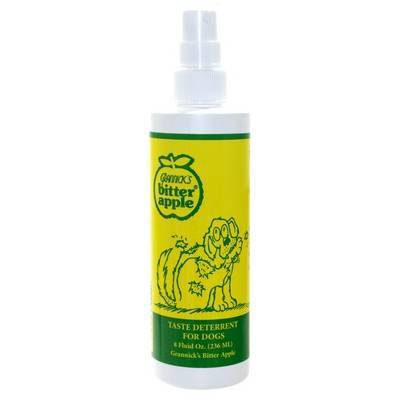
The powerful taste deterrent invented by a pharmacist in 1960 discourages fur bitting, hair chewing and hot spots.
New! Dabber Top for Cats available, "cause cats hate sprays!" Enables precise application.
Caution: Keep out of reach of children. May stain surfaces.
Ingredients: Water, isopropanol 20%, bitter principles, and extractives.
Directions: Shake well before using. Apply topically. Avoid eyes. Repeat as often as needed.
Punishment is the application of a stimulus that decreases the chance that a behavior will be repeated. It must coincide with the undesirable behavior, and must be unpleasant enough to deter the cat from repeating that behavior.
"...punishment the least desirable tool for changing behavior."
Inappropriately applied punishment can cause fear, anxiety and owner avoidance, making punishment the least desirable tool for changing behavior. Keep in mind that you are punishing the behavior, not the cat. Punishment should never be considered unless the pet has the means to satisfy its nature and its needs. For example, the scratching cat should be provided with an appropriate scratching post before any attempts to punish undesirable scratching are initiated.
Physical reprimands are one of the most frequently utilized and least successful forms of punishment. Hitting a cat can lead to hand-shyness, fear of the owner, and potential injury for both the owner and the cat. Depending on the problem, the cat will likely continue to perform the undesirable behavior in your absence since it learns that it can perform the behavior without punishment when you are out of sight. Physical punishment is generally ineffective, potentially dangerous and likely to have a negative effect between the owner and pet.
A light tap on the nose or top of the head has been advocated for owner directed behaviors such as play biting, hissing and swatting. However, even these mild forms of punishment can lead to retaliation, fear and an increased level of aggression in some cats, and cannot therefore be universally recommended. At the very least they tend to make the cat wary of your approach. Instead, whenever the cat begins to swat or play attack, immediately stop the play by walking away or by using some non-physical form of punishment such as a water sprayer, can of compressed air, cap gun, hand held alarm or perhaps a loud hiss. Although ideally you should just walk away from these forms of playful behavior to ensure that they are not reinforced, many cats will continue to pursue as part of the play and chase. Before any punishment is considered, the cat should be given ample opportunities for social play. Toys that can be chased, swatted, and batted should be provided. Species appropriate punishment such as "hissing" or the use of a punishment devices such as a water sprayer, can of compressed air, or hand held alarm are better than using any physical techniques since they are less likely to lead to fear and retaliation. There may be times when gently shaking or lifting the cat by the scruff of the neck can be used to successfully calm, distract or restrain a cat but only to disrupt undesirable behavior and not as a punishment. Remember that giving any form of attention to a cat that is swatting, or attacking in play, might, at the other extreme be misconstrued as play, and further reinforce the behavior.
"The key to successfully stopping undesirable behavior is to associate an unpleasant consequence with the undesirable behavior."
The key to successfully stopping undesirable behavior is to associate an unpleasant consequence with the undesirable behavior. However, unless the owner remains out of sight while administering punishment the cat may learn to cease the behavior only when you are present. Punishing the cat remotely, while you remain out of sight, is an effective means of deterring undesirable behavior. However, it takes preparation, time and forethought. Another effective means of punishment is to booby-trap an area, so that the cat learns to "stay away". Keep in mind that the cat must also have appropriate outlets for play, exercise, scratching, climbing, jumping and chasing.
For remote techniques to be successful there are two key elements. First, you must monitor the cat while out of sight so that you know when the problem begins. The second element is that the punishment must be delivered while the inappropriate behavior is occurring (and while you remain out of sight).
Keep a close watch on the problem area while hidden around a corner, in a nearby closet, or behind a piece of furniture. Or, monitor your cat using an intercom, a motion detector or even just a set of bells that might "jingle" when disturbed.
As soon as the cat enters the area or begins to perform the undesirable behavior (climb, scratch), use a long-range water pistol, noise device or remote control device (see below) to chase the cat away.
If the cat cannot determine where the noise or water is coming from, it should quickly learn to stay away from the area whether the owner is present or not.
A commercial remote device is the citronella spray collar. It can be attached to a harness on the cat or just placed in the area and activated remotely as the cat enters the area. Another option is to set up a remote control switch near the problem area and have a device such as a water pik, alarm, or hair dryer plugged in.
When the owner is not around to supervise and monitor, booby-trap devices can be utilized or the cat should be confined to an area of the home that has been cat-proofed and supplied with a litter box, bedding area, toys for play and areas for scratching or climbing.
Punishing the behavior remotely, with you out of sight, is impractical if the cat cannot be prevented from performing the undesirable behavior when you are not there to supervise and monitor. Booby-traps are a way of teaching the pet to avoid the area or the behavior itself. One of the simplest ways to discourage a cat from entering an area where an undesirable behavior is likely to be performed (scratching, eliminating) is to make the area less appealing (or downright unpleasant) for scratching or eliminating. If the cat is scratching furniture, a large piece of material draped over the furniture may do the trick, since the cat won't be able to get its claws into the loose fabric. A small pyramid of empty tin cans or plastic containers could also be balanced on the arm of a chair so that it topples onto the cat when scratching begins. A piece of plastic carpet runner with the "nubs" facing up can be placed over a scratched piece of furniture to reduce its appeal; a few strips of double-sided sticky tape would send most cats looking for another place to scratch (hopefully to the scratching post!). Mousetrap trainers, shock mats, or motion detector alarms are also very effective at keeping cats away from problem areas. There are devices that are triggered by motion that will spray the cat with compressed air and startle them so they leave the area. For outdoor use, there are motion detector sprinklers, a motion activated compressed air spray, and a variety of sonic and ultrasonic motion detectors.
"To be effective, the first exposure to a product must be as repulsive as is humanely possible, so that the cat is immediately repelled whenever it smells or tastes that product again."
Most of these same booby traps would also be effective for destructive behaviors such as chewing and sucking. Taste deterrents might also be helpful, provided they are unpleasant enough to deter the behavior. Products such as bitter apple, bitter lime or Tabasco sauce are often recommended, but many cats quickly learn to accept the taste. A little water mixed with cayenne pepper, oil of eucalyptus, any non-toxic mentholated product, or one of the commercial anti-chew sprays often work. To be effective, the first exposure to a product must be as repulsive as is humanely possible, so that the cat is immediately repelled whenever it smells or tastes that product again. Therefore a spray of the bitter spray into the cat's mouth might be most effective to reduce the chances of the cat returning to the area. Never leave any objects or areas untreated until the cat learns to leave the object or area alone.
Perhaps most important, punishment whether interactive or remote should never be a substitute for good supervision and the opportunity to engage in the proper behavior. This is very important with kittens that are learning what is acceptable in a new home. Prevention, by confining the cat to a cat-proofed area with toys, scratching post, litter and water, is often the best solution when the owners are not available to supervise.
Destructive Behavior in Dogs – Chewing
Dogs, especially puppies, are extremely playful and investigative. While play with people and other dogs is an important part of socialization and social development, exploration and object play are important ways for dogs to learn about their environment. Therefore it is a normal behavior for puppies to investigate their environment by sniffing, tasting and perhaps chewing on objects throughout the home. Dogs that chew may also be scavenging for food (as in garbage raiding), playing (as in the dog that chews apart a book or couch), teething (dogs 3 to 6 months of age that chew on household objects), or satisfying a natural urge to chew and gnaw (which may serve to help keep teeth and gums healthy). Some dogs may chew because they receive attention (even if it is negative) or treats from the owners each time they chew, but by giving attention, the owners are inadvertently rewarding the behavior. Chewing and destructive behaviors may also be a response to anxiety. Dogs that are confined in areas where they are insecure may dig and chew in an attempt to escape. Dogs that are in a state of conflict, arousal or anxiety, such as separation anxiety, may turn to chewing and other forms of destructiveness as an outlet.
First, determine why the dog is chewing. If the dog is a puppy or young adult dog that is chewing a variety of objects in the household, it is likely that play and investigation (and perhaps teething) are the motives.
"Determining the cause and motivation for chewing is essential
in developing a treatment strategy."
Dogs that raid garbage and steal food off counters are obviously motivated by the presence and odor of food. Dogs that chew at doorways or the doors of a cage may be attempting to escape confinement while others may be chewing as an outlet for anxiety. Determining the cause and motivation for chewing is essential in developing a treatment strategy. One of the best ways to determining why the dog is chewing and how the behavior might be resolved is to keep a diary of the pet's daily activities to determine when and where it is chewing, what occurred immediately prior to the behavior and what do family members do when they catch the dog chewing. In addition, the diary can help to determine whether the dog's daily schedule provides enough enrichment and a regular routine that serves all of the dog's needs. Although the goal of treatment is to stop undesirable chewing, the focus should be on providing sufficient enrichment and outlets and in rewarding desirable behavior. If the chewing occurs while you are gone, setting up a videotape may help determine is anxiety is the cause of the behavior.
Directing the chewing into appealing alternatives, providing sufficient play and exercise, and preventing inappropriate chewing are needed for the exploratory dog. You must also ensure that you are not inadvertently rewarding the behavior. Ignoring the dog, or using a device to interrupt the chewing may be useful for these dogs. With puppies, this behavior may decrease in time, provided you provide enough daily play and exercise and you direct the chewing to proper outlets. Dogs that are garbage raiding or food stealing need to be treated by supervision, prevention (by keeping food inaccessible) and booby-traps, since the behavior itself is self-rewarding. Dogs that are destructive when trying to escape from confinement must learn to become comfortable and secure in the cage or room where they are to be confined. In some cases, a new confinement area may have to be chosen. Dogs that are destructive due to anxiety will need to have the cause of the anxiety diagnosed, and the problem appropriately treated.
Before considering how to discourage inappropriate chewing, you need to provide some appropriate outlets for your dog's "needs," not only the chewing but also all of its requirements for physical exercise, social and object play and exploration.
"... products that can be torn apart such as rawhide or pig's ears may be more like the natural prey and wood products that attract most dogs."
To get your dog's chewing headed in the right direction, begin with a few toys having a variety of tastes, odors, and textures to determine what appeals most to the pet. Although plastic, nylon or rubber toys may be the most durable, products that can be torn apart such as rawhide or pig's ears may be more like the natural prey and wood products that attract most dogs. Coating or stuffing toys with liver or cheese spread, peanut butter, or bits of food may also increase their desirability. There are numerous durable rubber toys that are designed to be stuffed or filled with food or treats, which your dog will then need to chew or manipulate to obtain its "rewards". There are even flavored products that have been designed to stuff into the toys. Placing soup, meat products or canned dog food into the toys and freezing them can make them retain their interest and last a lot longer. In fact, if you are looking for ways to keep your dog occupied and amused when you cannot play or supervise, then it might be useful to provide some or all of your dogs meals inside these feeding toys, so your dog can work (and play) for its food.
Another option that might help reduce your dog's undesirable chewing, as well as helping maintain healthy teeth and gums, is to provide toys, food and treats that are designed to promote good dental hygiene. Although some dental foods and treats contain ingredients that help to reduce tartar; the ones that are likely to be the most beneficial to the dog with a need to chew are the ones that have a texture, consistency and size that encourages chewing and gnawing. Food and treats that are soft, small enough to be swallowed whole, or break apart with little or no chewing, are less likely to satisfy the chewing need.
To ensure that your puppy is encouraged and rewarded for chewing on its own toys, and discouraged from chewing on all other objects, it must be supervised at all times. Whenever supervision is not possible, you should prevent access to any object or area that might be chewed, other than the pet's toys.
In addition to providing ample opportunity to explore and play, you should insure that your pet has a regular (predictable) daily routine that provides social activity times, where the pet gets play, training and exercise and an opportunity to eliminate. For many dogs a daily walk can be very calming and provide exercise and activity. In between these social times, especially if the owner cannot supervise the pet will need to be placed in its bed, crate or room for a nap, or placed in a room or confinement area where it has appealing feeding, play or chew toys.
"Many of the breeds obtained as family pets have been bred
for a variety of working tasks."
Many of the breeds obtained as family pets have been bred for a variety of working tasks. This means that they are mentally and physically capable and "programmed for" activities such as retrieving, herding, hunting or sledding. Therefore the requirements of these breeds should be met by providing either work or an equivalent amount and type of play. Games such as tug-of-war, retrieving, catching a ball or Frisbee, jogging, pulling a cart, flyball, or even long walks are excellent alternatives for expending energy, while socially interacting with family members. However, the type and amount of play may vary with the breed, age and health of the pet. Obedience training, agility classes and training your dog to a few simple commands and tricks are not only pleasant interactive activities for you and your dog, but they also provide some stimulation and "work" in the dog's daily schedule.
Access to all areas that the dog might chew must be prevented unless the owner is present to supervise, or the area is effectively booby-trapped.
"Your dog can only be punished for chewing if it is caught in the act. "
Your dog can only be punished for chewing if it is caught in the act. Even then, punishment must be humane, immediate and effective. Punishment administered directly by the owner can lead to fear and defensive reactions in some dogs, and may serve as a form of attention and reinforcement to others. A shake can, alarm (audible or ultrasonic), or even verbal reprimand is preferable to techniques that use physical contact of any type. A hand reaching for your dog should always mean affection or treats; a hand reaching to punish can have the opposite effect. Punishment of any type, when the owner is in direct sight, can deter the pet in your presence, but the pet will quickly learn that the behavior is not punished in your absence. Therefore, remote punishment (where the owner is out of sight while administering punishment) may teach the dog that the behavior itself is inappropriate. A head halter and long remote leash that is pulled each time the dog chews, a water rifle, remote citronella collar or one of the audible or ultrasonic alarms may be effective. However, none of these products are practical when the owner is absent or cannot supervise. Arriving home and punishing a pet for an act that is already completed will only serve to increase the pet's anxiety.
The only way that chewing might be deterred when your dog cannot be supervised is by booby-trapping the areas where the dog might chew. To be successful the punishment must be noxious enough to immediately deter the pet. Taste or odor aversion is often the simplest and most practical type of booby trap but many pets will have to be conditioned in advance to detest the smell or taste by squirting anti-chew spray (e.g. bitter apple, RopelÔ) into the pet's mouth or across its nose. A small amount of cayenne pepper mixed with water, oil of citronella or commercial anti-chew sprays may also be successful as deterrents. Alternatively, the spray could be placed on any object that the dog might chew and a fishing line can be attached from the object to a stack of empty cans on a nearby table or counter. At the instant chewing begins, the stack will come crashing down. Most dogs are then conditioned after a few events to avoid that particular taste or odor for fear of another "can attack". An alarm mat, motion detector alarms, indoor citronella avoidance units and a motion detector spray can are a few other examples of environmental punishment.
Whenever you cannot supervise or monitor your dog's behavior, he or she should be confined to a cage or a dog-proof room, with any potential chewing sites effectively booby-trapped. If chewing is continuing, the underlying motivation may not have been accurately determined and the reasons for chewing should be revisited.