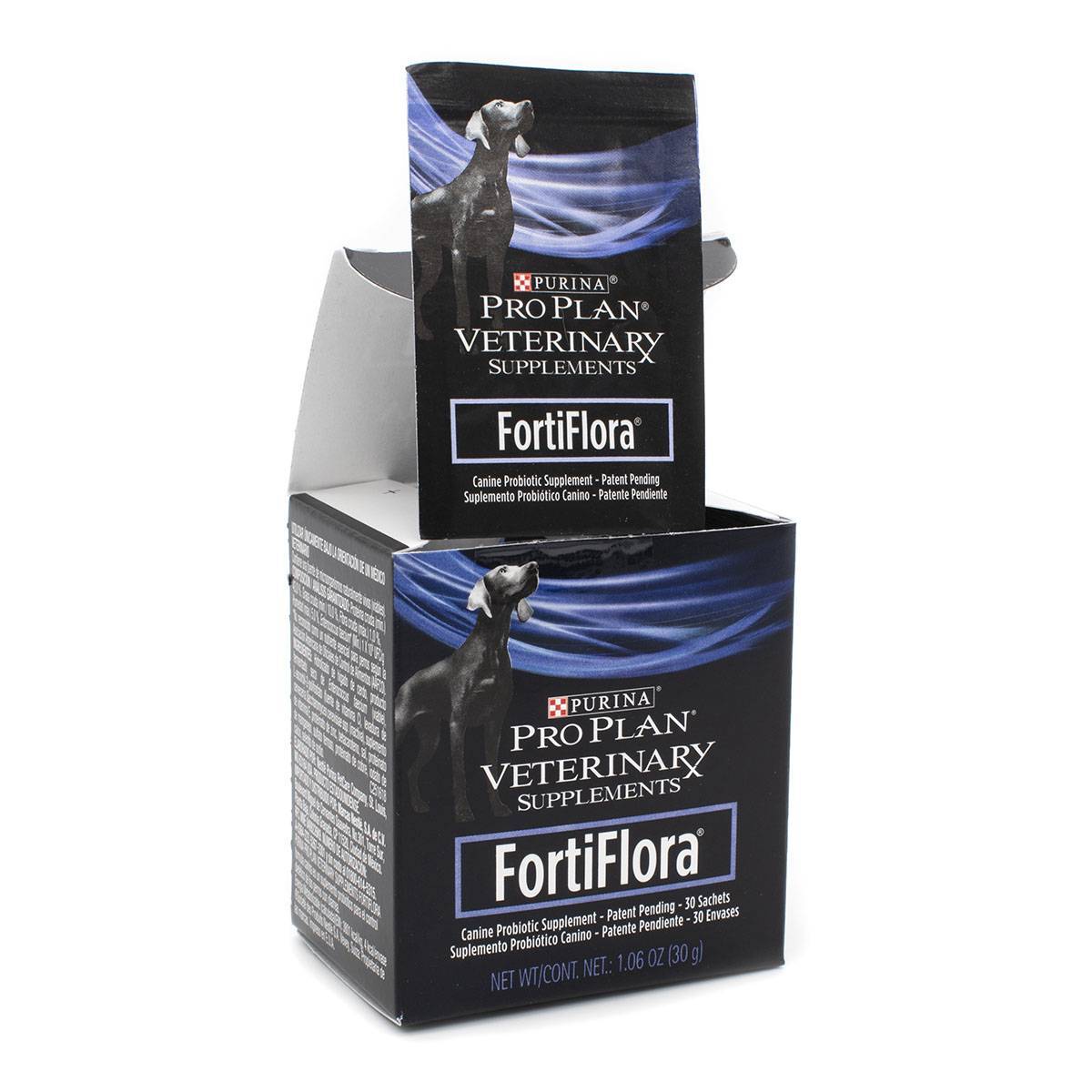

FortiFlora Probiotic for Dogs
FortiFlora Probiotic for Dogs
Our pharmacy is no longer selling FortiFlora. You may wish to see if your veterinarian recommends another probiotic.
What is FortiFlora for Dogs?
- FortiFlora for dogs is an over-the-counter nutritional supplement that contains a guaranteed amount of beneficial microorganisms.
- These agents increase intestinal microflora and promote a strong immune system -- both are important for overall good health.
- FortiFlora also helps control diarrhea in dogs.
- Plus, the powder contains high levels of Vitamins A, C and E – all valuable antioxidants your dog needs.
- The FortiFlora Chewable Tablets are an easy to feed probiotic supplement for dogs who don't like the powder.
Why do dogs use FortiFlora?
- FortiFlora is especially useful in helping balance your dog’s system when he’s under stress, has eaten something he shouldn’t have, has soft stools, or is taking antibiotics which can cause intestinal upset.
- Just sprinkle palatable FortiFlora powder on your dog’s food..
What else should I know about FortiFlora?
- Supports intestinal health and helps control diarrhea in dogs.
- Contains a guaranteed amount of live active cultures.
- Tasty, easy to use powder.
How do you use FortiFlora?
- Give as directed by your veterinarian.
- Manufacturer's suggested use: Give one packet or one tablet daily.
What is in FortiFlora?
FortiFlora Powder
- FortiFlora Powder Ingredients: Animal digest, Enterococcus faecium, L-ascorbyl-2-polyphosphate (source of Vitamin C), brewers dried yeast, Vitamin E supplement, zinc proteinate, beta-Carotene, salt, manganese proteinate, ferrous sulfate, copper proteinate, calcium iodate, sodium selenite.
- Calorie Content: Each 1 gram packet contains 4 kcals.Guaranteed analysis: Crude Protein (Min) 43%, Crude Fat (Min) 10%, Crude Fiber (Max) 1%, Moisture (Max) 5%, Microorganisms (Min) (Enterococcus faecium)* 1 X 10⁸ CFU/g.
FortiFlora Chewable Tablets
- FortiFlora Chewable Tablet Ingredients: Gum arabic, liver flavor, microcrystalline cellulose, dried Enterococcus faecium fermentation product, L-ascorbyl-2-polyphosphate (Vitamin C), brewers dried yeast, hydroxypropyl cellulose, Vitamin E supplement, zinc proteinate, beta-Carotene, salt, manganese proteinate, magnesium stearate, ferrous sulfate, copper proteinate, calcium iodate, sodium selenite.
- FortiFlora Chewable Tablet calorie content: 2.9 kcal per tablet.
- Guaranteed analysis: Crude Protein (Min) 16.5%, Crude Fat (Min) 4.5%, Crude Fiber (Max) 14%, Moisture (Max) 10%, Ash (Max) 8%, Microorganisms (Min) 1 x 10⁸ CFU/g (Enterococcus faecium).
Will I get what I see in the picture?
- FortiFlora is a brand name. You will receive the exact brand that you request.
Is it important for my dog to finish all of the FortiFlora?
- Dogs may use FortiFlora for different lengths of time. Please consult your veterinarian if you have any questions.
Review Summary
1467 total reviews
Rated 4.69 out of 5 stars
95% of respondents would recommend this to a friend
Ratings Distribution
1180 5 star reviews
203 4 star reviews
33 3 star reviews
19 2 star reviews
32 1 star reviews
Most Liked Positive Review
Excellent product. Many uses for your fur baby.
My husband and I have 5 rescues, our oldest was recently diagnosed with renal failure and our youngest has a very sensitive stomach. We mix a little into soft food on a regular basis. It smells just like chicken bouillon and I'm guessing that is what entices my oldest to eat (for her we use it to get her to eat more do she gets enough calories). It's also solved a lot of the sensitive stomach issues for our youngest. We don't use a whole packet per day, just a little sprinkle in with some soft food or on top of some very low sodium tuna (Starkist brand - about 2 tablespoons). Our vet was kind enough to let us sample it at first, now we buy it by the box.
Most Liked Negative Review
Didn't do much for my cat
My kitten of 6 month has been having diarrhea ever since I got him, my vet suggests that the food he was on was too rich and he has a very sensitive tummy. So we tried switching his food to a vet recommended special diet and added fortiflora to his food everyday. He didn't seem to improve much, his diarrhea was still runny its been 2 weeks. The first thing in the ingredients is animal digest, I understand it's probably there to promote eating, but I'm not sure if that's helping with my kitten who's suppose to be on a very strict diet. One thing that baffled me was that this only had one strain of bacteria, and there was no guaranteed analysis of how much bacteria culture is in each pouch. I'm not giving this product a negative review solely because it didn't help my cat, there might be other underlying problems, but I'm just very disappointed that a product suggested by a vet was this low of quality. Now I won't know if probiotics is not helping because my cat has some other health problem or if it's because there's not enough bacteria culture in fortiflora (since I have no idea how much there is) and not enough variety.
Reviews
-
Great for my elderly cat
From UndisclosedComments about FortiFlora Probiotic for Dogs 12 SachetsRecommended by our vet for our elderly kitty who was not eating well and as a result not getting enough fluids. He loves it with his food and is eating more.-
![Great for my elderly cat]()
Chichi needs his lap time
-
-
Helpful Hydration
From UndisclosedComments about FortiFlora Probiotic for Dogs 12 SachetsThe Hydra care also helps Bruce keep hydrated!-
![Helpful Hydration]()
Bruce taking a nap
-
-
My cat loves it!
From LouisianaComments about FortiFlora Probiotic for DogsCan she have a pack in a half if she weighs 7 pounds -
Keeps Kit Kats gut healthy during antibiotic tx
From UndisclosedComments about FortiFlora Probiotic for Dogs 30 SachetsI purchased FortiFlora after an ER vet prescribed two types of antibiotics for an aggressive bacteria that Kit Kat will need to take for months. This was meant to help prevent damage to her gut while she is on these antibiotics. I haven't found a regular vet yet and was looking for a refill when we were running out. Found this on VetRx direct for a great price. Kit Kat actually enjoys the flavor and looks forward to having this sprinkled in her food. Received this product in good condition and it doesn't expire anytime soon. Since I've discovered VetRx, I've ordered a few other things too.-
![Keeps Kit Kats gut healthy during antibiotic tx]()
Kit Kat ready for her next adventure
-
-
Calming care helped my dog
From UndisclosedComments about FortiFlora Probiotic for Dogs Canine Probiotic, 45 Sachets, 6-Week SupplyRecommended by my vet. Very , very happy with the end result . A much calmer dog.-
![Calming care helped my dog]()
Listening to commands calmly
-
-
Helped my dog
From UndisclosedComments about FortiFlora Probiotic for Dogs 30 SachetsVeterinarian put him on it -
-
Much needed hydration for my CKD kitty
From UndisclosedComments about FortiFlora Probiotic for Dogs 12 SachetsMy kitty Rudy has kidney disease and was also recently diagnosed with heart disease, which required me to cut way down on the sub-q fluids I was giving him because his heart can't take the fluid load. So I really needed a way to keep him hydrated. Two of our vets mentioned Hydra Care to us and so we tried it. Rudy loves it and drinks the entire portion without coming up for air. We're hoping it will be helpful for his kidneys, lab results are pending. Keep your paws crossed!-
![Much needed hydration for my CKD kitty]()
Rudy
-
-
RE: FortiFlora Loved by my cat & me!
From UndisclosedComments about FortiFlora Probiotic for Dogs 30 SachetsMy kitty, Bela, has kidney & GI issues. Forti Flora was highly recommended by her Vet, and has been a part of her treatment for several years. She enjoys the taste; also, I'm certain it contributes to her well-being, and helps her stay with me longer (-: It will remain an on-going part of her diet for sure!-
![RE: FortiFlora Loved by my cat & me!]()
Bumble Bee Bela
-
-
Yes, he doesn't scratch as much, he has allergies.
From UndisclosedComments about FortiFlora Probiotic for DogsOur vet recommended it and he takes the tablet as a treat. He enjoys it and has no problem chewing it. It should be good for him as probiotics are good for humans, too.-
![Yes, he doesn't scratch as much, he has allergies.]()
My rescued Shih Tzu, Kingston, whom I found running along a mountain dirt highway. Escaped from a puppy mill.that has been know to be in the area.
-
-
cat
From UndisclosedComments about FortiFlora Probiotic for DogsMy vet recommended for my cat that was getting urinary blockage, he drinks it but all my cats share it, especially my older ones


Displaying Reviews 1 - 10
Q & A
-
Can I give this to a litter of 5 week old puppies that have diarrhea. They have been diagnosed with round worms. They have been de wormed. But still have diarrhea. If so how much per 5 pound pup?
-
The manufacturer does not provide any specific instructions for using this product in young puppies with low body weights. In general, probiotics have been used successfully to treat diarrhea. However, product selection, dosing, and directions can differ. It is recommended that you consult with your veterinarian before using a probiotic product for your puppies.
Verified Answer
-
-
Does it need refrigerating if portion is unused??
-
The manufacturer recommends discarding any unused portion poured in the bowl should after 12 hours. Any unused portion remaining in the pouch may be stored in the refrigerator for no longer than 3 days.
Verified Answer
-
-
Do you mix this into water or just put in a separate bowl??
-
According to the manufacturer, Hydra Care should be fed in a third bowl, alongside your cat’s food and water.
Verified Answer
-
-
Hello, I have been reading up on giving cats with suppressed immune systems probiotics and most say you should not. It also says the same with humans. My vet told me to give it, but I think her immune system is compromised due to long term use of prednisolone (due to intestinal cancer) since she now has what seems to be a cold. I think I am probably making matters worse. What is your opinion? Now I have no idea what to give her for diarrhea. Thank you.?
-
VetRxDirect does not offer opinions or recommendations for over-the-counter products. Specific information about a drug or supplement can be addressed, but the recommendation to use or not use a product needs to be directed to your veterinarian, as they have the most in-depth knowledge on the health history of your pet.
Verified Answer
-
-
What are the side effects??
-
Side effects noted for FortiFlora are mild and gastrointestinal in nature. Please consult with your veterinarian if your dog is having side effects to FortiFlora before further administration.
Verified Answer
-
-
I bought the 30 sachets for my lapso Aphsa who weighs 16 lbs. How much do I give her, there are no directions that explain the dosing. Please advise. Thanks.?
-
The dosing recommendations from the manufacturer are one sachet or packet per day, regardless of weight. Sprinkle the contents onto one meal per day and make sure your dog eats all of it.
Verified Answer
-
-
How come the price of this has increased so drastically??
-
We apologize for the increase in price. Unfortunately, we have no control over the acquisition costs from our distributors so whenever those costs rise, the price of the product does as well. We do offer coupons that you could use on orders to help with that cost as well. Thank you, VetRxDirect
Verified Answer
-
-
I mistakenly ordered the canine Fortiflora instead of the feline Fortiflora. Can I use the canine version with my cat and what is the difference? My cat weighs 9 Ibs. if that is relevant.?
-
Judy, The FortiFlora feline and canine products contain the same ratio of nutritional components such as protein, fat and fiber as well as the same inactive ingredients. Also, the same microorganism, Enterococcus faecium, is used at the same concentration for both products. The only difference between the two formulations is the addition of taurine in the feline product. According to the manufacturer, taurine has been added for immune system health. Your veterinarian may have additional information on the product so we do recommend contacting him or her for further advice. Thank you, VetRxDirect
Community Answer
-
-
HI, I have a math question. For one box of FortiFlora it is $23.99. Your ad says if you buy three boxes you will save $36.84. My trusty calculator tells me 3 times $23.99 = $71.97. I'm only seeing a savings of $4.48. Can you explain? Thanks, Susan?
-
Susan, The ‘Save $36.84’ that you see is showing you a savings over the average price available on the internet for a particular item. The savings we have offered for purchasing a larger quantity (a package of 3 or 6 boxes) is not calculated from the average savings, it is a savings we offer for the higher quantity purchase. We hope that helps take some of the confusion out of the numbers! Thank you, VetRxDirect
Community Answer
-
-
Can Fortiflora be given to a diabetic, mega-colon, old cat???
-
There are reported cases of cats with diabetes using FortiFlora and not having any adverse events. The only contraindication for using FortiFlora in a pet would be if their immune system is severely compromised. For further information on FortiFlora in you cat contact your cat's veterinarian. Thank you, VetRxDirect
Community Answer
-
Displaying Questions 1 - 10
x
Sign Up and Save 10%!
Plus enjoy insider offers and be the first to learn about our new products and promotions.
*10% off valid on your next order. Must apply code at checkout.
Your 10% off gift is coming your way.
But first, tell us more about your pet and only get content that is special to them.


and welcome to our family and !