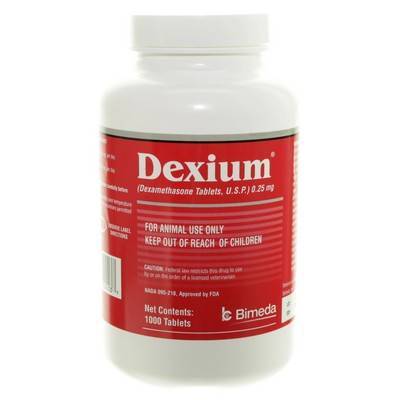
Why has my veterinarian prescribed Dexium® Tablets?
Dexamethasone is a cortisone-like medicine prescribed for treating inflammatory conditions that involve the joints and to treat nonspecific skin conditions. Your veterinarian may prescribe this medicine for other conditions.
How do I give Dexium® Tablets?
First, READ THE LABEL CAREFULLY.
Give Dexamethasone to your pet as directed by your veterinarian.
Give this medication with food.
If Dexamethasone is prescribed as a liquid, shake the medicine well, then measure the dose carefully.
Try to give this medication at about the same time each day.
DO NOT give your pet more medicine than directed.
DO NOT give your pet medicine more often than prescribed.
DO NOT stop giving your pet Dexamethasone unless directed by your veterinarian. Plan ahead to ensure you have the refills you need.
Try not to miss giving any doses.
If I miss a dose, what do I do?
If you miss a dose, give it to your pet as soon as possible. If it is almost time for the next dose, skip the missed dose, then continue with the regular dosing schedule. Do not give your pet two doses at once. Contact your veterinarian if you miss giving doses two or more days in a row.
How do I store Dexium® Tablets?
Keep this medicine out of reach of children.
Store this medicine at room temperature in a dry, cool place. Keep this medicine away from heat and direct sunlight.
Do not store this medicine in damp places, in the bathroom, or near the kitchen sink. This medication can break down when exposed to moisture or heat.
What are the potential side effects of Dexium® Tablets?
Your pet may experience an upset stomach. To reduce this possibility, give this medicine to your pet with meals.
Other side effects may include: excessive thirst, urination, or ingestion of food, panting, drowsiness, weakness, hair loss, weight loss, lack of appetite, and diarrhea. If these effects continue and are troublesome, contact your veterinarian.
Other side effects may occur. If you notice anything unusual, contact your veterinarian.
What about possible drug interactions?
Be sure to tell your veterinarian about any other medications or supplements you are giving your pet.
It’s not uncommon for your veterinarian to prescribe two different medications, which may cause a drug interaction to occur. If this happens, your veterinarian may change the dose and/or monitor your pet more closely.
Dexamethasone may interact with: bacteriostatic antibiotics, amphotericin B, furosemide, thiazide diuretics, salicylates, phenytoin, phenobarbital, rifampin, insulin, cyclosporine, non-steroidal anti-inflammatory agents, estrogens, and mitotane.
Animals that are receiving Dexamethasone should usually not be given live attenuated-virus vaccines.
Contact your veterinarian if your pet experiences any unusual reactions when different medications are given together.
Trade Names:
Dexium® Tablets
General Description:
This drug is a hormone related to cortisone and is used in dogs and cats to treat a variety of conditions. Dexamethasone is available in tablets and as an injectable.
What is this drug?
Reasons for prescribing:
What dogs/cats should not take this medication?
Directions:
Read and follow the prescription label carefully.
Give the exact amount prescribed and only as often as directed.
This medication is often given with food to reduce the potential for stomach upset. Due to the side effects of this medication, always ensure that your pet has access to fresh water and is allowed to urinate more frequently.
Give this medication for as long as your veterinarian directs. Do not skip doses or stop giving the medication without consulting your veterinarian.
Baseline blood work is recommended to assess your pet's general health before starting this drug.
Periodic blood work to monitor its effects on the body is also advised if long-term therapy is necessary.
Dose adjustments may be made based upon these results and an assessment of how your dog or cat is responding clinically.
Call ahead for refills.
Ideally, give this medication at the same time(s) daily.
What if a dose is missed?
If a dose is missed, give it as soon as you can. If it is time already for the next dose, skip the missed dose and go back to the normal schedule. Do not give two doses at the same time.
What to tell/ask a veterinarian before giving medication?
Talk to your veterinarian about:
Tell your veterinarian about:
Storage and Warnings:
Dexamethasone should be stored in a childproof container in a cool, dry place at room temperature away from heat and direct sunlight.
Keep this and all medication out of reach of children and pets.
Call your physician immediately if you accidentally take this product.
Potential side effects:
Can this drug be given with other drugs?
Overdosing?
Contact your veterinarian immediately if your pet receives more than the prescribed amount.
What else should I know?
Notify your veterinarian if your animal's condition does not improve or worsens despite this treatment.
As with all prescribed medicines, dexamethasone should only be given to the pet for which it was prescribed.
It should be given only for the condition for which it was prescribed.
This is just a summary of information about dexamethasone. If you have any questions or concerns about dexamethasone or the condition it was prescribed for, please contact your veterinarian.
| Every effort has been made to ensure the accuracy of the information published. However, it remains the responsibility of the readers to familiarize themselves with the product information contained on the USA product label or package insert. |
DEXIUM® TABLETS
Bimeda
(Dexamethasone Tablets, U.S.P.)
FOR DOGS AND CATS ONLY
NADA 095-218, Approved by FDA
DESCRIPTION:
Dexamethasone is a synthetic analogue of prednisolone. It acts similarly to prednisolone but has more potent anti-inflammatory, hormonal and metabolic effects. It is described chemically as 9-alpha-fluoro, 16-alpha-methyl prednisolone.
ACTION:
Dexamethasone is a synthetic corticosteroid and possesses glucocorticoid activity. Dexamethasone, as with other corticosteroids, is not specific. It differs from other corticosteroids only in its anti-inflammatory potency and ability to manifest mineralocorticoid properties.
INDICATIONS:
Dexamethasone is indicated for use as an anti-inflammatory agent.
DOSAGE AND ADMINISTRATION:
Dosage and administration for Dexium Tablets are as follows:
Dogs: Administer orally at 0.25 to 1.25 mg. per day up to 7 days
Cats: Administer orally at 0.125 to 0.5 mg. per day up to 7 days
CONTRAINDICATIONS:
Do not use in viral infections. Except for emergency therapy, do not use in animals with tuberculosis, chronic nephritis, cushingoid syndrome and peptic ulcers. Existence of congestive heart failure, diabetes and osteoporosis are relative contraindications.
PRECAUTIONS:
Because of the anti-inflammatory action of corticosteroids, signs of infection may be hidden and it may be necessary to stop treatment until diagnosis is made. Overdosage of some glucocorticoids may result in sodium retention, fluid retention, potassium loss and weight gain. When therapy with Dexamethasone is to be discontinued after long use, the dosage should be reduced gradually. The administration of ACTH during the period of gradual dosage reduction may help to accelerate the normal adrenocortical function.
Use of corticosteroids, depending on dose, duration, and specific steroid, may result in inhibition of endogenous steroid production following drug withdrawal. In patients presently receiving or recently withdrawn from systemic corticosteroid treatments, therapy with a rapid acting corticosteroid should be considered in unusually stressful situations.
SIDE EFFECTS: Side reactions such as weight loss, anorexia, diarrhea, polydypsia, and polyuria have been frequently observed during corticosteroid therapy.
SAP AND SGPT (ALT) enzyme elevations, polydypsia and polyuria have occurred following parenteral or systemic use of synthetic corticosteroids in dogs. Vomiting and diarrhea (occasionally bloody) have been observed in dogs.
Cushing’s syndrome in dogs has been reported in association with prolonged or repeated steroid therapy.
WARNING: Clinical and experimental data have demonstrated that corticosteroids administered orally or by injection to animals may induce the first stage of parturition if used during the last trimester of pregnancy and may precipitate premature parturition followed by dystocia, fetal death, retained placenta, and metritis.
Additionally, corticosteroids administered to dogs, rabbits and rodents during pregnancy have resulted in cleft palate in offspring. Corticosteroids administered to dogs during pregnancy have also resulted in other congenital anomalies including deformed forelegs, phocomelia and anasarca.
CAUTION: Federal law restricts this drug to use by or on the order of a licensed veterinarian.
HOW SUPPLIED: Available in bottles of 100 and 1000 tablets, each tablet containing 0.25 mg. Dexamethasone.
STORAGE: Store at controlled room temperature 20°-25°C (68°-77°F), with excursions permitted to 15°-30°C (59°-86°F).
FOR ANIMAL USE ONLY.
KEEP OUT OF REACH OF CHILDREN.
Dexium is a Registered Trademark of Bimeda, Inc.
Manufactured by: Bimeda, Inc., Le Sueur, MN 56058
Bimeda, Inc. is a Division of Cross Vetpharm Group Ltd.
8DEX002 Rev: 8/10
|
Net Contents: |
Product No. |
|
|
100 Tablets - 0.25 mg |
1DEX009 |
8DEX004-1108 |
|
1000 Tablets - 0.25 mg |
1DEX007 |
8DEX001-1108 |