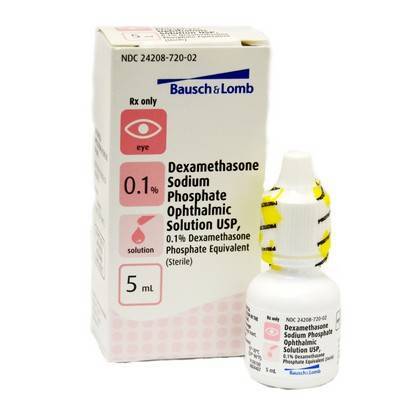

Dexamethasone Eye Drops (Generic) Rx
-
Usually ships the same weekday before 2pm CT with veterinary approval.
-
Requires veterinary authorization.
-
Your pet's veterinarian will provide directions for use.
-
Have you heard about Ocu-GLO Rx optimal canine vision support?
What is Dexamethasone Sodium Phosphate Eye Drops for Dogs and Cats?
- Swelling, pain and light sensitivity -- bacterial eye infections can cause real discomfort for your dog or cat.
- Swelling in the eye can be caused by a range of bacteria or be caused by an eye injury or surgery.
- Dexamethasone Eye Drops are an ophthalmic solution or a sterile eye drop that eases swelling in the eye to help give your pet relief.
Why do cats and dogs use Dexamethasone Eye Drops?
- If your dog or cat has inflammation in the eye, your veterinarian may prescribe sterile Dexamethasone Ophthalmic Solution to treat the cause of the swelling and comfort your pet.
What else should I know about Dexamethasone Eye Drops?
- Reduces eye inflammation due to infection in cats and dogs.
- Also treats swelling due to surgery or injury.
- Dropper top bottle for easy administration.
- Store drops in the refrigerator or at room temperature away from moisture and sunlight.
- There are approximately 20 drops per milliliter of medication in the solution.
What problems could my dog or cat have with Dexamethasone Eye Drops?
- Do not use in dogs and cats with eye ulcers or with fungal or viral eye infections.
- Do not use in birds.
How do you use Dexamethasone Eye Drops?
- Dexamethasone Eye Drops are usually used only for a short length of time.
- Use proper administration techniques to keep from contaminating the medication. Store the bottle with the cap on.
- Wait 5 minutes after applying the Dexamethasone to the eye before applying any other eye medication.
What is in Dexamethasone Eye Drops?
- Dexamethasone Ophthalmic Solution contains the active ingredient dexamethasone sodium phosphate, a synthetic corticosteroid that has effective anti-inflammatory properties.
Will I get what I see in the picture?
- Dexamethasone Eye Drops are sold as an FDA approved generic drug. Brand may vary from order to order and variation to variation. We are unable to guarantee which brand will be available at the time of order shipment.
Is it important for my dog or cat to finish all of the Dexamethasone Eye Drops?
- Dogs and cats may use Dexamethasone Eye Drops for different lengths of time. Please consult your veterinarian if you have any questions.
Review Summary
Ratings Distribution
Reviews
-
This med is absolutely critical to my dog's eyesight!
From UndisclosedComments about Dexamethasone Eye Drops (Generic) 0.1%, 5mL BottleMy dog, Sadie, has pigmentary keratitis which could have eventually blinded her. This medication has been absolutely critical to reversing some of the condition's effects and maintaining her eyesight over the years. I am glad VetRxdirect carries it and ships to my door.-
![This med is absolutely critical to my dog's eyesight!]()
Sadie says "Thanks".
-
-
This medicine helped my dig.
From UndisclosedComments about Dexamethasone Eye Drops (Generic) 0.1%, 5mL BottleMy dog needs eye drops,daily, for an autoimmune condition. Vetrxdirect has the best price and the eye drops are delivered right to my door. -
Much less expensive than buying from veternarian.
From UndisclosedComments about Dexamethasone Eye Drops (Generic) 0.1%, 5mL BottleMuch less expensive than buying from veternarian. -
AS LONG AS I KEEP USING THE GTTS
From UndisclosedComments about Dexamethasone Eye Drops (Generic) 0.1%, 5mL BottleTHE WHITES OF HER EYES ARE SO RED, AND THIS MEDICATION HELPS AS LONG AS I'M PUTTING IT IN 3 TIMES A DAY -
THE MEDS HAVE HELPED HER TREMENDOUSLY
From UndisclosedComments about Dexamethasone Eye Drops (Generic) 0.1%, 5mL BottleALREADY REVIEWED AS REALLY HELPING SASSY WITH SINUS PROBLEMS -
-
The medication helps Sassy
From UndisclosedComments about Dexamethasone Eye Drops (Generic)These drops when placed on her nose keep the sinus pathways open for Sassy. She is a pure-bread blue point Himalayan (retired show) and has a real pug nose. Her vet recommended the drops to be used as needed. -
Great for allergy eyes.
From UndisclosedComments about Dexamethasone Eye Drops (Generic)This is a new medication to us. My pet has horrible seasonal allergies and rubs his eyes like crazy. This has helped tremendously! -
-
Medication has helped my dog
From UndisclosedComments about Dexamethasone Eye Drops (Generic)This medication was prescribed by our vet. Our dog has glaucoma and cataracts and in his fake eye he had a detached retina prior to surgery. The medication has helped the remaining eye from getting worse. There has been no change to his eye, which is great! Highly recommend.-
![Medication has helped my dog]()
Shiloh
-
-
Meds for Bennie
From UndisclosedComments about Dexamethasone Eye Drops (Generic)Once they got the prescription verified, it went smoothly and I received the meds for Bennie at a substantial savings.-
![Meds for Bennie]()
Bennie
-
-
Drops
From UndisclosedComments about Dexamethasone Eye Drops (Generic)Seems to be keeping her eyes healthy after her cataract Surgery-
![Drops]()
Nails did hair did. Her feelings on the whole process.
-


Q & A
-
Seems to irritate my dogs eye more after use. How long will this take to start working??
-
If your dog is experiencing irritation from the dexamethasone eye drops, please consult your veterinarian as there may be a similar medication that your dog is able to better tolerate.
Verified Answer
-
-
My vet prescribed dexamethasone sodium phosphate ophthalmic solution, usp 0.1% for my kittens stuffy nose. I was told to do one drop in each nostril three times a day. Is that safe??
-
Dexamethasone is indicated for treating inflammation and irritation of the eye caused by allergies, bacterial infections, or foreign objects. The dosage of this medication will vary based on the type and severity of the condition it was prescribed for. Under the direction and guidance of a veterinarian, dexamethasone eye drops can be used safely in a manner inconsistent with stated directions for use. Please consult with your veterinarian with any questions or concerns regarding the dosage of this medication in your cat.
Verified Answer
-
-
Are these eye drops supposed to have a pungent smell to them or are they supposed to be an odorless liquid??
-
What is the expiration date of this product? Each one will be different but more less from the point ordered how long will the drops be good for??
-
This product will be good until the expiration date listed on the bottle and/or box. Check the bottle/box when you receive your product. If you would like more specific information about the expiration date of the current inventory in stock, you can contact our pharmacy staff via email at [email protected]. Other contact information is available on our site at: https://www.vetrxdirect.com/contact
Verified Answer
-
-
I adopted a dog from a shelter that has been on these drops for her cataracts. Is this medication ok for that? Is there one better? Your price is very fair.?
-
According to the manufacturer, dexamethasone eye drops can be used for dogs after they have had a cataract removal surgery for the affected eyes. It is not indicated for treatment of eye cataracts prior to surgery. Contact your veterinarian if you have further questions or concerns regarding this medication and if it is appropriate for your dog.
Verified Answer
-
-
I have a prescription for 12 bottles of this since my pet Rusty will need it for the unseen future. I dropped the prescription off at Walmart and I pick up my first bottle today. It will cost nearly twice what you are charging! How do I get the prescription changed to you??
-
Give us a call with your name, pet's name, and the location of your current prescription and one of the pharmacists will transfer it here for you.
Verified Answer
-
-
How long ahould I give this medication to my dog?
-
Dexamethasone eye drops can be used for many inflammatory eye conditions. Due to its wide variety of therapeutic uses, there is no determined length of therapy for every pet. The type and severity of disease will determine the appropriate length of dexamethasone therapy. Contact your veterinarian to determine if they want you to stop using it after a certain number of days, or if they would prefer that you taper down the number of drops per day as the inflammation resolves. Thank you, VetRxDirect
Verified Answer
-
-
Is for kids?
-
According to the package insert, Safety and effectiveness in pediatric patients have not been established. Talk to your doctor regarding effective eye drops in pediatric patients. Thank you, VetRxDirect
Verified Answer
-
-
Is this generic for Tacrolimus??
-
Dexamethasone eye drops are not the generic form of tacrolimus. Dexamethasone is a type of corticosteroid used as an anti-inflammatory.Tacrolimus is the generic name for Protopic, and is a topical immunosuppressant which can be used for skin conditions such as atopic dermatitis or other localized skin problems as defined by your veterinarian. Thank you, VetRxDirect
Community Answer
-
-
I have to order dexamethasone sodium phosphate ophthalmic solution .1% for my dog. Can I scan or fax you the prescription? Please let me know?
-
Due to pharmacy law, we cannot accept a copy of a prescription from a customer. You will either need to mail the prescription to us or we can send a fax to your veterinarian once an order is placed. Thank you, VetRxDirect
Community Answer
-
Sign Up and Save 10%!
Plus enjoy insider offers and be the first to learn about our new products and promotions.
*10% off valid on your next order. Must apply code at checkout.
Your 10% off gift is coming your way.
But first, tell us more about your pet and only get content that is special to them.


and welcome to our family and !