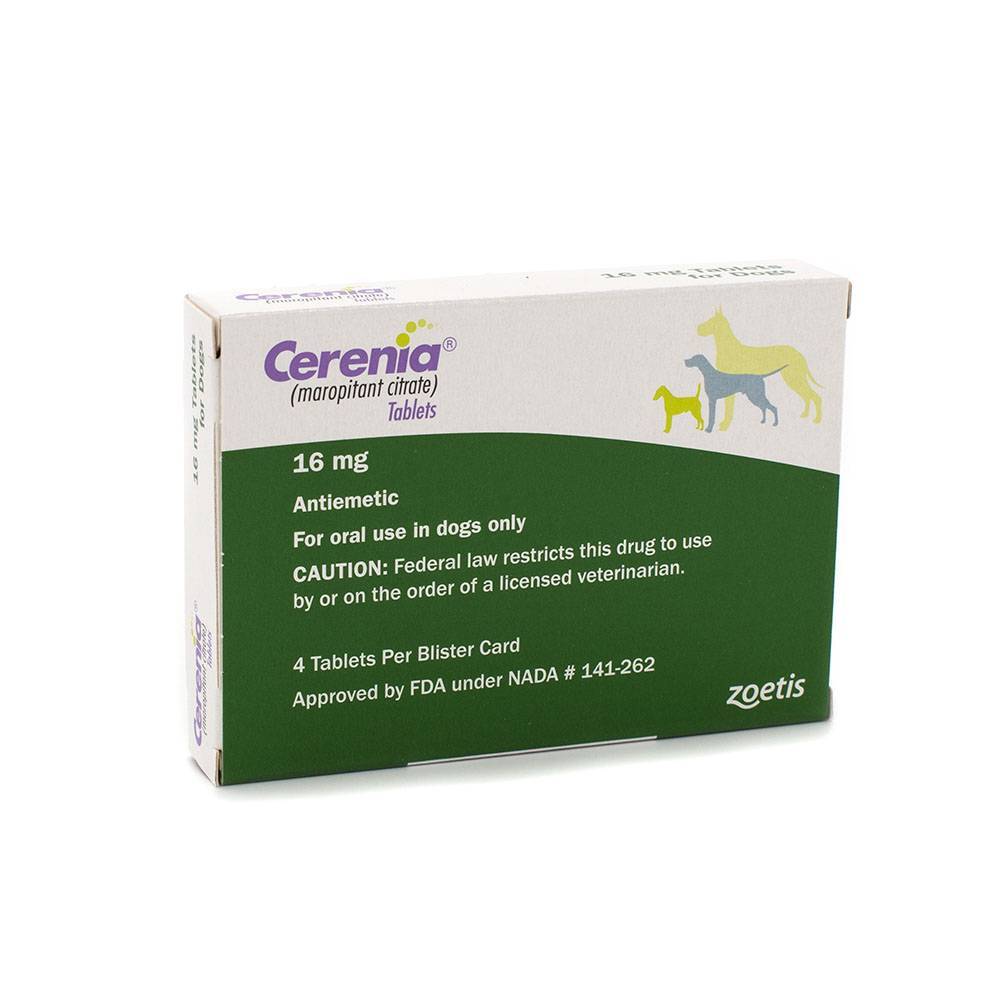
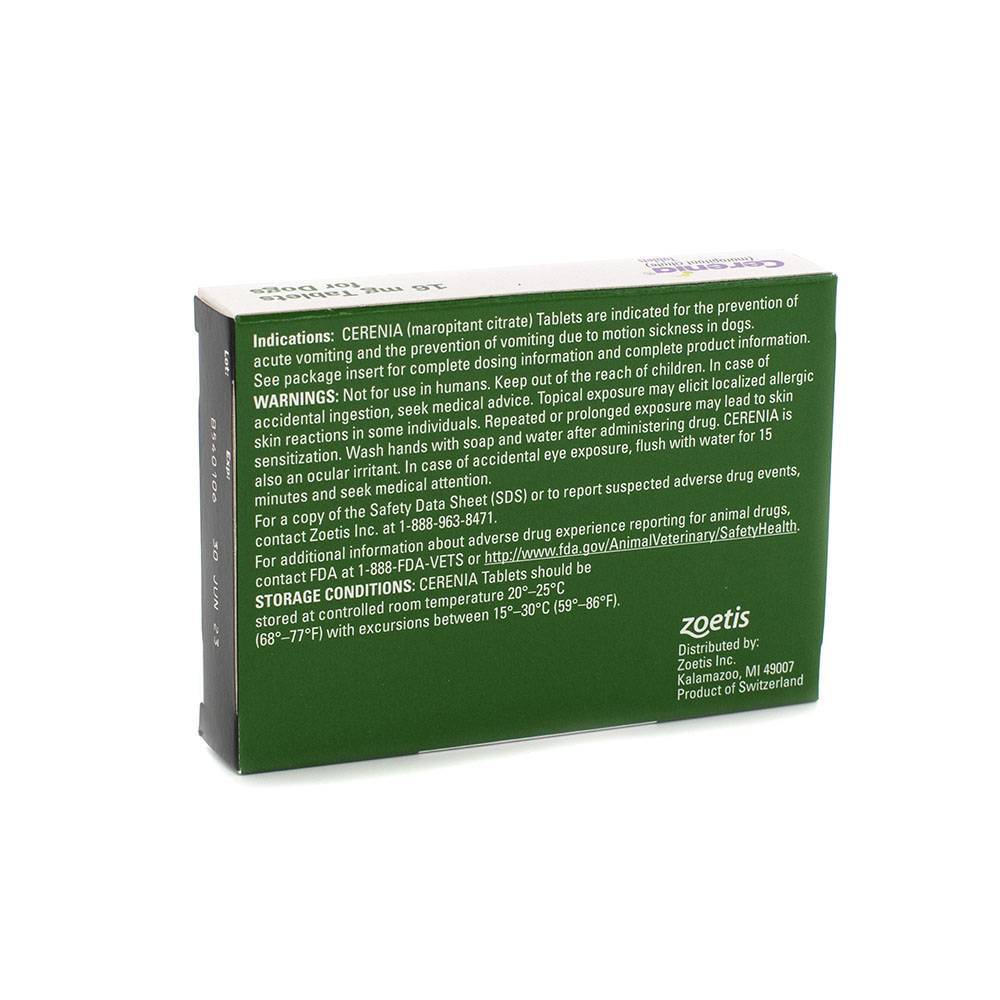
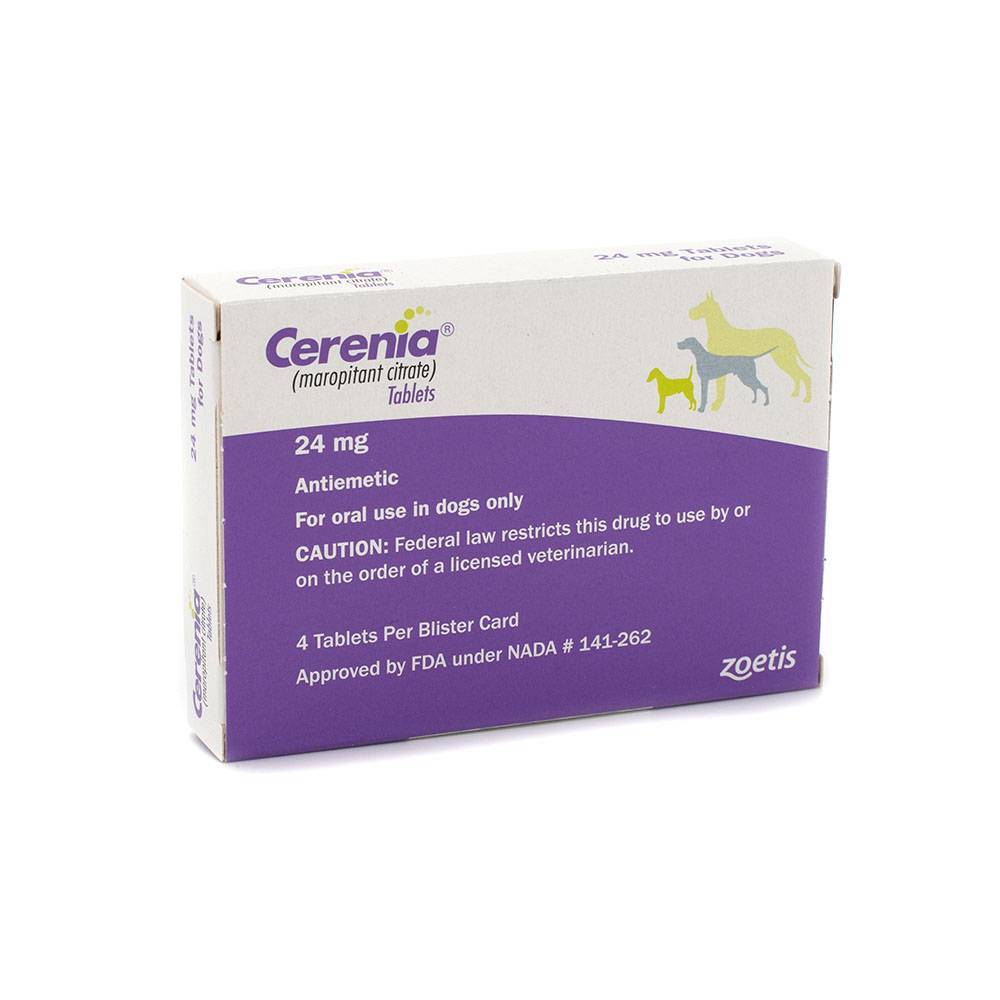
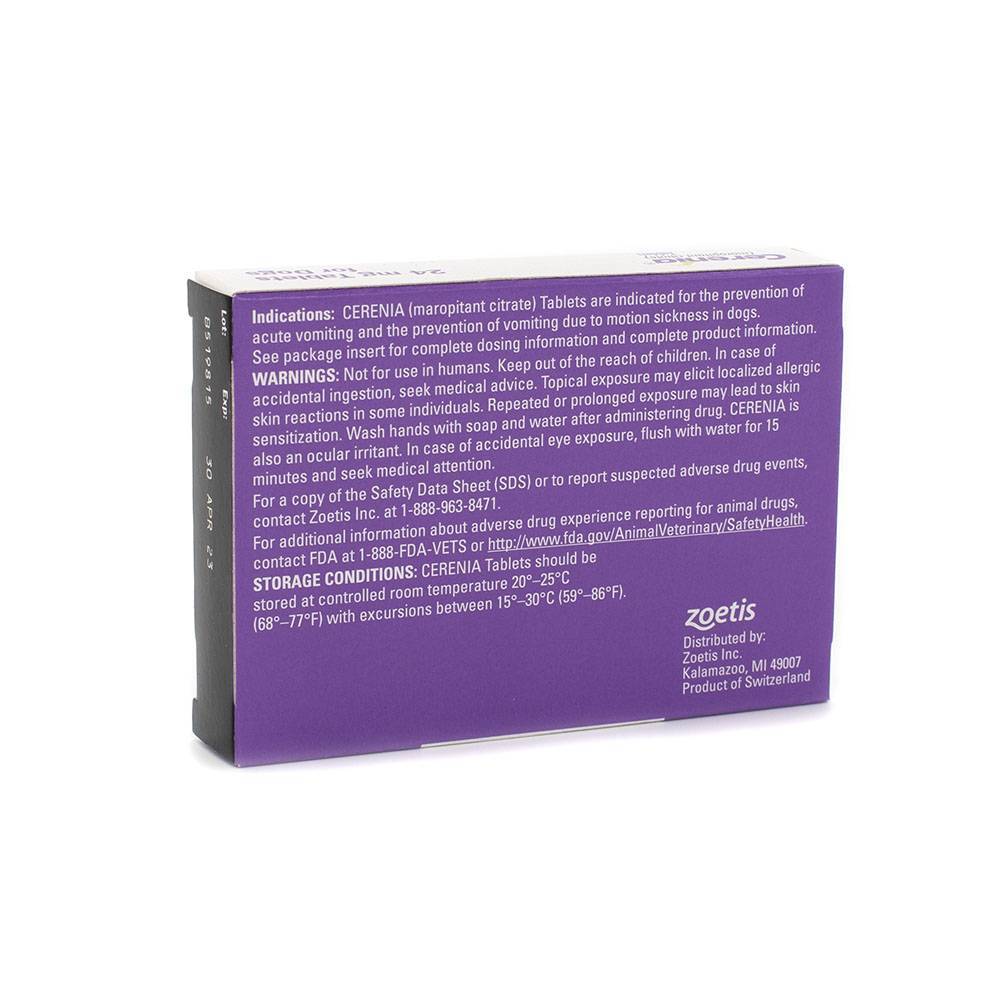
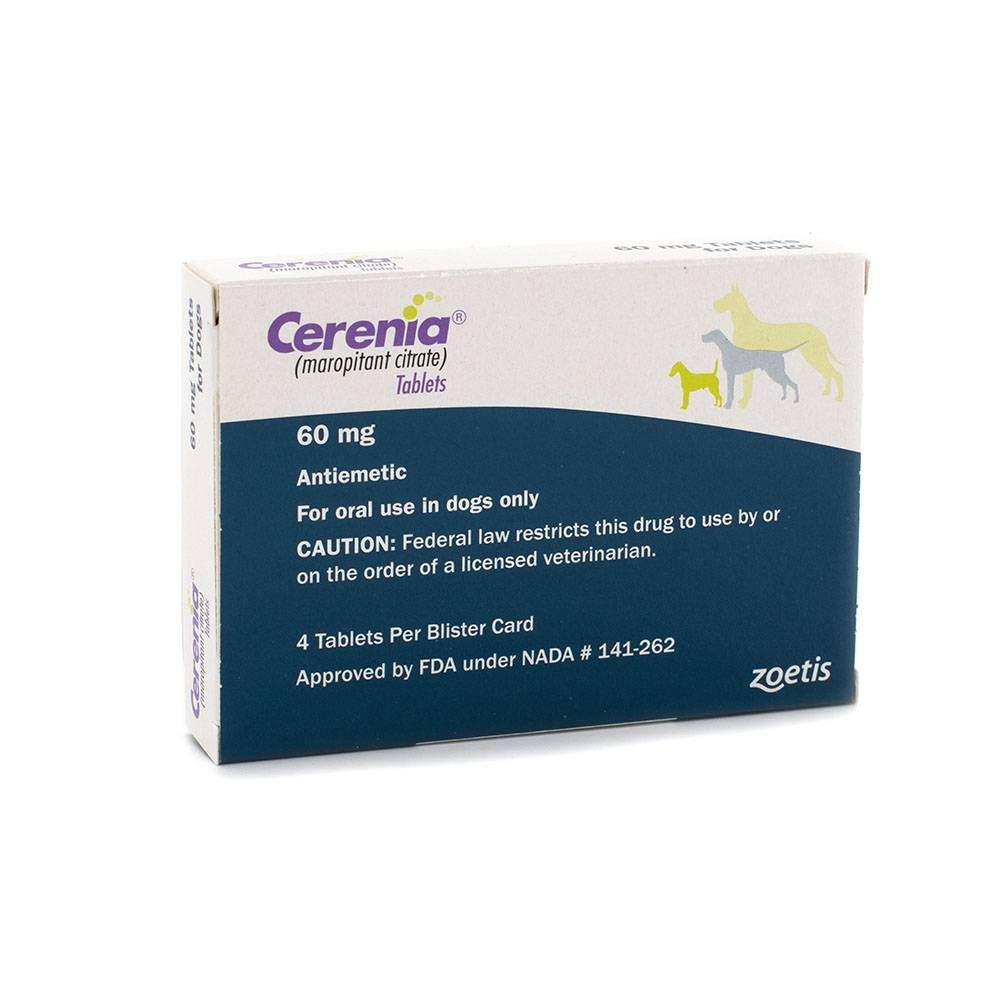
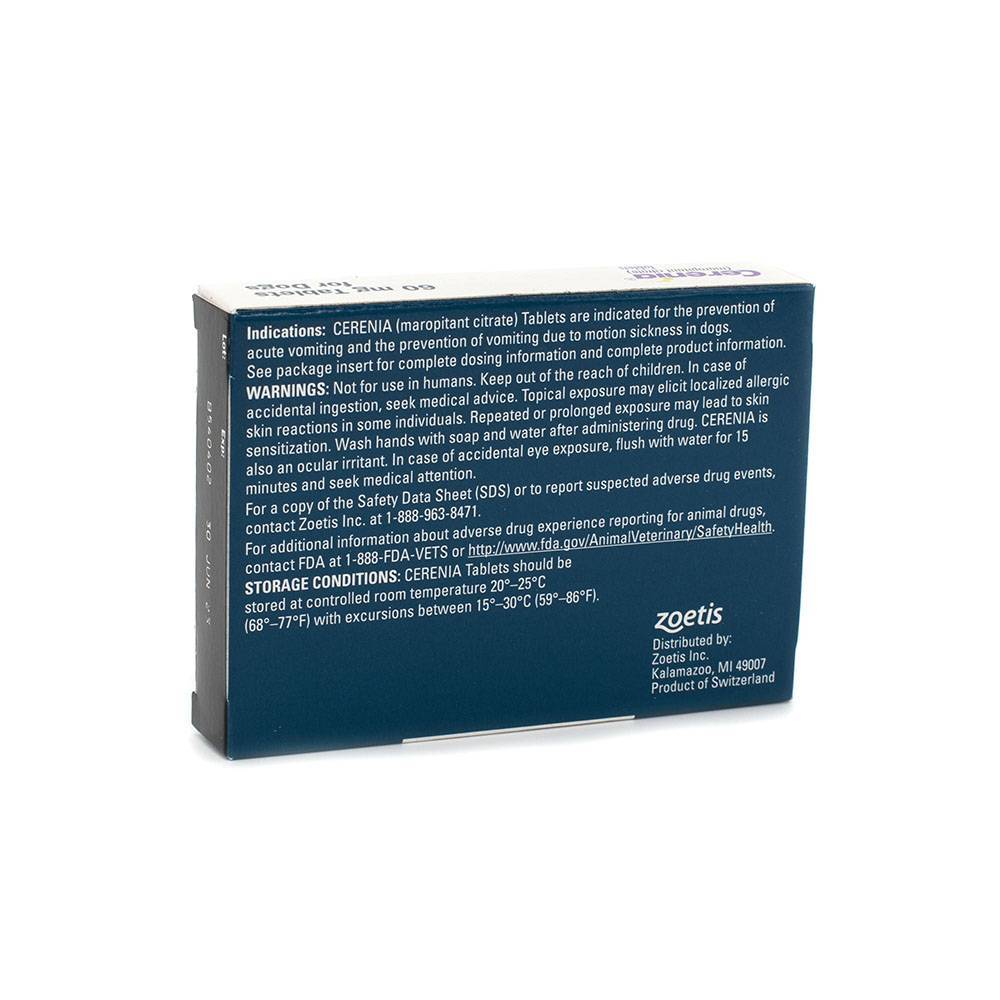
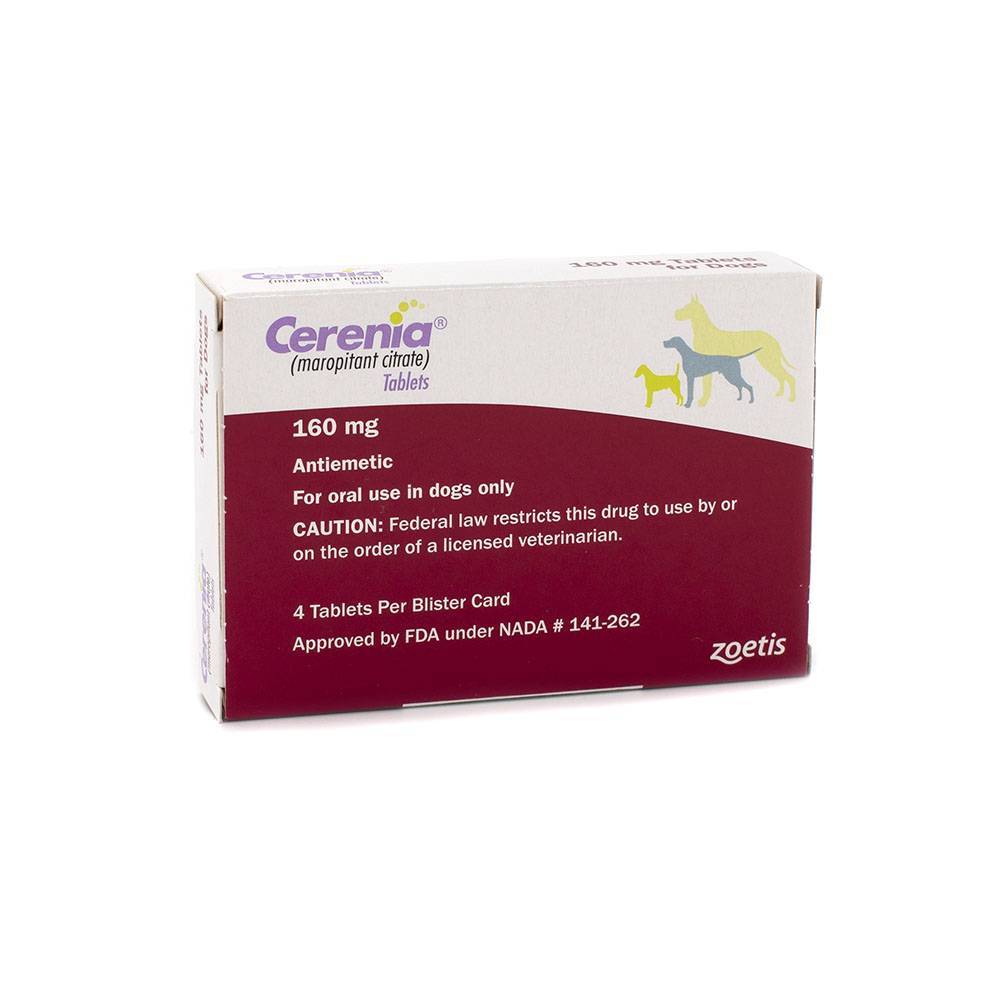
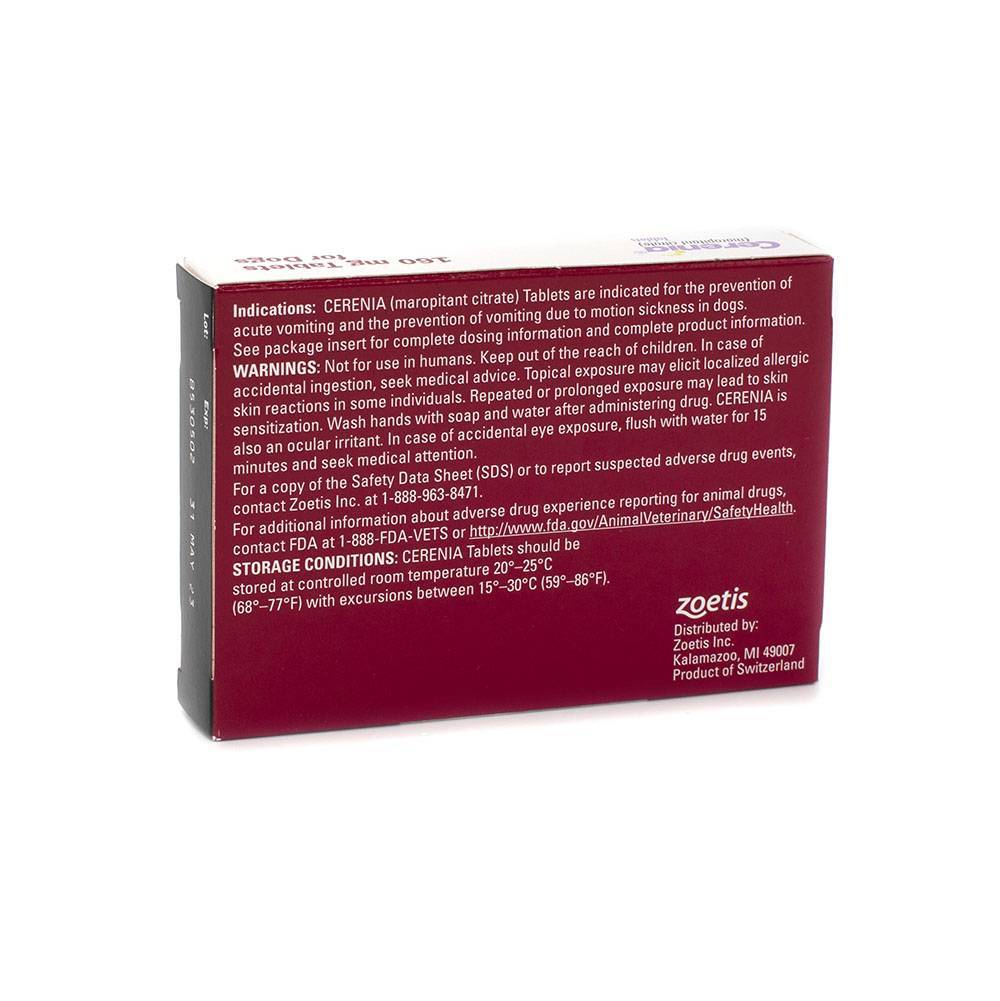

Cerenia (maropitant citrate) Rx
-
Guaranteed lowest authorized price. Learn more.
-
Guaranteed lowest authorized price. Learn more.
-
Guaranteed lowest authorized price. Learn more.
-
Guaranteed lowest authorized price. Learn more.
-
Usually ships the same weekday before 2pm CT with veterinary approval.
-
Requires veterinary authorization.
-
Your pet's veterinarian will provide directions for use.
What are Cerenia Tablets for Dogs and Cats?
- Cerenia is a prescription medication that contains Maropitant Citrate.
- Maropitant Citrate is an antiemetic medication that is used to relieve nausea and vomiting.
- Cerenia is non-sedating.
Why do cats and dogs use Cerenia?
- Your veterinarian may prescribe an antiemetic like Cerenia if your dog suffers from motion sickness or acute vomiting.
- Cerenia helps prevent symptoms of nausea and the motion sickness that might be experienced during car rides.
What problems could my dog or cat have with Cerenia?
- Some dogs may vomit after taking Cerenia. Talk to your veterinarian about whether you should give the Cerenia with small amounts of food.
- Do not wrap Cerenia tablets tightly in treats or pill maskers. This may prevent the drug from being released into the stomach.
- Don't use Cerenia with puppies less than 8 weeks old as bone marrow problems may develop.
- Side effects are unusual. Contact your veterinarian you notice an issue with drooling, lethargy, sleepiness, lack of appetite, or diarrhea.
How do you use Cerenia?
- To relieve motion sickness, your veterinarian may tell you to feed your dog or cat a snack 3 hours before traveling, and then give the Cerenia 1 hour later.
- Wash your hands immediately after handling Cerenia.
What is in Cerenia?
- Cerenia contains the drug Maropitant Citrate.
- Maropitant Citrate is an antiemetic medication that is used to relieve nausea and vomiting.
Will I get what I see in the picture?
- Cerenia is a brand name. You will receive the exact brand that you request.
Is it important for my dog or cat to finish all of the Cerenia?
- Dogs and cats may use Cerenia for different lengths of time. Please consult your veterinarian if you have any questions.
Review Summary
Ratings Distribution
Most Liked Positive Review
Yes It Works For Cats, Talk to Your Vet
Most Liked Negative Review
Abusively expensive
Reviews
-
Abusively expensive
From TampaComments about Cerenia (maropitant citrate)It works but its abusive to a pet owner battling pancreatitis. Company maker should be ashamed of being so heartless.for profit. -
So glad we found this medication
From UndisclosedComments about Cerenia (maropitant citrate) 24mg, 4 TabletsThese meds stop our boy from coughing and choking from his collapsible windpipe. No more cough medicine needed! -
-
Part of our healthy dog
From UndisclosedComments about Cerenia (maropitant citrate) 60mg, 4 TabletsAs ordered no problems, Fast delivery.-
![Part of our healthy dog]()
She's a cutie!
-
-
Helpful for Long car trips
From UndisclosedComments about Cerenia (maropitant citrate) 24mg, 4 TabletsThis really helps our little girl during long car trips.-
![Helpful for Long car trips]()
Silly Goldendoodle
-
-
This medication helped my dogs
From UndisclosedComments about Cerenia (maropitant citrate) 24mg, 4 TabletsWith IBD sometimes our boxer won't eat . Cerenia helps her . Very happy-
![This medication helped my dogs]()
Feeling better -
![This medication helped my dogs]()
-
-
Cerenia has helped my cat
From UndisclosedComments about Cerenia (maropitant citrate) 16mg, 4 TabletsWorks really well when you cat continues vomiting. Stops it quickly but does make him sleepy.-
![Cerenia has helped my cat]()
Sleepy Kitty
-
-
This medication has helped my canine buddy
From UndisclosedComments about Cerenia (maropitant citrate) 60mg, 4 TabletsMaxie Mae has a chronic bronchial issue. A small dose of Cerenia every other day keeps the associated coughing under control.-
![This medication has helped my canine buddy]()
Maxie Mae
-
-
it works
From UndisclosedComments about Cerenia (maropitant citrate) 60mg, 4 TabletsHumphrey gets upset stomachs and this takes care of it -
Cerenia has made a difference for Winstons travel adventures
From UndisclosedComments about Cerenia (maropitant citrate) 60mg, 4 TabletsWinston has always been a great traveler. We never had to give him anything to travel, however, recently he began to have anxiety while traveling. Our Vet recommended we try Cerenia as Winston may have developed motion sickness. While taking Cerenia Winston once again enjoys traveling with us everywhere. He is just calmer not all "drugged out". -
-
Amazing anti nausea medicine
From UndisclosedComments about Cerenia (maropitant citrate) 24mg, 4 TabletsMy dog has some stomach issues and this medicine is a lifesaver, it completely ended nausea and vomiting.


Q & A
-
My pet's vet put my little multipoo, twelve yrs old on cerenia because she has a collapsing trachea and said it was for infalmmation. She also has a comprimised liver. And I read she shouldn't take if has liver problems. She doesn't have motion sickness or does she vomit. Should she take this? Thank you JS?
-
According to Plumb’s Veterinary Drug Handbook, Cerenia may be prescribed extra-label as a cough suppressant in dogs with airway disease or tracheal collapse. Caution is advised in dogs with liver dysfunction because this drug is metabolized in the liver. The dose may need to be adjusted if liver dysfunction is present. Please consult with your veterinarian with any further questions or concerns regarding this medication for your dog.
Verified Answer
-
-
Our vet recommended this product for my dogs motion sickness. Can you tell me how long it will stay in her system and be effective? Dramamine is out of her system within a few hours, it seems. Thank you!?
-
According to the manufacturer's product insert, the time it will take cerenia to be out of the system (elimination half-life) varies by the route of administration. If you are administering the tablet form by mouth, it will stay in the system for about 35 hours (a day and half) and remain effective throughout that time. However, the injection given subcutaneously will stay in the system for almost 90 hours (almost 4 days).
Verified Answer
-
-
How fast does Cerenia take to start working. My Vet ordered it - I gave it - an hour later she was vomiting again.?
-
The active ingredient in Cerenia is maropitant citrate. Maropitant is an antiemetic, which means it prevents and treats vomiting. In dogs and cats, maropitant begins to work after about one hour, with the full effect in approximately two hours. It continues to work for about 24 hours after it starts working. If your pet does not have an adequate response after two hours, we recommend that you contact your veterinarian.
Verified Answer
-
-
Can this be crushed and dissolved in water and given through a syringe for dogs that have a very difficult time with pills??
-
Cerenia can be given with a small amount of food but it's recommended not to wrap the tablets too tightly in fatty foods (ex. cheese or meat), as this may delay absorption of the drug and delay the desired effect. Also the manufacturer states not to use hot dogs, sausage or pill pockets to wrap the medication. The manufacturer doesn't state whether or not the tablet may be crushed. It's important to note that If a Cerenia tablet is crushed the medication may be bitter and not completely dissolve in a small amount of water. Pleas consult with your veterinarian if you have any further issues administering the medication. Thank you, VetRxDirect
Verified Answer
-
-
Can you crush up the cerenia and put in a syringe? Although a small pill, my dog won't eat in food, and its a fight to shove it down her throat. Thanks?
-
Per the manufacturer, it is important not to crush and dissolve this medication. The act of dissolving Cerenia could prevent the medication from being absorbed and your dog may not get the full dose of the medication. If you try other foods, it is important to avoid hiding the tablet in fatty foods such as sausage and pill pockets as this may slow absorption and the medication may take longer to be effective. Your veterinarian may be able to provide you with some suggestions for easier tablet administration for your dog. Alternatively, there is an injectible form of this medication. If this is something you are interested in, please contact your veterinarian. Thank you, VetRxDirect
Verified Answer
-
-
I have this to use on my 16 yr old cat with Chronic Kidney Disease and is not eating. How long does it take to work. I only have 4 pills that will last 8 days.?
-
Cerenia (Maropitant Citrate) is antiemetic that works by blocking the key neurotransmitter involved in vomiting. This medication is rapidly absorbed, unfortunately there is limited information on how fast the medication works. This medication can be dosed different ways including, daily for 5 days, twice weekly, every other day. Talk with your veterinarian to determine the best dosing schedule when treating your cat with this medication. Thank you, VetRxDirect
Verified Answer
-
-
is there a similar product to the cerenia in 16 or 24 mg??
-
Cerenia (maropitant citrate) is a prescribed veterinarian medication used in the treatment of vomiting in dogs and cats. Drugs that reduce vomiting are referred as antiemetics. In dogs, it is commonly used for the prevention of acute vomiting and vomiting caused by motion sickness. It can also be used in dogs to control vomiting caused by medication adverse effects. Cerenia is available in several different strengths through VetRxDirect, including 16 and 24 mg. There are a variety of antiemetic agents available but the choice of treatment will depend on the medical condition your pet needs treated. We recommend contacting your veterinarian to determine the most appropriate treatment option for your pet. Thank you, VetRxDirect
Community Answer
-
-
The vet prescribed this for my senior chihuahua. He doesn't have nausea or motion sickness, are there any other ailments this drug treats??
-
Cerenia (maropitant citrate) is a prescribed veterinarian medication used in the treatment of vomiting in dogs and cats. In dogs, it is commonly used for the prevention of acute vomiting and vomiting caused by motion sickness. It can also be used in dogs to control vomiting caused by medications. It is recommended that you contact your veterinarian with any questions you have regarding the usage of this medication in your dog. Thank you, VetRxDirect
Community Answer
-
-
When will you be getting this in? Can you email me when you do? this is a required med for my pet and we are almost out.. maybe a week or 2 left.?
-
We do not have a specific date of when that will be in stock again. Unfortunately this product takes awhile to get in from the manufacturer. We are hoping that it will be here in a week or two but there is no guarantee. We suggest to keep checking the website as we will update it as soon as we have it back in stock. Thank you, VetRxDirect
Community Answer
-
-
the cerenia my vet sold me says 16 mg but it says for dogs. Can this be given to cats??
-
Maropitant citrate, brand name Cerenia, is FDA-approved for vomiting in dogs and is labeled according to this approval. However, while it is not FDA-approved for vomiting in cats, maropitant citrate has generally been used safely and effectively for this indication at the discretion of a licensed, experienced, veterinarian. Accumulation of the drug after repeated doses, or with higher doses may still occur in cats (as in dogs). For this reason, it has been generally recommended that the medication should only be administered for 5 consecutive days. If a longer duration of therapy is needed, we recommend you follow-up with your pet’s veterinarian. The strength of each dose will also be determined by your pet’s veterinarian based upon your pet’s weight. Thank you, VetRxDirect
Community Answer
-
Sign Up and Save 10%!
Plus enjoy insider offers and be the first to learn about our new products and promotions.
*10% off valid on your next order. Must apply code at checkout.
Your 10% off gift is coming your way.
But first, tell us more about your pet and only get content that is special to them.


and welcome to our family and !