Call us today! 1-866-761-6578 Sign In To Your Account    0 Items
Items Unit Price Qty Total
Order Sub-total $0.00
Checkout
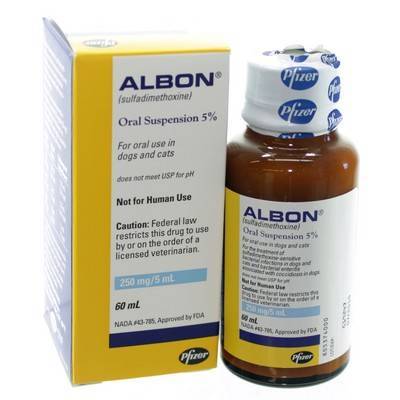
Albon (sulfadimethoxine)

Albon (sulfadimethoxine) Rx

Save $3.43!
$21.42 $17.99

In Stock FREE Shipping Eligible Price Match Guarantee

For the treatment of sulfadimethoxine-sensitive bacterial infections in dogs and cats and bacterial enteritis associated with coccidiosis in dogs.

INDICATIONS AND USAGE: Albon is indicated for the treatment of respiratory, genitourinary tract, enteric, and soft tissue infections in dogs and cats: tonsillitis, pharyngitis, bronchitis, pneumonia, cystitis, nephritis, metritis, pyometra, pustular dermatitis, anal gland infections, abscesses, wound infections, bacterial enteritis, canine salmonellosis, bacterial enteritis associated with coccidiosis in dogs when caused by streptococci, staphylococci, escherichia, salmonella, klebsiella, proteus or shigella organisms sensitive to sulfadimethoxine.

Every effort has been made to ensure the accuracy of the information published. However, it remains the responsibility of the readers to familiarize themselves with the product information contained on the US product label or package insert.


ALBON® ORAL SUSPENSION 5%

Pfizer Animal Health

(sulfadimethoxine)

For the treatment of sulfadimethoxine-sensitive bacterial infections in dogs and cats and bacterial enteritis associated with coccidiosis in dogs.

CAUTION: Federal law restricts this drug to use by or on the order of a licensed veterinarian.

DESCRIPTION: Albon is a low-dosage, rapidly absorbed, long-acting sulfonamide, effective for the treatment of a wide range of bacterial infections commonly encountered in dogs and cats.

Sulfadimethoxine is a white, almost tasteless and odorless compound. Chemically, it is N1-(2,6-dimethoxy-4-pyrimidinyl) sulfanilamide. The structural formula is:


CLINICAL PHARMACOLOGY: Sulfadimethoxine has been demonstrated clinically or in the laboratory to be effective against a variety of organisms, such as streptococci, klebsiella, proteus, shigella, staphylococci, escherichia, and salmonella.1,2 These organisms have been demonstrated in respiratory, genitourinary, enteric, and soft tissue infections of dogs and cats.

The systemic sulfonamides which include sulfadimethoxine are bacteriostatic agents. Sulfonamides competitively inhibit bacterial synthesis of folic acid (pterolyglutamic acid) from para-aminobenzoic acid. Mammalian cells are capable of utilizing folic acid in the presence of sulfonamides.

The tissue distribution of sulfadimethoxine, as with all sulfonamides, is a function of plasma levels, degree of plasma protein binding, and subsequent passive distribution in the tissues of the lipid-soluble un-ionized form. The relative amounts are determined by both its pKa and by the pH of each tissue. Therefore, levels tend to be higher in less acid tissue and body fluids or those diseased tissues having high concentrations of leucocytes.2

In the dog, sulfadimethoxine is not acetylated as in most other animals, and it is excreted predominantly as the unchanged drug.3 Sulfadimethoxine has a relatively high solubility at the pH normally occurring in the kidney, precluding the possibility of precipitation and crystalluria. Slow renal excretion results from a high degree of tubular reabsorption,4 and plasma protein binding is very high, providing a blood reservoir of the drug. Thus, sulfadimethoxine maintains higher blood levels than most other long-acting sulfonamides. Single, comparatively low doses of Albon give rapid and sustained therapeutic blood levels.1

To assure successful sulfonamide therapy (1) the drug must be given early in the course of the disease, and it must produce a high sulfonamide level in the body rapidly after administration, (2) therapeutically effective sulfonamide levels must be maintained in the body throughout the treatment period, (3) treatment should continue for a short period of time after the clinical signs have disappeared, and (4) the causative organisms must be sensitive to this class of drugs.

INDICATIONS AND USAGE: Albon is indicated for the treatment of respiratory, genitourinary tract, enteric, and soft tissue infections in dogs and cats: tonsillitis, pharyngitis, bronchitis, pneumonia, cystitis, nephritis, metritis, pyometra, pustular dermatitis, anal gland infections, abscesses, wound infections, bacterial enteritis, canine salmonellosis, bacterial enteritis associated with coccidiosis in dogs when caused by streptococci, staphylococci, escherichia, salmonella, klebsiella, proteus or shigella organisms sensitive to sulfadimethoxine.

Limitations: Sulfadimethoxine is not effective in viral or rickettsial infections, and as with any antibacterial agent, occasional failures in therapy may occur due to resistant microorganisms. The usual precautions in sulfonamide therapy should be observed.

WARNING: Not for human use.

PRECAUTION: During treatment period, make certain that animals maintain adequate water intake.

If animals show no improvement within 2 or 3 days, reevaluate your diagnosis.

DOSAGE AND ADMINISTRATION:

Initial Dose: 25 mg/lb (55 mg/kg) of animal body weight.

Subsequent Daily Doses: 12.5 mg/lb (27.5 mg/kg) of animal body weight.

Dogs and cats should receive 1 teaspoonful of Albon Oral Suspension 5% per 10 lb of body weight (25 mg/lb or 55 mg/kg) as an initial dose, followed by 1/2 teaspoonful per 10 lb of body weight (12.5 mg/lb or 27.5 mg/kg) every 24 hours thereafter. Representative weights and doses are indicated in the following table:

Animal Weight

Initial Dose
25 mg/lb (55 mg/kg)

Subsequent Daily Doses
12.5 mg/lb (27.5 mg/kg)

5 lb (2.2 kg)

1/2 tsp (2 1/2 mL)

1/4 tsp (1 1/4 mL)

10 lb (4.5 kg)

1 tsp (5 mL)

1/2 tsp (2 1/2 mL)

20 lb (9.1 kg)

2 tsp (10 mL)

1 tsp (5 mL)

40 lb (18.2 kg)

4 tsp (20 mL)

2 tsp (10 mL)

80 lb (36.4 kg)

8 tsp (40 mL)

4 tsp (20 mL)

Treatment may be initiated with Albon Injection 40% to obtain effective blood levels almost immediately or to facilitate treatment of the fractious animal.

Length of treatment depends on the clinical response. In most cases treatment for 3-5 days is adequate. Treatment should be continued until the animal is asymptomatic for 48 hours.

TOXICITY AND SAFETY: Data regarding acute and chronic toxicities of sulfadimethoxine indicate the drug is very safe. The LD50 in mice is greater than 2 g/kg of body weight when administered intraperitoneally and greater than 16 g/kg when administered orally. In dogs receiving massive single oral doses of 3.2 g/kg of body weight, diarrhea was the only adverse effect observed. Dogs given 160 mg/kg of body weight orally daily for 13 weeks showed no signs of toxicity.

STORAGE: Store at controlled room temperature 15°-30°C (59°-86°F).

HOW SUPPLIED: Albon Oral Suspension is available in 60- and 473-mL bottles; each tsp (5 mL) contains 250 mg sulfadimethoxine in a custard-flavored carrier.

REFERENCES:

1. Data on file, Pfizer Animal Health.

2. Stowe CM: The sulfonamides. In Jones LM (ed), Veterinary Pharmacology and Therapeutics, Ames, Iowa, Iowa State University Press, chapter 33, 1965.

3. Bridges JW, Kirby MR, Walker SR, et al: Species differences in the metabolism of sulfadimethoxine. Biochem J 109:851, 1968.

4. Baggot JD: Some aspects of drug persistence in domestic animals. Res Vet Sci 11(2):130, 1970.

NADA #43-785, Approved by FDA

Distributed by: Pfizer Animal Health, Div. of Pfizer Inc, NY, NY 10017

805 373 000

NAC No.: 36901772


Every effort has been made to ensure the accuracy of the information published. However, it remains the responsibility of the readers to familiarize themselves with the product information contained on the US product label or package insert.


ALBON® TABLETS

Pfizer Animal Health

(sulfadimethoxine)

For the treatment of sulfadimethoxine-sensitive bacterial infections in dogs and cats and bacterial enteritis associated with coccidiosis in dogs.

CAUTION: Federal law restricts this drug to use by or on the order of a licensed veterinarian.

DESCRIPTION: Albon is a low-dosage, rapidly absorbed, long-acting sulfonamide, effective for the treatment of a wide range of bacterial infections commonly encountered in dogs and cats.

Sulfadimethoxine is a white, almost tasteless and odorless compound. Chemically, it is N1-(2,6-dimethoxy-4-pyrimidinyl) sulfanilamide. The structural formula is:


Action: Sulfadimethoxine has been demonstrated clinically or in the laboratory to be effective against a variety of organisms, such as streptococci, klebsiella, proteus, shigella, staphylococci, escherichia, and salmonella.1,2 These organisms have been demonstrated in respiratory, genitourinary, enteric, and soft tissue infections of dogs and cats.

The systemic sulfonamides which include sulfadimethoxine are bacteriostatic agents. Sulfonamides competitively inhibit bacterial synthesis of folic acid (pterolyglutamic acid) from para-aminobenzoic acid. Mammalian cells are capable of utilizing folic acid in the presence of sulfonamides.

The tissue distribution of sulfadimethoxine, as with all sulfonamides, is a function of plasma levels, degree of plasma protein binding, and subsequent passive distribution in the tissues of the lipid-soluble un-ionized form. The relative amounts are determined by both its pKa and by the pH of each tissue. Therefore, levels tend to be higher in less acid tissue and body fluids or those diseased tissues having high concentrations of leucocytes.2

In the dog, sulfadimethoxine is not acetylated as in most other animals, and it is excreted predominantly as the unchanged drug.3 Sulfadimethoxine has a relatively high solubility at the pH normally occurring in the kidney, precluding the possibility of precipitation and crystalluria. Slow renal excretion results from a high degree of tubular reabsorption,4 and plasma protein binding is very high, providing a blood reservoir of the drug. Thus, sulfadimethoxine maintains higher blood levels than most other long-acting sulfonamides. Single, comparatively low doses of Albon give rapid and sustained therapeutic blood levels.1

To assure successful sulfonamide therapy (1) the drug must be given early in the course of the disease, and it must produce a high sulfonamide level in the body rapidly after administration, (2) therapeutically effective sulfonamide levels must be maintained in the body throughout the treatment period, (3) treatment should continue for a short period of time after the clinical signs have disappeared, and (4) the causative organisms must be sensitive to this class of drugs.

INDICATIONS AND USAGE: Albon is indicated for the treatment of respiratory, genitourinary tract, enteric, and soft tissue infections in dogs and cats: tonsillitis, pharyngitis, bronchitis, pneumonia, cystitis, nephritis, metritis, pyometra, pustular dermatitis, anal gland infections, abscesses, wound infections, bacterial enteritis, canine salmonellosis, bacterial enteritis associated with coccidiosis in dogs when caused by streptococci, staphylococci, escherichia, salmonella, klebsiella, proteus or shigella organisms sensitive to sulfadimethoxine.

Limitations: Sulfadimethoxine is not effective in viral or rickettsial infections, and as with any antibacterial agent, occasional failures in therapy may occur due to resistant microorganisms. The usual precautions in sulfonamide therapy should be observed.

WARNING: Not for human use.

PRECAUTION: During treatment period, make certain that animals maintain adequate water intake.

If animals show no improvement within 2 or 3 days, reevaluate your diagnosis.

DOSAGE AND ADMINISTRATION:

Initial Dose: 25 mg/lb (55 mg/kg) of animal body weight.

Subsequent Daily Doses: 12.5 mg/lb (27.5 mg/kg) of animal body weight.

For ease of administration in animals of varying weights, 3 tablet sizes are provided. The following table indicates how dosage may be adjusted depending on tablet size and body weight. Subsequent doses should be given at 24-hour intervals.

Tablet Size

Approximate Animal Weight

Initial Dose
25 mg/lb (55 mg/kg)

Subsequent Daily Doses
12.5 mg/lb (27.5 mg/kg)

125 mg

5 lb (2.2 kg)

1 tablet

1/2 tablet

250 mg

10 lb (4.5 kg)

1 tablet

1/2 tablet

500 mg

20 lb (9.1 kg)

1 tablet

1/2 tablet

Treatment may be initiated with Albon Injection 40% to obtain effective blood levels almost immediately or to facilitate treatment of the fractious animal.

Length of treatment depends on the clinical response. In most cases treatment for 3-5 days is adequate. Treatment should be continued until the animal is asymptomatic for 48 hours.

TOXICITY AND SAFETY: Data regarding acute and chronic toxicities of sulfadimethoxine indicate the drug is very safe. The LD50 in mice is greater than 2 g/kg of body weight when administered intraperitoneally and greater than 16 g/kg when administered orally. In dogs receiving massive single oral doses of 3.2 g/kg of body weight, diarrhea was the only adverse effect observed. Dogs given 160 mg/kg of body weight orally daily for 13 weeks showed no signs of toxicity.

STORAGE: Store at controlled room temperature 15°-30°C (59°-86°F).

HOW SUPPLIED: Albon Tablets are available in the following strengths for dogs and cats: 125 mg, 250 mg, or 500 mg sulfadimethoxine per tablet.

REFERENCES:

1. Data on file, Pfizer Animal Health.

2. Stowe CM: The sulfonamides. In Jones LM (ed), Veterinary Pharmacology and Therapeutics, Ames, Iowa, Iowa State University Press, chapter 33, 1965.

3. Bridges JW, Kirby MR, Walker SR, et al: Species differences in the metabolism of sulfadimethoxine. Biochem J 109:851, 1968.

4. Baggot JD: Some aspects of drug persistence in domestic animals. Res Vet Sci 11(2):130, 1970.

NADA #15-102, Approved by FDA

MADE IN INDIA

Distributed by: Pfizer Animal Health, Div. of Pfizer Inc, NY, NY 10017

75-8430-11IN.00

MAR 2008

NAC No.: 36901782

Albon® Oral Suspension 5% and Tablets for Pets

Generic Name:

Sulfadimethoxine

General Description:

Sulfadimethoxine is an oral sulfonamide antibiotic used to treat various bacterial infections in dogs and cats (ex. respiratory, genitourinary, gastrointestinal and soft tissue infections). Sulfadimethoxine may be prescribed to treat diarrhea caused by an intestinal parasite called coccidia. Sulfadimethoxine is available as an oral suspension or as tablets.

What is this drug?
  • A sulfonamide antibiotic (sulfa drug)
  • Given by mouth
Reasons for prescribing:
  • Useful to treat a variety of bacterial infections in dogs and cats
  • Also used to treat coccidial (microscopic, single celled intestinal parasite) infections
  • Low dosage, rapidly absorbed, long acting
What pets should not take this medication?
  • Pets with liver or kidney disorders, bladder or kidney stones
  • Dehydrated pets
  • Pregnant or nursing animals
  • Pets known to have had a prior allergic reaction to Sulfadimethoxine or other sulfa drugs
Directions:

Ensure that your pet has access to plenty of fresh, clean drinking water while taking Sulfadimethoxine.
Before sending your pet home with a prescription for oral Sulfadimethoxine, treatment may have been initiated at the veterinary hospital with an injection of Sulfadimethoxine in order to obtain effective blood levels.
Give medication as directed by your veterinarian. Read and follow the label carefully.
This medication may be given with food.
Give the exact amount prescribed and only as often as directed.
Give this medication for as long as your veterinarian directs. Finish the entire course of treatment.
For liquids, shake well before accurately measuring the dose.
Ideally, give the medication at the same time daily.

What if dose is missed?

If a dose is missed, give it as soon as you can. If it is time already for the next dose, skip the missed dose and go back to the normal schedule. Do not give two doses at the same time.

What to tell/ask veterinarian before giving medication? Talk to your veterinarian about:
  • When will your pet need to be rechecked
  • What tests may need to be performed prior to and during treatment with this drug
  • Risks and benefits of using this drug

Tell your veterinarian about:

  • If your pet has experienced side-effects on other drugs/products
  • If your pet has experienced digestive upset now or ever
  • If your pet has experienced liver or kidney disease now or ever
  • If your pet has experienced any other medical problems or allergies now or ever
  • All medicines and supplements that you are giving your pet or plan to give your pet, including those you can get without a prescription. Your veterinarian may want to check that all of your pet's medicines can be given together.
  • If your pet is pregnant or nursing or if you plan to breed your pet
Storage and Warnings:

Store at room temperature in a cool, dry place. Keep away from heat and direct sunlight.
Keep this and all medication out of reach of children and pets. Call your physician immediately if you accidentally take this product.
Pet owners allergic to sulfa drugs should avoid handling this drug.

Potential side effects:
  • Diarrhea
  • Sulfa crystals in the urine
  • Dry eye (KCS), joint inflammation and skin rash
  • Anemia, fever, decrease in appetite, vomiting, diarrhea
  • Kidney damage
  • Polyarthritis and/or dermatologic reactions, especially in the Doberman
  • Allergy symptoms to this medication include: scratching, facial swelling, hives, sudden diarrhea, shock, seizures, pale gums, cold limbs, or coma.
  • It is important to stop therapy and contact your veterinarian immediately if you think your pet has a medical problem or side effect from this product's therapy
Can this drug be given with other drugs?
  • Yes, but possible interactions may occur with antacids, aspirin, methotrexate, oral hypoglycemic agents, phenylbutazone, phenytoin, probenicid, thiazide diuretics, urinary acidifying agents and warfarin
  • If your pet is already on antacids, give these 2-3 hours before or after giving this medication
  • If your pet experiences any unusual reactions when taking multiple medications, contact your veterinarian
Overdosing?

Contact your veterinarian immediately if your pet receives more than the prescribed amount.

What else should I know?

Notify your veterinarian if your animal's condition does not improve or worsens despite this treatment.

As with all prescribed medicines, Sulfadimethoxine should only be given to the dog/cat for which it was prescribed. It should be given only for the condition for which it was prescribed.

This is just a summary of information about Sulfadimethoxine. If you have any questions or concerns about Sulfadimethoxine or for the condition it was prescribed, contact your veterinarian.