Call us today! 1-866-761-6578 Sign In To Your Account    0 Items
Items Unit Price Qty Total
Order Sub-total $0.00
Checkout
Acarexx ivermectin Otic Suspension for ear mites in cats and kittens

Acarexx (ivermectin) Otic Suspension Rx

Package of (2) 0.5mL Ampules

Save $4.57!
$20.56 $15.99

In Stock FREE Shipping Eligible Price Match Guarantee

Acarexx® (ivermectin) Otic Suspension for Pets


Why has my veterinarian prescribed Acarexx®?

Ivermectin is an intestinal de-wormer and is prescribed as a preventative for heartworm. It is also prescribed to treat various types of mites.


How do I give Acarexx®?

First, READ THE LABEL CAREFULLY.


Give Ivermectin to your pet as directed by your veterinarian.


If Ivermectin is prescribed as a liquid measure the dose carefully.


Try to give this medication at the same time each day.


DO NOT give your pet more medicine than directed.


DO NOT give your pet medicine more often than prescribed.


Try not to miss giving any doses.


If I miss a dose, what do I do?

If you miss a dose, give it to your pet as soon as possible. If it is almost time for the next dose, skip the missed dose, then continue with the regular dosing schedule. Do not give your pet two doses at once.


How do I store Acarexx®?

Keep this medicine out of reach of children.


Store this medicine at room temperature in a dry, cool place. Keep this medicine away from heat and direct sunlight.


Do not store this medicine in damp places, in the bathroom, or near the kitchen sink. This medication can break down when exposed to moisture or heat.


What are the potential side effects of Acarexx®?

Use this medication with caution in collie or collie-cross breeds and observe them closely for adverse effects.


There are very few side effects when this medication is given at the usual dose.

Ivermectin may cause a shock-like reaction in dogs. If this occurs, notify your veterinarian.


Other side effects may occur. If you notice anything unusual, contact your veterinarian.


What about possible drug interactions?

Be sure to tell your veterinarian about any other medications you are giving to your pet.


It’s not uncommon for your veterinarian to prescribe two different medications, which may cause a drug interaction to occur. If this happens, your veterinarian may change the dose and/or monitor your pet more closely.


Contact your veterinarian if your pet experiences any unusual reactions when different medications are given together.


Ivermectin (Rx)

Trade Names:

HEARTGARD® Chewables for Cats

HEARTGARD® Chewables for Dogs

HEARTGARD® Tablets for Dogs

General Description:

Ivermectin is an anti-parasitic drug used monthly in dogs and cats to prevent heartworm infection and for the treatment and control of hookworms and some forms of mange. This medication is available as regular tablets, chewable tablets and also as a topical solution.

What is this product?

  • Ivermectin is an anti-parasite drug
  • Ivermectin is given by mouth

Reasons for prescribing:

  • For heartworm prevention in dogs and cats
  • For treatment and control of adult and immature hookworm infections in cats
  • For treatment of some types of mange

What dogs/cats should not take this medication?

  • Puppies and kittens less than 6 weeks of age
  • Use with caution in Collies, Australian shepherds, Old English sheepdogs, Shelties and any of these crossbreed dogs
  • Considered safe for use in young cats at the regular heartworm preventive doses
  • Pets known to have had an allergic reaction to ivermectin or like products

Directions:

Give this medication with or without food. Ivermectin is bitter, so some pets may need the taste masked with food.

Ensure that your pet consumes the entire dose.

Give medication as directed by your veterinarian. This medication is often given seasonally.

As a heartworm preventative, this medication is given once a month, beginning within a month after the pet's first exposure to mosquitoes. The medication kills the parasites acquired during the previous month. The final dose should be given within a month of the last exposure to mosquitoes. Ideally, give the medication on or about the same day each month.

If this product replaces another type of heartworm preventive, the first dose must be given within 30 days after the last dose of the previous product.

What if dose is missed?

If a dose is missed, give it as soon as you can. If it is time already for the next dose, skip the missed dose and go back to the normal schedule. Do not give two doses at the same time. If you miss more than 8 weeks in a row, give the drug as soon as you remember, but you should have your pet's blood tested for heartworms within 6 months (as infection may have occurred).

What to tell/ask veterinarian before giving medication?

Talk to your veterinarian about:

  • When will your pet need to be rechecked
  • Whether a blood test will need to be performed prior to treatment with this drug
  • Risks and benefits of using this drug

Tell your veterinarian about:

  • If your pet has experienced side-effects on other drugs/products
  • If your pet has experienced digestive upset now or ever
  • If your pet has experienced liver or kidney disease now or ever
  • If your pet has experienced any other medical problems or allergies now or ever
  • All medicines and supplements that you are giving your pet or plan to give your pet, including those you can get without a prescription. Your veterinarian may want to check that all of your pet's medicines can be given together.

Storage and Warnings:

Store in a tight, light resistant, childproof container in a cool, dry place at room temperature away from heat and direct sunlight.

Dispose of this product properly as it is very toxic to fish, turtles and other wildlife.

People should not take this product. Keep this and all medication out of reach of children and pets. Call your physician immediately if you accidentally take this product.

Potential side effects:

  • Side effects are rare for ivermectin given at heartworm preventive doses
  • Considered to be safe in pregnant and nursing animals
  • Problems may arise at high doses in some dogs, especially Collies, Australian Shepherds, Old English Sheepdogs, Shelties and any of these crossbreed dogs. If your dog is one of these breeds, observe your pet for at least 8 hours after treatment for any signs of weakness, staggering, dilated pupils, trembling, etc. Take your pet to your veterinary clinic if s/he exhibits these symptoms.
  • When the parasite begin to die off, the animal may experience swelling, irritation and pain at the sites where the parasites are located. Dogs with a large number of heartworm larvae (immature heartworm) may experience a shock-like reaction as the parasites die all at once.
  • It is important to stop therapy and contact your veterinarian immediately if you think your pet has a medical problem or side effect from this product's therapy

Can this drug be given with other drugs?

  • Yes, when ivermectin is used at heartworm preventive doses, there are no contraindicated drugs. When higher doses are used (ie. for skin mites), interactions may occur with amitraz dips and collars (Mitaban®, Preventic®), spinosad (Comfortis™) or diazepam or related tranquilizers.
  • If your pet experiences any unusual reactions when taking multiple medications, contact your veterinarian

Overdosing?

Contact your veterinarian immediately if pet consumes more than the prescribed amount.

What else should I know?

Notify your veterinarian if your animal's condition does not improve or worsens despite this treatment.

As with all prescribed medicines, ivermectin should only be given to the dog/cat for which it was prescribed. It should be given only for the condition for which it was prescribed.

This is just a summary of information about ivermectin. If you have any questions or concerns about ivermectin or for the condition it was prescribed, contact your veterinarian.

Every effort has been made to ensure the accuracy of the information published. However, it remains the responsibility of the readers to familiarize themselves with the product information contained on the USA product label or package insert.

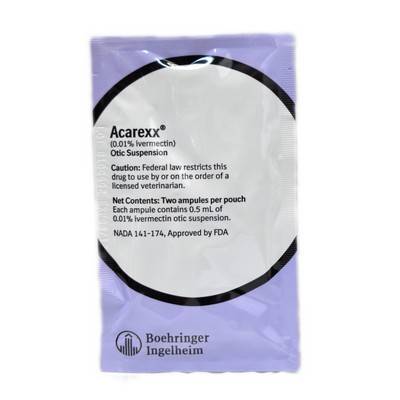
ACAREXX® OTIC SUSPENSION

Boehringer Ingelheim

(0.01% Ivermectin)

NADA 141-174, Approved by FDA

CAUTION

Federal law restricts this drug to use by or on the order of a licensed veterinarian.

DESCRIPTION

Chemical name: Ivermectin is a mixture of 5-0-demethyl-22,23-dihydroavermectin A1a (component B1a) and 5-0-demethyl-25-de(1-methylpropyl)-22,23-dihydro-25-(1-methylethyl) avermectin A1b (component B1b). Empirical formula: B1a = C48H74O14, B1b = C47H72O14. Molecular weight: B1a = 875.10, B1b = 861.07.

INDICATIONS

Acarexx (0.01% ivermectin) Otic Suspension is indicated for the treatment of adult ear mite (Otodectes cynotis) infestations in cats and kittens four weeks of age or older. Effectiveness against eggs and immature stages has not been proven.

DOSAGE

Acarexx suspension is administered topically in the ear canal at an ivermectin concentration of 0.01%. One dose of 0.5 mL is applied in each ear. Repeat treatment one time if necessary, based upon the ear mite life cycle and the response to treatment.

ADMINISTRATION

Tear foil pouch at the notch to remove the two plastic ampules. Use one ampule per ear. Shake well before use. Snap off the cap of the ampule and place the tip into the external ear canal. Squeeze the entire contents of one ampule into the ear and massage the base of the ear to distribute the medication. Repeat the procedure in the other ear using the second ampule. In clinical field trials, ears were not cleaned and many animals still had debris in their ears at the end of the study. Cleaning the ears prior to administration of Acarexx suspension is not necessary to provide effectiveness.

HUMAN WARNINGS:

Not for human use. Keep out of reach of children.

PRECAUTIONS

The safe use of Acarexx suspension in cats used for breeding purposes, during pregnancy, or in lactating queens, has not been evaluated.

ADVERSE REACTIONS

In approximately 1% of 80 cats and kittens, pain associated with the pinna and vomiting were observed following treatment with Acarexx suspension.

To report suspected adverse reactions, to obtain a Material Safety Data Sheet or for technical assistance, call 1-866-638-2226.

EFFECTIVENESS

One treatment with Acarexx suspension was 92% effective in treating adult ear mite (Otodectes cynotis) infestations after seven days in a dose titration/confirmation study. In a well-controlled clinical field trial, one treatment of Acarexx suspension was 94% effective in clearing cats and kittens of adult ear mite infestations within 7 to 10 days.

SAFETY

In two Target Animal Safety studies, Acarexx suspension was proven to be safe in kittens four weeks of age or older. Four-week-old kittens were administered Acarexx suspension at dose rates of 1X, 3X and 5X the recommended dose for three or six consecutive days and no adverse reactions were observed, except one kitten treated at 1X the dose had histologic evidence of minimal, chronic dermal inflammation of the ear. In a well-controlled clinical field trial, Acarexx suspension was used safely in cats and kittens receiving other frequently used veterinary products such as flea control products, vaccines, anthelmintics, antibiotics and steroids.

STORAGE

Store below 86°F (30°C). Protect from freezing.

HOW SUPPLIED

Acarexx Otic Suspension is packaged in two polypropylene ampules per foil pouch, which are packaged 12 foil pouches per display carton. Each ampule is filled to deliver 0.5 mL of 0.01% ivermectin otic suspension per ear.

Manufactured for: Boehringer Ingelheim Vetmedica, Inc., St. Joseph, MO 64506 U.S.A.

Acarexx is a registered trademark of Boehringer Ingelheim Vetmedica, Inc.

© 2010 Boehringer Ingelheim Vetmedica, Inc. All Rights Reserved.

449701L-00-1002

Revised 02/10

Net Contents:

Code


Two ampules per pouch

449711

449702F-01-1005

12 foil pouches containing 2 ampules per pouch.

449711