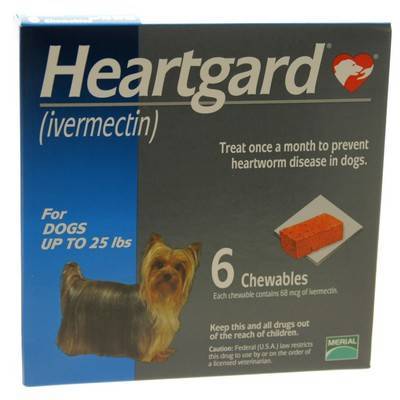

Dog Heartgard (ivermectin) Chewables Rx
Dog Heartgard (ivermectin) Chewables Rx
Heartgard (ivermectin only) has been discontinued by the manufacturer. Please contact your veterinarian about other medication options.
What are Heartgard Chewables for Dogs?
- Heartgard Chewables are a prescription heartworm preventative for dogs containing the antiparasitic Ivermectin.
- Heartgard Chewables also treat and control hookworms and some forms of mange.
- Tasty Heartgard chewables for dogs prevent heartworm infection for a full month with one dose.
Why do dogs use Heartgard?
- Prescription Heartgard chewables contain the highly effective active ingredient Ivermectin that prevents heartworm infection by killing the parasite at the larval stage.
- By giving your dog a chewable once a month on the same day, you’ll have peace of mind knowing that your dog is protected from dangerous heartworm.
What else should I know about Heartgard?
- Heartgard (ivermectin) has been discontinued. Please talk to your veterinarian about Heartgard PLUS Chewables for Dogs (Ivermectin and Pyrantel) or other heartworm preventatives.
- Prevents heartworm in dogs.
- Convenient monthly treatment.
- Tasty beef-flavored chewables for easy dosing.
- The American Heartworm Society and most veterinarians recommend an annual heartworm test before prescribing a heartworm preventative for your dog.
- Talk with your pet's veterinarian for more information and to find the best flea and tick preventative to complement Heartgard.
- Heartgard is sold as a prescription drug in a maximum of a 12-month supply per dog per year.
- To buy the same size for more than one dog, add what you need to the cart. You can split the amount to different dogs in checkout!
- Contact your local waste management about the safe disposal of Heartgard. Heartgard can be very toxic to fish and wildlife.
What problems could my dog have with Heartgard?
- Keep out of reach of other animals. Heartgard can be toxic to some species, such as turtles, skunks, and some birds. Overdoses of Ivermectin can also be serious. Contact your veterinarian if you suspect an overdose.
- Heartgard and Ivermection should be used with caution in breeds with a certain genetic mutation, MDR1. This mutation is most commonly seen in collies, Australian shepherds, shelties, and long-haired whippets. Ivermection at high doses may be toxic to dogs with this mutation.
- Contact your veterinarian immediately if you see neurologic signs such as coma, weakness, clumsiness, dilated pupils, trembling, excessive drooling, or if your dog presses its head against the wall.
How do you use Heartgard?
- Heartgard chewables may be given with or without food. Follow your veterinarian's directions.
What is in Heartgard?
- The active ingredient in Heartgard is Ivermectin.
- Ivermectin treats and kills certain parasites like heartworms and hookworms.
Will I get what I see in the picture?
- Heartgard is a brand name. You will receive the exact brand that you request.
Is it important for my dog to finish all of the Heartgard?
- Dogs may use Heartgard for different lengths of time. Please consult your veterinarian if you have any questions.
Review Summary
22 total reviews
Rated 4.91 out of 5 stars
100% of respondents would recommend this to a friend
Ratings Distribution
20 5 star reviews
2 4 star reviews
0 3 star reviews
0 2 star reviews
0 1 star reviews
Reviews
-
My dog will happily take her medicine.
From UndisclosedComments about Dog Heartgard (ivermectin) Chewables 1-25 lbs, 6 Month SupplyEasy to administer and effective. No need to hide her dose in something else like peanut butter or cheese. She thinks these are a special treat.-
![My dog will happily take her medicine.]()
Ready for the rain!
-
-
Luna
From UndisclosedComments about Dog Heartgard (ivermectin) Chewables 1-25 lbs, 6 Month SupplyGreat profuct. -
-
Safe and easy
From UndisclosedComments about Dog Heartgard (ivermectin) Chewables 26-50 lbs, 6 Month SupplyMonthly heart worm protection-
![Safe and easy]()
Callie the golden doodle
-
-
We have never had a positive stool sample test for heartworm
From UndisclosedComments about Dog Heartgard (ivermectin) Chewables 51-100 lbs, 6 Month SupplyWe have never had any bad side effects from ivermectin chewables from VetRx. Our dog Meg takes them with no problem. She seems to like the taste of them.-
![We have never had a positive stool sample test for heartworm]()
Meg's waiting for Santa
-
-
keeps her saft from sickness
From UndisclosedComments about Dog Heartgard (ivermectin) Chewables 51-100 lbs, 6 Month Supplyprotects best against heartworms -
-
This helps my dog my preventing heartworm
From UndisclosedComments about Dog Heartgard (ivermectin) Chewables 1-25 lbs, 6 Month SupplyI picked this product because my rescue dog has been on it before I got her and I continue to keep her on it.-
![This helps my dog my preventing heartworm]()
My girl Charlee ❤
-
-
Convenient!
From UndisclosedComments about Dog Heartgard (ivermectin) Chewables 51-100 lbs, 6 Month SupplyGreat customer service, very convenient, would recommend to anyone that's having trouble making time to get by the vets office! -
-
Monthly preventative.
From UndisclosedComments about Dog Heartgard (ivermectin) ChewablesI prefer to give my pet Heartworm preventive without the added parasite preventive as he has stomach issues. -
Easy and tasty
From UndisclosedComments about Dog Heartgard (ivermectin) ChewablesGreat!! -
Dogs like
From UndisclosedComments about Dog Heartgard (ivermectin) ChewablesEasy. Dogs eat. No issues.


Displaying Reviews 1 - 10
Q & A
-
do you have for dogs 55 lbs??
-
Heartgard (ivermectin) has been discontinued by the manufacturer. We do not have any left over boxes for dogs greater than 50 lbs. The manufacturer is instead making Heartgard Plus (ivermectin/pyrantel). This contains an extra parasitic agent and is used to prevent heartworm as well as treat hookworms and roundworms. It is available for dogs sized 1-25lbs, 26-50lbs, and 51-100lbs in either a six or twelve month supply.
Verified Answer
-
-
Is there an unflavored heartgard for dogs who are allergic to beef ??
-
There is no unflavored Heartgard available. Please consult with your veterinarian for alternative heartworm prevention options.
Verified Answer
-
-
Can a 8 month old puppy take Heartguard plus??
-
According to the manufacturer, Heartgard chewables may be used in dogs 6 weeks of age and older. Please consult with your veterinarian with any other questions regarding the use of this medication for your dog.
Verified Answer
-
-
whats the diiference in heartguard and heartguard plus?
-
Heartgard contains one active ingredient, ivermectin. Ivermectin is used to prevent heartworm disease in dogs. Heartgard Plus contains two active ingredients, ivermectin and pyrantel. Pyrantel is used for removal of ascarids (roundworms) and hookworms. Heartgard prevents heartworm disease and Heartgard Plus prevents heartworm disease and also helps remove roundworms and hookworms. Please consult your veterinarian regarding recommendations and any concerns regarding these medications.
Verified Answer
-
-
do you have packages of 12 Chewables??
-
Yes, we can fill prescriptions for 12 chewables. Please order two boxes of 6 chewables to fill the 12 chewable Rx.
Verified Answer
-
-
I am using Heartgard for dogs up to 25 pounds for my Havanese puppy. He likes to eat rabbit poop when we are outside. My trainer said to check to see if Heartgard has Panicure (spelling) which is what would cover the parasite that could be caused by rabbit poop.?
-
Heartgard contains the active ingredient ivermectin. In dogs, this is only indicated for the prevention of heartworms. Panacur is a different product that contains fenbendazole as its active ingredient which is used for the removal of various other parasite types. Contact your veterinarian to determine the most appropriate product for your dog.
Verified Answer
-
-
I have a 184 lb Great Dane. How many chewable so should I give her? I didn't know if I should give her 2 chewables. Thank you!?
-
Rachael, Yes, the correct dose would be to give two brown Heartgard to your very extra large dog. Your pet's veterinarian will also include these directions when the product is prescribed. Thank you, VetRxDirect
Community Answer
-
Displaying Questions 1 - 7
x
Sign Up and Save 10%!
Plus enjoy insider offers and be the first to learn about our new products and promotions.
*10% off valid on your next order. Must apply code at checkout.
Your 10% off gift is coming your way.
But first, tell us more about your pet and only get content that is special to them.


and welcome to our family and !