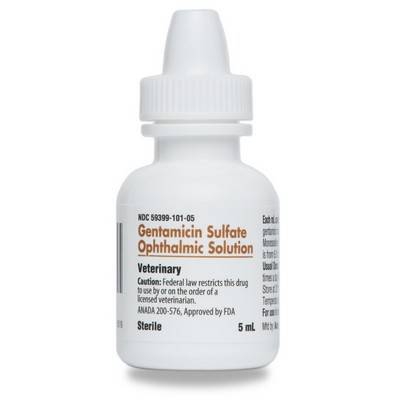

Gentamicin Sulfate Eye Drops (Generic) Rx
3 mg/mL, 5mL
Starting At
$15.49
Gentamicin Sulfate Eye Drops (Generic) Rx
$15.49
In Stock
Free shipping when you buy 5 or with a $65 order
Or save an extra 5% on your first order (up to $20) with Autoship*
$14.72
-
Usually ships the same weekday before 2pm CT with veterinary approval.
-
Requires veterinary authorization.
-
Your pet's veterinarian will provide directions for use.
What are Gentamicin Sulfate Eye Drops for Dogs and Cats?
- Gentamicin Sulfate Ophthalmic Solution is a prescription antibacterial eye drop that fights infection.
- The active ingredient in these eye drops, Gentamicin, is an aminoglycoside antibiotic, which inhibits the growth of bacteria that cause infection.
Why do cats and dogs use Gentamicin Eye Drops?
- Veterinarians prescribe sterile Gentamicin Ophthalmic Solution for dogs and cats because it works quickly and effectively on a range of bacteria.
- If your dog or cat has conjunctivitis, keratitis, blepharitis, or another bacterial eye infection, your pet's veterinarian may prescribe Gentamicin Sulfate Ophthalmic Solution to treat the infection and give your pet relief.
- This medication is also prescribed for birds, rabbits, and other pets.
What else should I know about Gentamicin Eye Drops?
- Prescribed for bacterial eye infections.
- Dropper top bottle makes eye drop application easy.
- There are approximately 20 drops per milliliter of the solution.
- Store in the refrigerator or at room temperature away from moisture and sunlight.
What problems could my dog or cat have with Gentamicin Eye Drops?
- Gentamicin may cause some mild burning, stinging, irritation, or redness of the eye.
- Do not use the medicaiton if it changes color, becomes cloudy, or if you see particles in the solution.
How do you use Gentamicin Eye Drops?
- Use proper administration techniques to avoid contamination of the bottle. Keep the cap on when not in use.
- Wait 5 minutes after applying Gentamicin to the eye before administering any other eye medication.
What is in Gentamicin Eye Drops?
- Gentamicin Sulfate is an aminoglycoside antibiotic that works against certain kinds of bacteria.
Will I get what I see in the picture?
- Gentamicin Eye Drops are sold as an FDA approved generic drug. Brand may vary from order to order and variation to variation. We are unable to guarantee which brand will be available at the time of order shipment.
Is it important for my dog or cat to finish all of the Gentamicin Eye Drops?
- Gentamicin is an antibiotic. Resistance is a major concern when using antibiotics. To help avoid resistance, it is important for you to use this for as long as your veterinarian has prescribed, even if you dog or cat is looking and feeling better.
Review Summary
8 total reviews
Rated 4.50 out of 5 stars
0% of respondents would recommend this to a friend
Ratings Distribution
5 5 star reviews
2 4 star reviews
1 3 star reviews
0 2 star reviews
0 1 star reviews
Reviews
-
The only eye treatment that gives Rocky some relief
From UndisclosedComments about Gentamicin Sulfate Eye Drops (Generic) 3 mg/mL, 5mLThank you for filling this order, due to my pet, Rocky's skin condition a rash developed that was resistant to antibiotics and the Gentamicin Sulfate eye drop is the only eye treatment that gives his eyes some relief. As soon as the prescription was approved, the eye drops were delivered within a few days.-
![The only eye treatment that gives Rocky some relief]()
Hit a rough patch
-
-
This medicine help my pet
From UndisclosedComments about Gentamicin Sulfate Eye Drops (Generic)Doctor prescribed it-
![This medicine help my pet]()
Rico Nour
-
-
Great price
From UndisclosedComments about Gentamicin Sulfate Eye Drops (Generic)My vet was completely willing to provide the prescription to VetRxDirect even though your price was significantly better than his price. Since my 17 year old pup will need this for the rest of his life, I really appreciate that. -
I'll keep buying this eye drops!
From undisclosedComments about Gentamicin Sulfate Eye Drops (Generic)This medication is perfect for my little chihuahua that has big issues with his right eye. Thanks! -
This medication works great!
From undisclosedComments about Gentamicin Sulfate Eye Drops (Generic)My dog got hit in the eye by another dog's tail and it caused a crater in his eyeball. My dog is diabetic and his healing time is a lot longer than a non-diabetic dog. Once the vet determined his eyeball was not going to heal on its own she performed surgery removing the loose layers of cataracts on his eye. My vet sent me home with this medication to put 4 drops in his eye 3 times a day. The drops seem to soothe his eye and they are definitely helping it heal. If he starts scratching at his eye (I imagine it itches from healing) I put 2 drops of this medication in his eye and the scratching stops, he would just lie there nice and peaceful acting like the drops felt good. I highly recommend this medication with a vet's prescription.-
![This medication works great!]()
Rufus my 11 year old Toy Poodle, Yorkie mix
-
-
For Chronic Dry Eye
From UndisclosedComments about Gentamicin Sulfate Eye Drops (Generic)I give this to my bully for his chronic dry eye. these drops keep his eyes moist and infection free. -
Works Well
From Tucson, AZ, USAComments about Gentamicin Sulfate Eye Drops (Generic)We have 2 persian cats who develop "weepy" eyes as a result of allergies this time of year. These eye drops work well to clear up the problem and reduce sinus drainage. -
Hard to use
From Brooklyn, NY, USAComments about Gentamicin Sulfate Eye Drops (Generic)They work pretty good but my only problem was couldn't get my dog to stay still. My dog won't let me put the drops in his eyes I think cream version of it would be much better.


Displaying Reviews 1 - 8
Q & A
-
With a dosage of twice a day, how many days is typical treatment with this antibiotic??
-
Given that there are 5 ml in your bottle and considering that there are roughly 20 drops per ml, a 5ml bottle would contain approximately 100 drops. If using 1 drop per dose twice daily, this amount could theoretically last 50 days. However, the actual duration of treatment will depend on the specific directions prescribed by your veterinarian, which could be based on the severity and nature of the eye condition being treated. It's essential to follow their guidance for effective recovery. Please consult your veterinarian regarding any further questions or concerns regarding this product.
Verified Answer
-
-
Should Gentamicin Sulfate 0.3% be used on my 15 year old Maltese, who has kidney problems? The vet prescribed it for an eye infection. She knew about his kidney issue.?
-
Gentamicin Sulfate is an antibiotic eye drop that is prescribed to treat a range of bacterial eye infections. According to Plumb’s Veterinary Drug Book, Gentamicin Sulfate Ophthalmic Solution should be used with caution in animals that have kidney problems. Please consult your veterinarian if you have any further questions or concerns regarding this medication for your dog.
Verified Answer
-
-
Li Cat licked a drop when came down face. Will this hurt her?
-
The manufacturer only has data on the potential accidental ingestion by humans. According to Plumb’s Veterinary Drug Handbook, gentamicin is not appreciably absorbed after oral administration. If any residue is left on your animalʼs face after giving the eye drops, gently wipe it off with a damp cloth or tissue. When used as an eye medication overdoses are unlikely, but side effects or toxic effects could occur if your animal eats the medication. If this happens contact your veterinarian or an animal poison control center for further advice.
Verified Answer
-
-
Can you get this w/out RX I'm wondering if you can? it may sound strange I had this for bacterial Pinkeye not to long ago, but also noticed it helped a ton with my seasonal allergies. weather or not it's allergic pinkeye, I swear it helps with the itching, burning and inflammation and no dr. will prescribe. :(?
-
Gentamicin Sulfate Eye Drops is a human labeled generic medication that may be prescribed for extra-label use by a veterinarian to treat eye conditions in dogs and cats. As a pet pharmacy, VetRxDirect only dispenses this medication with a veterinarian’s prescription for use in animals.
Verified Answer
-
-
gentamicin sulphate solution what is the percent UPS. UPS 0.03% ??
-
How often to apply?
-
Gentamicin sulfate is an antibiotic used to treat infections that are susceptible to gentamicin. A typical dose is one drop 2-3 times per day. However, the dose and duration may vary based on the severity of the infection. Your vet will be able to provide you with an accurate diagnosis of the eye infection and will prescribe the most appropriate medication for your pet. Thank you, VetRxDirect
Verified Answer
-
-
can this be used on my hamster??
-
Gentamicin Sulfate eye drops is available in both animal- and human-labeled medications. The animal-labeled product, Gentocin Durafilm, was tested and indicated for dogs only. Your veterinarian may determine that this antibiotic is appropriate for your hamster for off-label use. Please discuss any concerns you may have with your veterinarian before starting the therapy.
Verified Answer
-
-
What is the results of leaving the product out of refrigeration for a day??
-
Gentamicin Sulfate ophthalmic solution is meant to be stored at or below 77 degrees fahrenheit (25 degrees Celsius). The package label recommends avoiding excessive heat, which is defined as greater than 104 degrees fahrenheit (40 degrees Celsius). The Gentamicin Sulfate eye drop contains a preservative and is stable outside of the refrigerator as long as excessive heat is avoided. Thank you, VetRxDirect
Verified Answer
-
-
Is this product safe for kittens (age 12 weeks)? My vet believes the kitten has the calicivirus. She just finished taking Clavomox but her eyes are still watery and one eye is oozing green stuff.?
-
A manufacturer of this product indicated that they do not possess any information regarding its use in animals. Some practitioners suggest that the medication is appropriate for kittens of that age but it would be important to discuss with your vet a full range of options that you might have available if your pet is experiencing symptoms. Thank you, VetRxDirect
Verified Answer
-
-
Is this gentomyacin sulfate an antbiotic also?
-
Yes, this medication is an antibiotic. Thank you, VetRxDirect
Community Answer
-
Displaying Questions 1 - 10
x
Sign Up and Save 10%!
Plus enjoy insider offers and be the first to learn about our new products and promotions.
*10% off valid on your next order. Must apply code at checkout.
Your 10% off gift is coming your way.
But first, tell us more about your pet and only get content that is special to them.

and welcome to our family and !