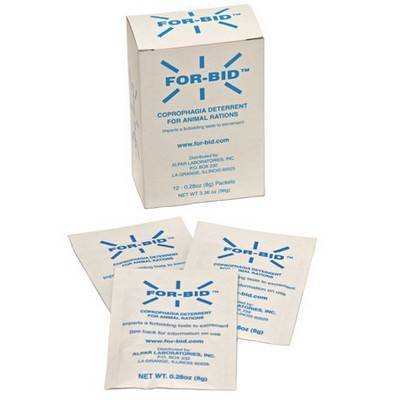

For-bid
12 Packets
Starting At
$21.75
For-bid
$21.75
In Stock
Free shipping when you buy 3 or with a $65 order
Or save an extra 5% on your first order (up to $20) with Autoship*
$20.67
-
Usually ships the same weekday before 2pm CT.
What is For-Bid Coprophagia Deterrent for Cats and Dogs?
- For-Bid is a stool-eating deterrent product for dogs and cats with coprophagia.
- Coprophagia is when animals consume their own stool or the stool of other animals.
- For-Bid powder is sprinkled over your food.
- For-Bid then causes the feces of animals eating the food to have an unpleasant taste.
- Making stools less appealing helps curb the behavior.
- For-Bid is not an enzyme, and does not interrupt normal digestion.
Why is For-Bid used for cats and dogs?
- Veterinarians may recommend For-Bid to help stop coprophagia, or stool eating, in dogs and cats.
- For-Bid is added to food. As that food passes through the gastrointestinal tract, For-Bid is broken down and this ends up in feces. The animal is then sensitized to the feces. When the animal attempts to eat the feces, it is discarded.
- A response should be seen adter the first or second day of use.
What else should I know about For-Bid?
- When a dog is eating another dog's stool, or those from a cat's litter box, treat all animals.
- For-Bid is 95-99% effective at stopping cophophagia in young animals under 5 years old that have only had coprophagia for under three months.
- For-Bid may not be effective for animals over 5 years old that have been eating feces for 1-3 years. In this case, consult your veterinarian or other animal behavior and training professional.
What problems could my dog or cat have with For-Bid?
- For-Bid should not be used with dogs or cats taking steroids as the steroids will counter the effect.
- Undigested food may end up in the feces if an animal is being overfed. This may encourage coprophagia. Consult your veterinarian if this might be an issue.
- It may also be helpful to consult your veterinarian about a change in diet. A diet with a range of vitamins and minerals may be helpful.
How do you use For-Bid?
- Use as directed by your veterinarian.
- Sprinkle the recommended dose on food. If giving dry food, moisten the food with water before adding For-Bid.
- Manufacturer's suggested use: Cats, give 1/4 packet once daily for 4 to 5 days. Dogs 3 to 20 lbs, give 1/4 packet twice daily for 5 days. Dogs 20 to 100 lbs, give 1/2 packet twice daily for 5 to 6 days. You should see a response after the first or second day. If coprophagy starts again after the initial dosage, give 1/8 packet once daily for 2 to 3 weeks as necessary.
What is in For-Bid?
- For-Bid contains wheat gluten and monosodium glutamate.
Will I get what I see in the picture?
- For-Bid is a brand name. You will receive the exact brand that you request.
Is it important for my dog or cat to finish all of the For-Bid?
- Dogs and cats may use For-Bid for different lengths of time. Please consult your veterinarian if you have any questions.
Who makes For-Bid?
- For-Bid is made by the manufacturer Alpar Laboratories.
Review Summary
4 total reviews
Rated 3.25 out of 5 stars
0% of respondents would recommend this to a friend
Ratings Distribution
1 5 star reviews
1 4 star reviews
1 3 star reviews
0 2 star reviews
1 1 star reviews
Reviews
-
Helped my dog stop eating his poop!!!
From UndisclosedComments about For-bid 12 PacketsWorks very well! Helped my dog stop eating his poop when left alone. -
Nope
From UndisclosedComments about For-bid 12 PacketsDoesn't seem to work. -
I would not buy this product again.
From UndisclosedComments about For-bidI had high hopes for this product, but it hasn't solved the issue. -
I would purchase this again & recommend this to anyone
From UndisclosedComments about For-bidThis is working on my puppy.
Displaying Reviews 1 - 4
Q & A
-
Does For-bid have an expiration date??
-
The expiration date for For-bid will be printed on the box. Our stock generally turns over fairly rapidly. The expiration dating of over-the-counter orders is double checked by technicians and shipping personnel.. If you have specific concerns about a particular product before you order, you can contact our pharmacy technicians via email at [email protected].
Verified Answer
-
-
Is prolonged use dangerous??
-
Lance, Typically dogs will respond within five days of use, many dogs will respond to For-bid after the first day. Occasionally, dogs can go back to eating stool after stopping use and another dosage of For-Bid will need to be given. A few dogs have developed a bad habit and are using For-bid on a maintenance schedule. There have been no long term usage side effects to For-Bid. But, it's very important to consult your veterinarian about you dog's stool eating. Coprophagic habits can be signs of serious GI conditions. Thank you, VetRxDirect
Community Answer
-
-
WHAT ARE THE INGREDIENTS IN FORBID? MY VET HAS RECOMMENDED IT FOR COPROPHAGIA.?
-
James, For-Bid anticoprophagic condiment for dog's food contains wheat gluten and monosodium glutamate. You can find more information about For-bid by clicking the 'Product Label' link under the Product Insert tab above. Thank you, VetRxDirect
Community Answer
-
Displaying Questions 1 - 3
x
Sign Up and Save 10%!
Plus enjoy insider offers and be the first to learn about our new products and promotions.
*10% off valid on your next order. Must apply code at checkout.
Your 10% off gift is coming your way.
But first, tell us more about your pet and only get content that is special to them.

and welcome to our family and !