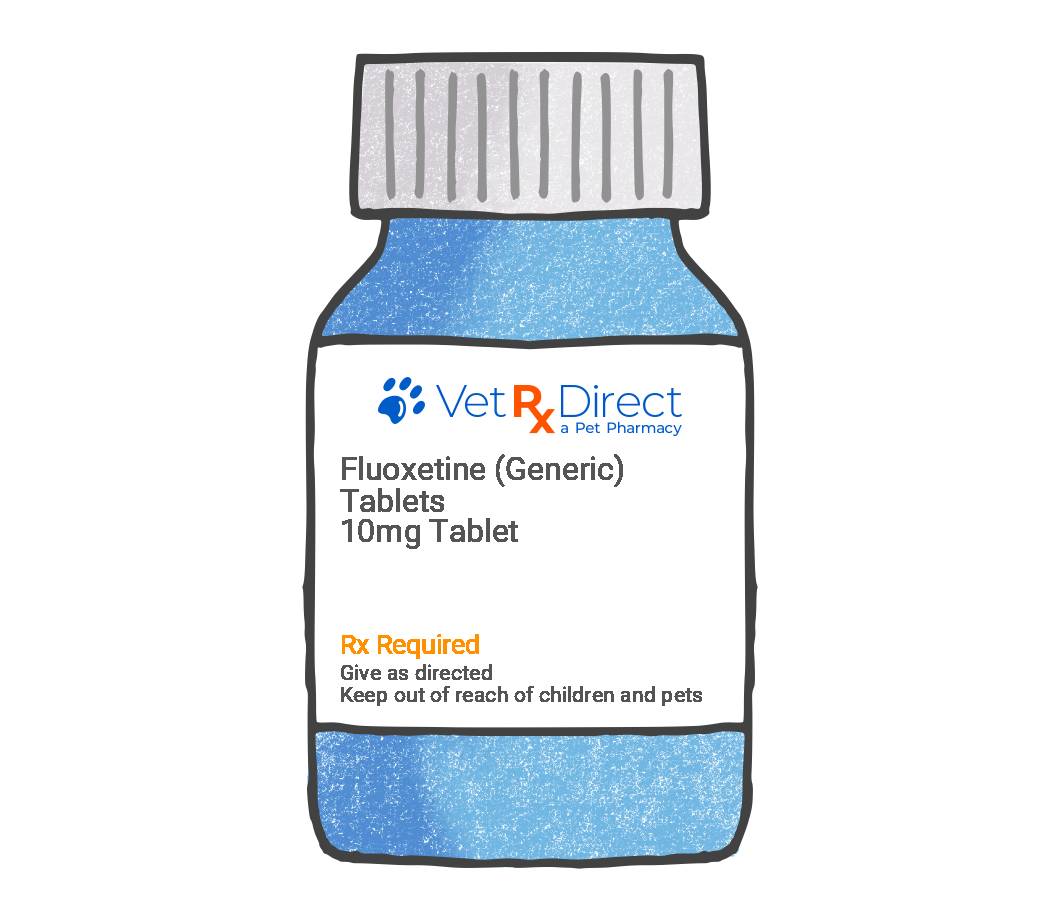
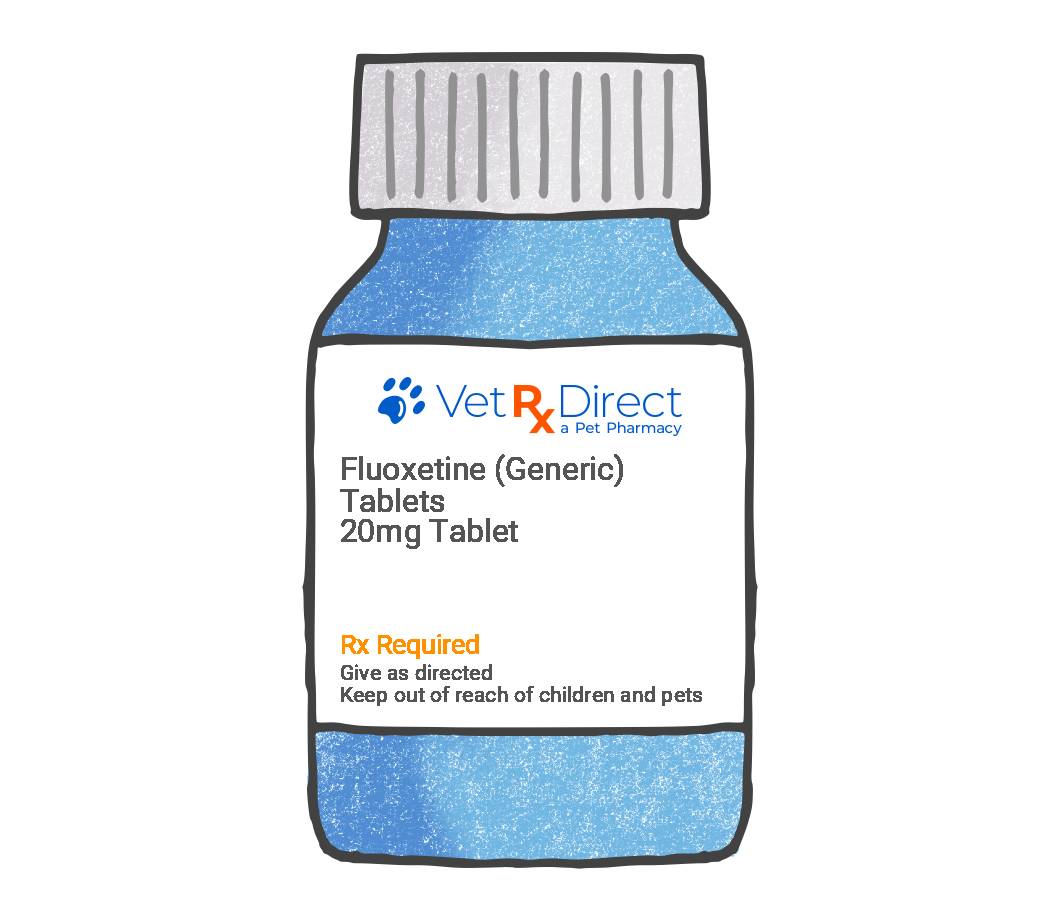

Fluoxetine (Generic) Tablets Rx
Starting At
$0.75
per tablet
Fluoxetine (Generic) Tablets Rx
$0.75
per tablet
Or save an extra 5% on your first order (up to $20) with Autoship*
$0.72
-
Usually ships the same weekday before 2pm CT with veterinary approval.
-
Requires veterinary authorization.
-
Your pet's veterinarian will provide directions for use.
What are Fluoxetine Tablets for Dogs and Cats?
- Fluoxetine is a prescription behavior modifying medication used in dogs and cats to treat several behavioral disorders including aggression in dogs and anxiety.
- Fluoxetine is the generic drug name for Prozac.
Why do cats and dogs use Fluoxetine?
- Fluoxetine may be prescribed to treat a variety of behavior disorders, such as agression, obsessive-compulsive behavior, or anxiety.
- Fluoxetine may also help against inappropriate elimination in cats.
What else should I know about Fluoxetine?
- Fluoxetine is most effective when used in conjunction with behavior programs.
- It may be several weeks before it can be determined if Fluoxetine is effective.
- Tablets can be split to give a specific dose.
- Looking for Fluoxetine Capsules?
- Looking for Reconcile (fluoxetine) Chewable Tablets?
What problems could my dog or cat have with Fluoxetine?
- Common side effects include sleepiness and reduced appetite.
- Rare, but serious, side effects include seizures and aggression. Contact your veterinarian immediately if you notice these signs.
- Overdoses can be serious. Keep Fluoxetine out of the reach of children and other animals.
- Do not use flea collars while you are giving Fluoxetinewithout consulting with your veterinarian.
- This medication should not be used in dogs with a history of epilepsy or seizures.
- Fluoxetine should be used with caution in pets that have diabetes as it may alter the blood sugar levels.
How do you use Fluoxetine?
- Fluoxetine may be given with or without food. Follow your veterinarian's directions.
What is in Fluoxetine?
- Fluoxetine is a behavior modifying drug.
- It is a selective seratonin reuptake inhibitor (SSRI) that works to increase the levels of seratonin in the brain.
Will I get what I see in the picture?
- Fluoxetine is sold as an FDA approved generic drug. Brand may vary from order to order and variation to variation. We are unable to guarantee which brand will be available at the time of order shipment.
Is it important for my dog or cat to finish all of the Fluoxetine?
- Dogs and cats may use Fluoxetine for different lengths of time. Please consult your veterinarian if you have any questions.
- Do not stop giving Fluoxetine without consulting with your pet's veterinarian as serious side effects may result.
Review Summary
16 total reviews
Rated 4.63 out of 5 stars
100% of respondents would recommend this to a friend
Ratings Distribution
13 5 star reviews
2 4 star reviews
0 3 star reviews
0 2 star reviews
1 1 star reviews
Most Liked Positive Review
This product is a life saver!
These tablets split nicely for a 5mg daily dose for my cat, Ozzy. I put it in 1/2 of a pill pocket the night before and he gobbles it down every morning. Being on fluoxetine has calmed him down to where we are no longer constantly thinking about re-homing him. While I'm not a fan of jumping to a medication as a 'fix', Ozzy has always been overly challenging and seemed to have a 'screw loose'. This past month has been much better and we wish we had started this a long time ago! Ozzy will be 3 in June.
Most Liked Negative Review
didn't work for my cat, but that's just my cat.
I bought this for my cat who was going on puppy pads instead of the litter box. I gave it to him for a week. His personality changed. He avoided being around anyone, hid, and his pupils were constantly dilated, and he still peed on the puppy pads. So I consulted my vet and took him off the medication. He's a bit more sociable, but still mean when he does not want to be bothered. Guess that's just his personality.
Reviews
-
Fluoxetine
From UndisclosedComments about Fluoxetine (Generic) Tablets 10mg TabletDefinitely helps my guy's anxiety. -
-
This medication has really helped my anxious dog.
From UndisclosedComments about Fluoxetine (Generic) Tablets 10mg TabletHawkeye has been very anxious from the day I got him. This helps calm at night so he and I can rest. -
-
Great!
From UndisclosedComments about Fluoxetine (Generic) Tablets 10mg TabletGreat price and fast shipping -
-
Works on some aggressive dogs
From UndisclosedComments about Fluoxetine (Generic) Tablets 10mg TabletTreats minimal aggressions in my terrier-
![Works on some aggressive dogs]()
Aj looking innocent
-
-
Great online vet pharmacy
From UndisclosedComments about Fluoxetine (Generic) Tablets 10mg TabletYou guys are great at delivering medicine my cat needs -
-
This medication helped Stanley
From UndisclosedComments about Fluoxetine (Generic) Tablets 10mg TabletWe give this to Stanley because he was peeing outside the box...a lot. Now, on this medication, he only rarely does it anymore. It helped!-
![This medication helped Stanley]()
Stan the Man
-
-
Good medicine at reasonable prices.Used
From UndisclosedComments about Fluoxetine (Generic) TabletsUsed to help calm my cat so she does not chew her fur off. It has helped a lot. Easy to give. -
I will definitely keep buying this medication.
From UndisclosedComments about Fluoxetine (Generic) TabletsMy cat is on a dosage of 5 mg per day. It is a Godsend! -
yes i would
From undisclosedComments about Fluoxetine (Generic) Tabletsworking very well so far. -
Of my cats has a separation anxiety disorder and this medici
From undisclosedComments about Fluoxetine (Generic) TabletsOne Of my cats has a separation anxiety disorder and this medicine is wonderful for her.-
![Of my cats has a separation anxiety disorder and this medici]()
Sophia
-


Displaying Reviews 1 - 10
Q & A
-
Is there a coating on this pill? My Vet switched brands and the new one has a coating, i really think the old one was better for my cat and I'm looking for the old brand. Dr reddy sounds familiar but is it coated in anyway, blue, clear or otherwise??
-
Fluoxetine is a human labeled, FDA approved generic drug. The size, shape, color, and coating of generic medications often varies between manufacturers. The manufacturer of this medication may vary from order to order and variation to variation. We are unable to guarantee which manufacturer will be available at the time of order shipment. If you have specific concerns about a particular product before you order, you can contact our pharmacy via email at [email protected]
Verified Answer
-
-
Can this be cut in half? What is the size of the pill??
-
Yes, the tablets can be cut in half. The size of the tablets depends on what manufacturer we have in stock, but on average they are about ¼ inch in diameter.
Verified Answer
-
-
What dosage would you use for a 6 pound adult cat for urinating/spraying problems?? Thanks!?
-
Fluoxetine medication is used to help reduce anxiety and compulsive behaviors in both cats and dogs. Dosing for this medication is weight based and once the patient has started on fluoxetine, it may take up to 8 weeks to see the full effect. When used for urine marking behavior, the patient may be tapered down on their fluoxetine dose after 8 to 12 weeks of successful treatment. It is important not to taper down on your own before the initial 8 to 12 weeks of therapy. Tapering down on the dose after effective treatment can help determine if the patient can be effectively managed on a lower dose of medication and whether the treatment is still necessary. Please contact your veterinarian to determine an appropriate dose for your pet. Thank you, VetRxDirect
Verified Answer
-
-
how much should I give a 40 lb puppy??
-
Your veterinarian will determine the proper dosage and duration of the medication. In general, the dosage is 0.5 - 1mg per pound. Thank you, VetRxDirect
Community Answer
-
-
Do I need a perscription to buy this medicine? ?
-
Yes, this medication does require a prescription. Thank you, VetRxDirect
Community Answer
-
-
I ordered 170 of the 10mg tablet in July, 2014. I KNOW I Didn't pay $1.45 per tablet! Have they gone up this much? Can the $.15 per capsule be substituted? My dog needs this med, but I Can't afford $1.45 per pill.?
-
Unfortunately, the price of this tablet has increased significantly since your last order. Too often, medication costs change frequently without notice, but we still make every attempt to offer competitive pricing. It would be best to talk with your pet's veterinarian about substituting in the capsule form. Thank you.
Community Answer
-
-
can you give a dog try lexis and fluoxetine?
-
Loulou, The term “try lexis” is unclear. Could you please elaborate more on “try lexis” and we would be happy to help you. Thank you, VetRxDirect
Community Answer
-
Displaying Questions 1 - 7
x
Sign Up and Save 10%!
Plus enjoy insider offers and be the first to learn about our new products and promotions.
*10% off valid on your next order. Must apply code at checkout.
Your 10% off gift is coming your way.
But first, tell us more about your pet and only get content that is special to them.


and welcome to our family and !