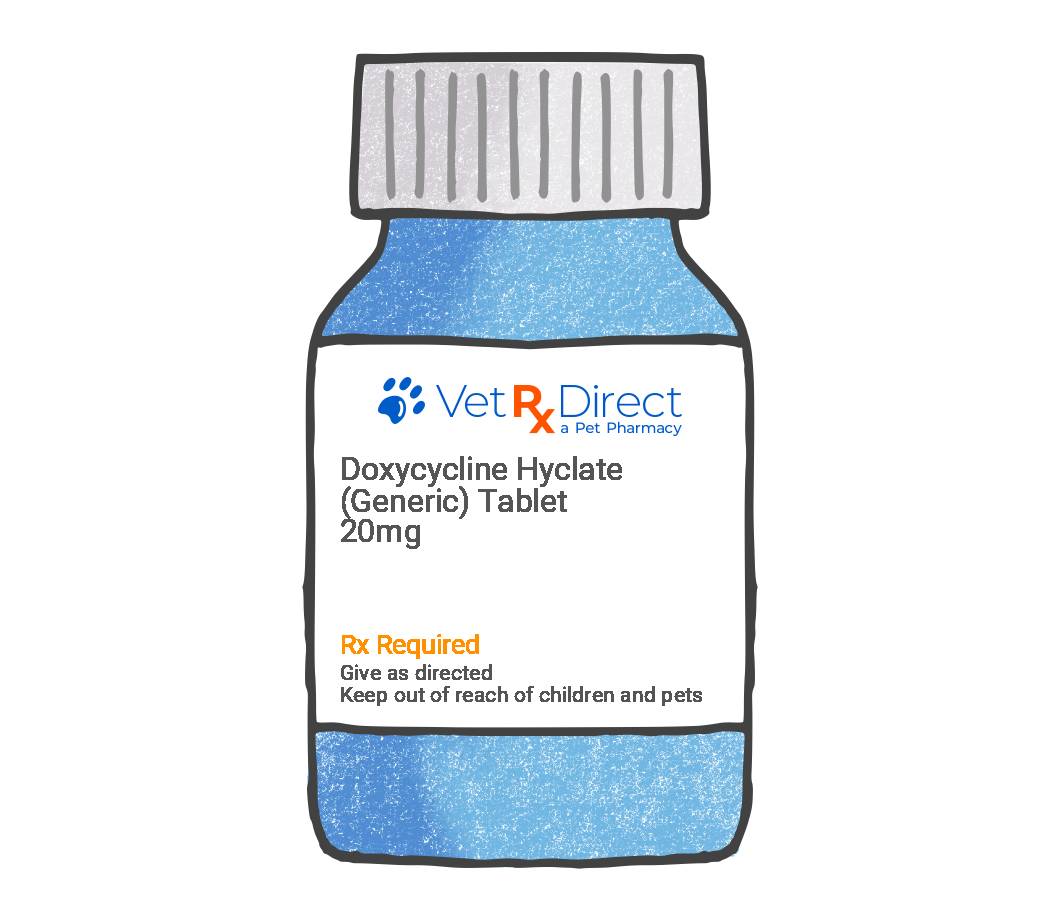
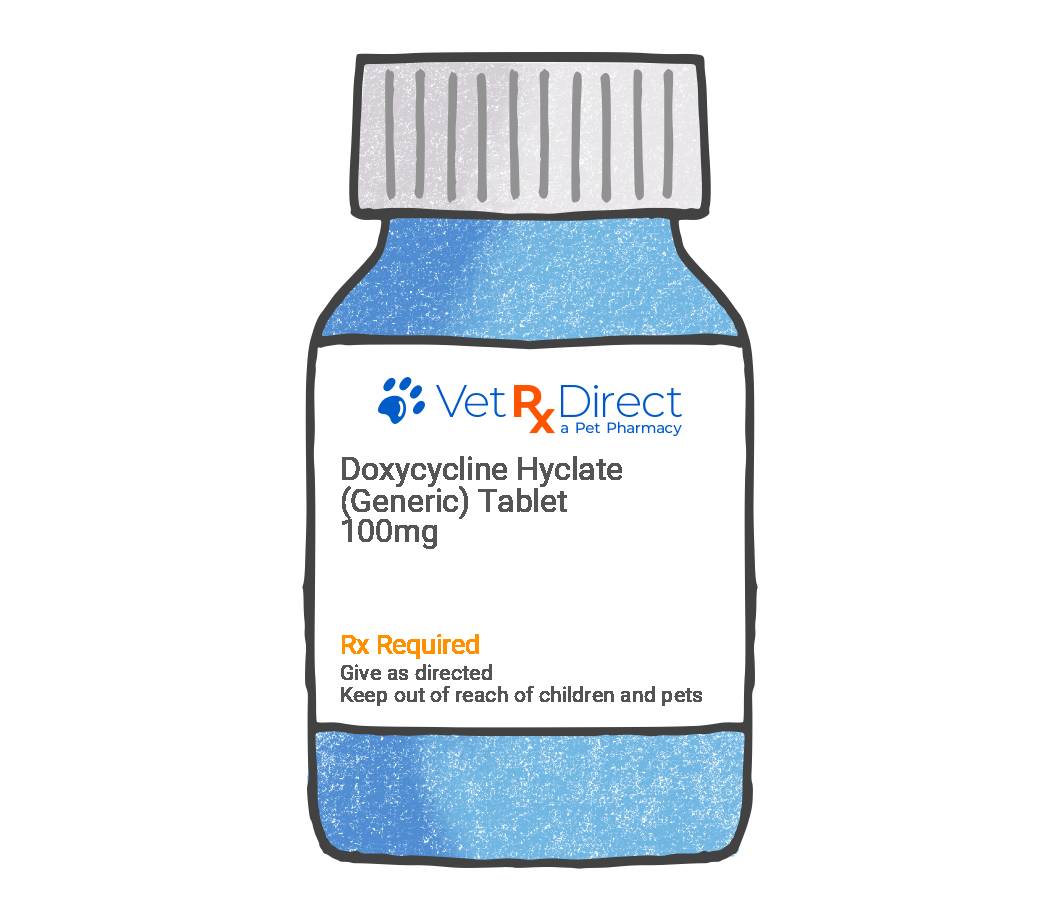

Doxycycline Hyclate (Generic) Tablet Rx
Starting At
$0.28
per tablet
Doxycycline Hyclate (Generic) Tablet Rx
$0.28
per tablet
Or save an extra 5% on your first order (up to $20) with Autoship*
$0.27
-
Usually ships the same weekday before 2pm CT with veterinary approval.
-
Requires veterinary authorization.
-
Your pet's veterinarian will provide directions for use.
What are Doxycycline Hyclate Tablets for Dogs and Cats?
- Doxycycline is a semi-synthetic tetracycline antibiotic prescribed to treat various bacterial infections and diseases borne by ticks.
- Doxycycline prevents bacteria from reproducing so the animal’s immune system can fight the existing infection.
Why do cats and dogs use Doxycycline?
- Doxycycline may be prescribed to treat various bacterial infections such as urinary tract and bladder infections.
- Veterinarians also use Doxycycline to treat some diseases such as Rocky Mountain Spotted Fever and Lyme disease.
What else should I know about Doxycycline?
- Effective treatment for bacterial infections in dogs.
- Used to treat Lyme disease, Rocky Mountain Spotted Fever, and chlamydia.
- Tablets can be split into smaller doses, but are more expensive than capsules.
- Looking for Doxyclycline Hyclate Capsules?
What problems could my dog or cat have with Doxycycline?
- Doxycycline may upset the stomach.
- Do not give multivitamins, calcium supplements, antacids, or laxatives within 2 hours of giving Doxycycline. These could lessen the effectiveness of the Doxycycline.
- Doxycycline may make your cat or dog's skin more sensitive to sunlight. Watch for reddening or burning of the skin, especially in hairless areas such as the nose, eyelids, or ears.
How do you use Doxycycline?
- Doxycycline should be given with a moist treat or a small amount of liquid to make sure that the medication reaches the stomach. This is especially important for cats. Doxycycline can cause ulcers in the throat or esophagus if it gets stuck before reaching the stomach. Always give the medication as your veterinarian directs.
What is in Doxycycline?
- Doxycyline Hyclate is a tetracycline antibiotic.
- Tetracycline antibiotics prevent the growth and spread of certain types of bacteria.
Will I get what I see in the picture?
- Doxycycline is sold as an FDA approved generic drug. Brand may vary from order to order and variation to variation. We are unable to guarantee which brand will be available at the time of order shipment.
Is it important for my dog or cat to finish all of the Doxycycline?
- Doxycycline is an antibiotic. Resistance is a major concern when using antibiotics. To help avoid resistance, it is important for you to use this for as long as your veterinarian has prescribed, even if you dog or cat is looking and feeling better.
Review Summary
12 total reviews
Rated 4.75 out of 5 stars
0% of respondents would recommend this to a friend
Ratings Distribution
9 5 star reviews
3 4 star reviews
0 3 star reviews
0 2 star reviews
0 1 star reviews
Reviews
-
Doxy really works!
From UndisclosedComments about Doxycycline Hyclate (Generic) Tablet 20mgCleared up their respiration problems. Which is usually tough, but the doxy came through... Dolly thanks you!-
![Doxy really works!]()
Dolly says "Hey!"
-
-
Smooth process
From UndisclosedComments about Doxycycline Hyclate (Generic) Tablet 100mgQuick easy order, veterinary prescription confirmation, and shipping. So smooth and easy to keep my pet treated.-
![Smooth process]()
Boris Approval
-
-
Thank you
From UndisclosedComments about Doxycycline Hyclate (Generic) Tablet 20mgAwesome medicine -
Medication is great!
From UndisclosedComments about Doxycycline Hyclate (Generic) Tablet 20mgCouldn't afford a dental procedure right away so I invested in Doxy to help control the infection. It's worked great so far and given me such a peace of mind! -
Love Vet Rx Direct!!
From UndisclosedComments about Doxycycline Hyclate (Generic) Tablet 20mgOrdering was easy. Cost was significantly lower than the local pharmacy. No hassle, site was easy to navigate and delivery was fast. Wonderful folks at Vet Rx Direct. -
Prescribed by Dogs' Endodontist
From UndisclosedComments about Doxycycline Hyclate (Generic) Tablet 20mgPrescribed by my dogs' Endodontist. Be taking for about 2 years. Use Pill Pockets for administering the meds. -
Prescribed by Dogs' Endodontist
From UndisclosedComments about Doxycycline Hyclate (Generic) TabletPrescribed by my dogs' Endodontist. Be taking for about 2 years. Use Pill Pockets for administering the meds. -
This medication helped my pet
From UndisclosedComments about Doxycycline Hyclate (Generic) Tablet 100mgHelped my pet -
Pudge feels better
From UndisclosedComments about Doxycycline Hyclate (Generic) Tablet 100mgI purchased to administer to Pudge before her heartworm treatment. Product was delivered quickly and was a good price. Thanks!-
![Pudge feels better]()
Miss Pudge
-
-
I like this company
From undisclosedComments about Doxycycline Hyclate (Generic) TabletI read the comments and saw it had horrible reviews and thought maybe I would experience the same. It wasn't like that other than getting a hold of them on the phone took 30 minutes. The product arrived sooner than I thought and can see a great improvement in my dog's nose.


Displaying Reviews 1 - 10
Q & A
-
My cat has a urinary tract infection, she weighs 12 pds, what dosage do I give her?
-
Doxycycline Hyclate is an antibiotic medication used to treat a variety of different infections in cats and dogs. Doxycycline is available as a human-labeled medication and can be used by veterinarians in an extra-label manner in animals. The dosage of this medication will vary based on the severity and type of infection it is prescribed for. It is recommended that you talk with your veterinarian before giving this medication and follow their recommendations for use.
Verified Answer
-
-
Is there a possibility this drug could make dogs drink more or lose control of their bladder? My 6 yr old beagle was given this by her vet, has been on this 8 days and started peeing in the house several times. Getting worried.?
-
Currently, no data exists supporting doxycycline and increased thirst/urination. Please follow up with your veterinarian for further questions regarding your dog’s urination as it could be due to other causes.
Verified Answer
-
-
How big are these tablets. With dogs, this can be a big deal on getting them to take these. I notice it's also available in capsules, so I'd really love it if you had a picture of these tablets so I can make an informed decision.?
-
Generic medications, such as the doxycycline hyclate, often change manufacturer from order to order due to our distributor's ever-changing availability. If we were to show you the tablet that we have in stock right now we may have a different manufacturer in stock by the time we process a prescription for your pet. If you did want to try the tablets, we would suggest that you put the tablet in a pill pocket, some cheese, or an alternate snack that your dog enjoys. If you decide to opt for the capsules instead, you would have the option to open the capsule and sprinkle the medicine into a small amount of canned food. Some people find this to be more convenient than coaxing their dogs into taking a tablet.
Verified Answer
-
-
How often and what dose for a cat with bladder infection.?
-
Doxycycline is an antibiotic medication requiring a prescription and is usually dosed 5-10mg/kg every 12 hours. A proper diagnosis from your veterinarian is needed to determine the cause of the bladder infection and if doxycycline would be the appropriate treatment. The optimal dose and duration may vary based on the diagnosis, severity of the infection and overall health of the cat. Speak with your veterinarian to determine if doxycycline is the correct medication for your cat. Thank you, VetRxDirect
Verified Answer
-
-
Is this the same as Apoquel??
-
No, Apoquel is a brand form of the drug oclacitinib used for the treatment of dermatitis in dogs. Doxycycline is an antibiotic used to treat a variety of infections. Please contact your veterinarian to determine the appropriate drug therapy for your pet. Thank you, VetRxDirect
Community Answer
-
-
Can humans take this medication? I understand it's for pets but what would happen if a human took it? ?
-
Doxycycline is a tetracycline antibiotic that can be prescribed by a medical doctor for use in humans to treat a wide variety of bacterial infections. The dose, duration and frequency of administration will vary based on the type and severity of infection. Contact your physician for more information on the use of doxycycline in humans. Thank you, VetRxDirect
Community Answer
-
-
Hello I was wondering if this ,was recommended for poultry? And specifically lung infections. My chicken had some wheezing this morning and I was advised to get tetracycline for her. Any advice or directions would be much appreciated.?
-
Tetracyclines is a class of antibiotics used to treat a variety of infections in small companion animals as well as birds. An appropriate antibiotic to treat a susceptible infection will be determined and prescribed by your veterinarian. We recommend following up with your veterinarian for specific advice as it relates to your pet’s health. Thank you, VetRxDirect
Community Answer
-
-
Is doxycycline for dogs or human??
-
It is a medication used in both humans and pets. We only sell prescription medications for pets though. Thank you, VetRxDirect
Community Answer
-
-
Hi, I was wondering the price for 10 to 15 tablets please. Also do you have Express shipping available? Thank You.?
-
Gave, It depends on the strength you are needing. The 20 milligram strength is $1.19 per capsule and the 100 milligram strength is $3.29 per capsule. We do have expedited shipping. We have priority shipping for $6.99, 2nd day shipping for $14.99, and next day shipping for $19.99. Thank you, VetRxDirect
Community Answer
-
-
is this meds good for chronic bronchitis? if so i do not see any reference to that in the description of the meds, and did i read correct? one pill is $1,19 each? so if i get the 20mg and fill the bottle what will it cost? and how cheap are you compared t?
-
Doxycycline is an antibiotic that is used to treat infections that are caused by bronchitis in dogs. Your dog’s veterinarian(s) most likely determined that an infection in your dog's airways exist and an antibiotic is necessary to treat this infection. Once the infection is treated, coughing caused by this flare up will most likely be reduced. If coughing is still present after the drug therapy is finished please follow up with the veterinarian. Duration of therapy can range between 2 weeks to 3 months depending on the type and severity of infection. The determining factors for choosing a compounded product over a commercially-available product will be dose and dosage form availability. VetRxDirect carries doxycycline 20mg, 50mg, and 100mg commericially-available tablet/capsule strengths. Side effects to monitor while on this medication are vomiting, diarrhea, and weight loss. Giving the medication with food may help reduce the GI adverse effects. Please give us a call if you have any further questions. As to your questions regarding cost, all doxycycline is sold per tablet or per capsule, so you can order the amount that the veterinarian has prescribed, which will vary depending on the duration of therapy and the necessary dose. Thank you, VetRxDirect
Community Answer
-
Displaying Questions 1 - 10
x
Sign Up and Save 10%!
Plus enjoy insider offers and be the first to learn about our new products and promotions.
*10% off valid on your next order. Must apply code at checkout.
Your 10% off gift is coming your way.
But first, tell us more about your pet and only get content that is special to them.


and welcome to our family and !