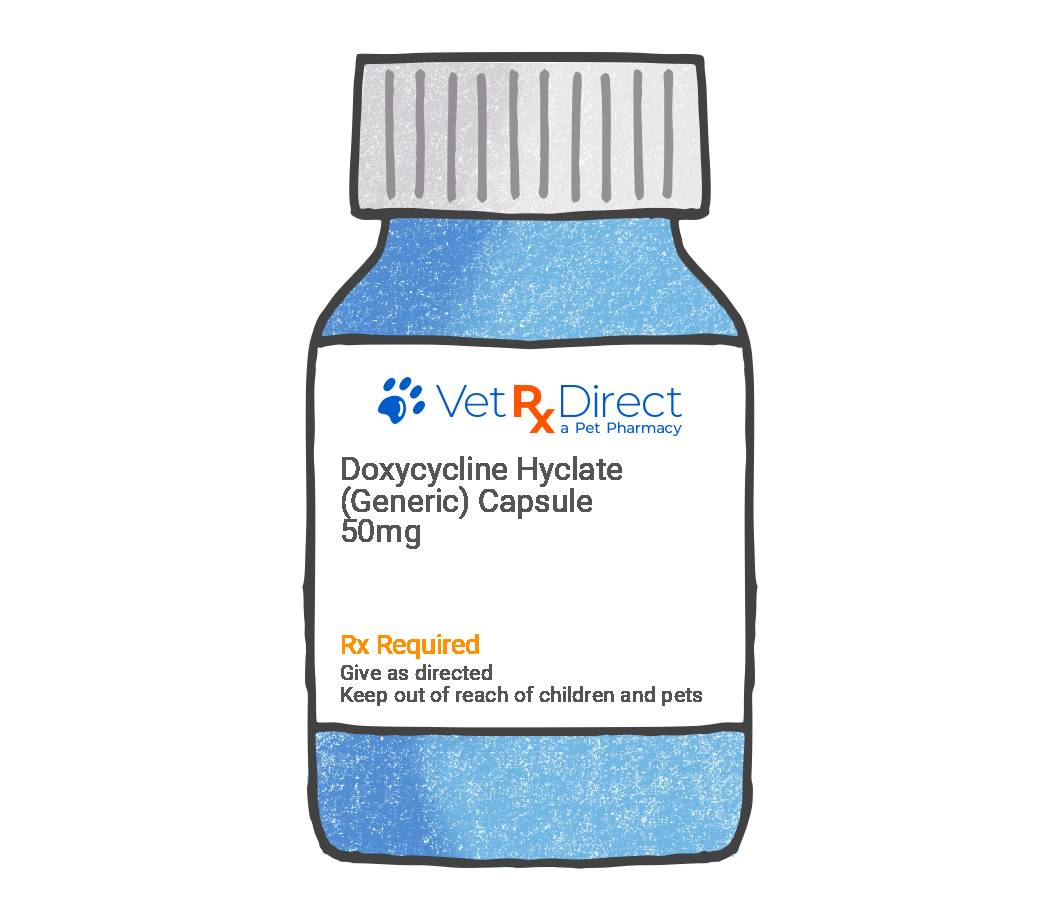
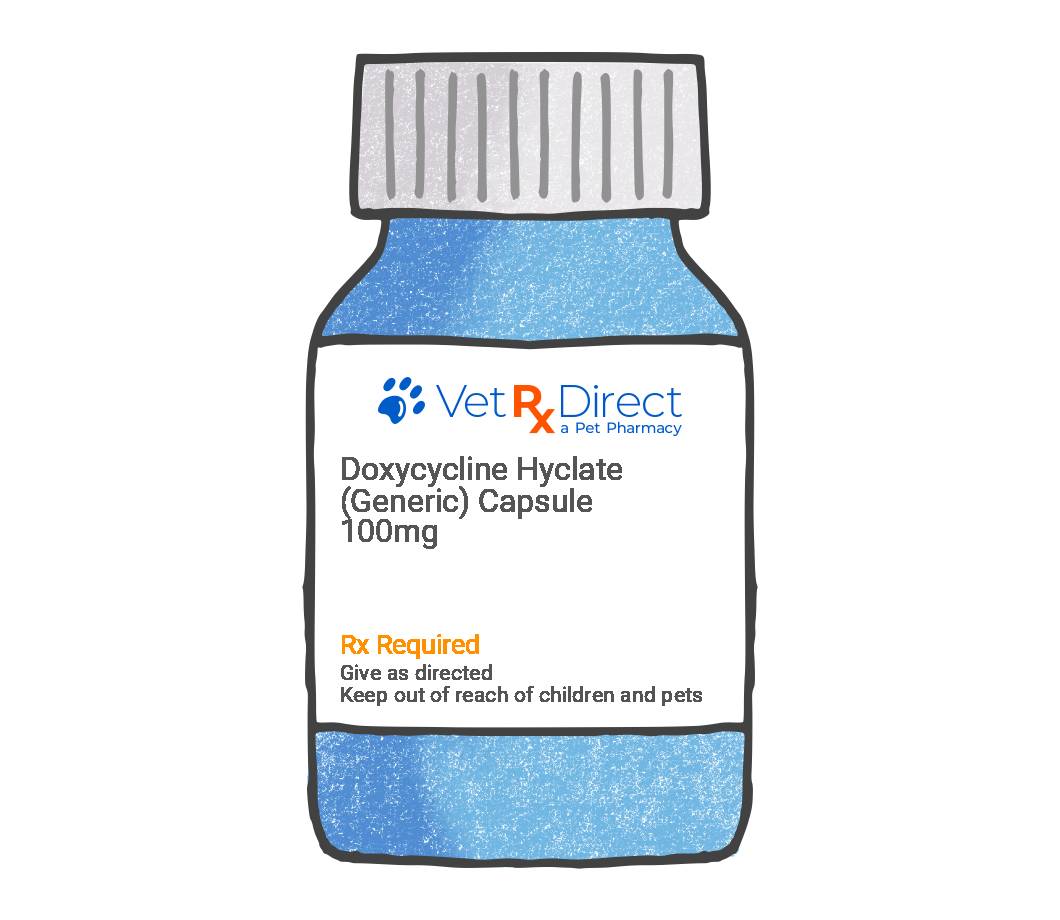

Doxycycline Hyclate (Generic) Capsule Rx
Starting At
$0.30
per capsule
Doxycycline Hyclate (Generic) Capsule Rx
$0.30
per capsule
Or save an extra 5% on your first order (up to $20) with Autoship*
$0.29
-
Usually ships the same weekday before 2pm CT with veterinary approval.
-
Requires veterinary authorization.
-
Your pet's veterinarian will provide directions for use.
What are Doxycycline Hyclate Capsules for Dogs and Cats?
- Doxycycline is a semi-synthetic tetracycline antibiotic prescribed to treat various bacterial infections and diseases borne by ticks.
- Doxycycline prevents bacteria from reproducing so the animal’s immune system can fight the existing infection.
Why do cats and dogs use Doxycycline?
- Doxycycline may be prescribed to treat various bacterial infections such as urinary tract and bladder infections.
- Veterinarians also use Doxycycline to treat some diseases such as Rocky Mountain Spotted Fever and Lyme disease.
What else should I know about Doxycycline?
- Effective treatment for bacterial infections in dogs.
- Used to treat Lyme disease, Rocky Mountain Spotted Fever, and chlamydia.
- It is not recommended to split capsules into smaller doses.
- Looking for Doxycycline Hyclate Tablets?
What problems could my dog or cat have with Doxycycline?
- Doxycycline may upset the stomach.
- Do not give multivitamins, calcium supplements, antacids, or laxatives within 2 hours of giving Doxycycline. These could lessen the effectiveness of the Doxycycline.
- Doxycycline may make your cat or dog's skin more sensitive to sunlight. Watch for reddening or burning of the skin, especially in hairless areas such as the nose, eyelids, or ears.
How do you use Doxycycline?
- Doxycycline should be given with a moist treat or a small amount of liquid to make sure that the medication reaches the stomach. This is especially important for cats. Doxycycline can cause ulcers in the throat or esophagus if it gets stuck before reaching the stomach. Always give the medication as your veterinarian directs.
What is in Doxycycline?
- Doxycyline Hyclate is a tetracycline antibiotic.
- Tetracycline antibiotics prevent the growth and spread of certain types of bacteria.
Will I get what I see in the picture?
- Doxycycline is sold as an FDA approved generic drug. Brand may vary from order to order and variation to variation. We are unable to guarantee which brand will be available at the time of order shipment.
Is it important for my dog or cat to finish all of the Doxycycline?
- Doxycycline is an antibiotic. Resistance is a major concern when using antibiotics. To help avoid resistance, it is important for you to use this for as long as your veterinarian has prescribed, even if you dog or cat is looking and feeling better.
Review Summary
7 total reviews
Rated 5.00 out of 5 stars
100% of respondents would recommend this to a friend
Ratings Distribution
7 5 star reviews
0 4 star reviews
0 3 star reviews
0 2 star reviews
0 1 star reviews
Reviews
-
Love VetRxDirect!
From UndisclosedComments about Doxycycline Hyclate (Generic) CapsuleEasy to order. Fast delivery. Exactly what I needed for my dog. Loved that I was able to get the exact number of pills that I needed. VetRxDirect contacted my vet directly to make things easy and smooth. -
Great product, fast service!!!!
From undisclosedComments about Doxycycline Hyclate (Generic) CapsuleGreat product at a great price, thanks Vetrx -
Many have same good products; here you get service & caring!
From undisclosedComments about Doxycycline Hyclate (Generic) CapsuleThe prescription was for 100 capsules, so I expected to receive 2 of the bottles pictured at the website. Instead it came in a regular pharmacy bottle with a safety lid that has to be pushed down and turned to open and close. I don't think my dogs would know how to open an non-protected bottle, but VetRXdirect doesn't know there are no young children in my home. But it made me giggle. The dog has glaucoma secondary to tick borne diseases. We've been told this medicine should clear his diseases best by many friends who have dealt with various tick borne illnesses. We are very happy with this online pharmacy, which is new to us. As farmers we need quality and affordability. With VetRXdirect we also get excellent customer care, possibly the most important thing any retailer has to offer. And our sick baby said THANK YOU for the gift of a cookie that came with his medicine. You made him happy after I had to throw the first dose of pills down his throat.-
![Many have same good products; here you get service & caring!]()
Thank you for my cookie; it made the pills taste better.
-
-
Yes
From undisclosedComments about Doxycycline Hyclate (Generic) CapsuleWould be helpful to know the expiration date on the meds. Also, turnaround was a bit slow. Other than tha it was perfect! -
Great Service!
From Rural PAComments about Doxycycline Hyclate (Generic) CapsuleThe process couldn't have been simpler. Price was excellent. At my local pharmacy's they wanted to charge me $300+ for this prescription! -
-
I would buy this product again
From Elkridge, MDComments about Doxycycline Hyclate (Generic) CapsuleThey kept in contact with my vet until prescription was faxed. Quick shipping and reasonable price. Will use their service again. -
My pets are getting old and as time goes on will use VetRXDi
From OregonComments about Doxycycline Hyclate (Generic) CapsuleI have only gotten the one medication so far. Have not had a problem from start to finish.


Displaying Reviews 1 - 7
Q & A
-
When you get a bottle of doxycycline hydrate antibiotics. Will and does the bottle have a over the bottle itself under the cap that has the contents in the bottle sealed and have to pull off once you take the cap off of the bottle??
-
Generic Doxycycline Capsules are sold per capsule and dispensed in a prescription drug bottle provided by our pharmacy. These bottles do not have an additional safety seal underneath of the cap.
Verified Answer
-
-
i have 1 capsule that says M71 and 1 capsule that says M73 what are the mg of each one?
-
If you obtained these medications from VetRxDirect, please contact our pharmacy directly and we can assist you in identifying the capsules or we can help you place an order for the appropriate medication.
Verified Answer
-
-
Can the capsule be opened and spread among the dogs food??
-
can a dog take this medication doxycycline if they are anti seizure medicine phenobarbital?
-
According to the Plumb's Veterinary Drug Book, phenobarbital may reduce the half life and levels of doxycycline when given in conjunction. Please contact your veterinarian about giving these medications to your pet.
Verified Answer
-
-
can we get this as a pill? Its very hard to get the castles down?
-
Doxycycline Hyclate is available as 50 mg capsules, 100 mg capsules, 20 mg tablets, and 100 mg tablets. Discuss this with your veterinarian. He or she may be willing to write a new prescription for the doxycycline hyclate tablets.
Verified Answer
-
-
what is the amount that should be ordered for large dogs 90 lbs or more I was just told that this was the right med can you please tell me I need 30 days worth thanks?
-
Ally, This question is complicated because it deals with multiple dosage forms and different dosing for different infections. The dosing for doxycyline differs by what bacteria is causing the infection, and where the infection is located. Doxycycline also comes in different strengths, and we carry tablets or capsules (50 and 100 mg capsules, and 100 mg tablets). The best recommendation would be to contact the veterinarian who is prescribing the medication, and see what strength he or she would like your dog to have, and if the veterinarian is prescribing the 100mg strength, there is the decision between the tablets or capsules. The veterinarian will know best what to recommend based on the type and location of the infection. Thank you, VetRxDirect
Community Answer
-
-
Hi I was just curious if this is the same medication we use for acne and can we take it for acne purpose?
-
Arsalan, Doxycycline is a human medication that has uses in veterinary pharmacy. VetRxDirect only dispenses medications for veterinary use, however, and we cannot fill prescriptions for humans or prescriptions written by anyone other than a licensed United States veterinarian. Thank you, VetRxDirect
Community Answer
-
-
For the 100mg, is the price per capsule or for the bottle? How many capsules are in the bottle??
-
William, The listed price is per capsule. Please order the quantity of capsules prescribed by your pet's veterinarian. Thank you, VetRxDirect
Community Answer
-
Displaying Questions 1 - 8
x
Sign Up and Save 10%!
Plus enjoy insider offers and be the first to learn about our new products and promotions.
*10% off valid on your next order. Must apply code at checkout.
Your 10% off gift is coming your way.
But first, tell us more about your pet and only get content that is special to them.


and welcome to our family and !