Call us today! 1-866-761-6578 Sign In To Your Account    0 Items
Items Unit Price Qty Total
Order Sub-total $0.00
Checkout
Disal (furosemide) Tablets is a Diuretic-Saluretic for Prompt Relief of Edema in Dogs

Disal (furosemide) Rx

Save $0.13!
$0.32 $0.19

In Stock FREE Shipping Eligible Price Match Guarantee

Disal® (furosemide) Tablets: Diuretic for Dogs


Why has my veterinarian prescribed Disal® Tablets?

Furosemide is a diuretic that is prescribed to help reduce the amount of water in your pet's body by increasing the flow of urine. Furosemide is also used to treat high blood pressure and reduce the workload on the heart and arteries.


How do I give Disal® Tablets?

First, READ THE LABEL CAREFULLY.


Give Furosemide to your pet as directed by your veterinarian.


Give this medicine with meals.


If Furosemide is prescribed as a liquid, measure the dose carefully.


Try to give this medicine at about the same time each day.


DO NOT give your pet more medicine than directed.


DO NOT give your pet medicine more often than prescribed.


Try not to miss giving any doses.


If I miss a dose, what do I do?

If you miss a dose, give it to your pet as soon as possible. If it is almost time for the next dose, skip the missed dose, then continue with the regular dosing schedule. Do not give your pet two doses at once.


How do I store Disal® Tablets?

Keep this medicine out of reach of children.


Store this medicine at room temperature in a dry, cool place. Keep this medicine away from heat and direct sunlight.


Do not store this medicine in damp places, in the bathroom, or near the kitchen sink. This medication can break down when exposed to moisture or heat.


What are the potential side effects Disal® Tablets?

If you notice the following symptoms in your pet, contact your veterinarian: excessive thirst, drowsiness, weakness, restlessness, diminished urination in relation to fluid intake, stomach upset, or a fast heart rate. Notify your veterinarian if side effects are persistent or troublesome.


Other side effects may occur. If you notice anything unusual, contact your veterinarian.


What about possible drug interactions?

Be sure to tell your veterinarian about any other medications or supplements you are giving your pet.


It’s not uncommon for your veterinarian to prescribe two different medications, which may cause a drug interaction to occur. If this happens, your veterinarian may change the dose and/or monitor your pet more closely.


Furosemide may interact with: theophylline, aminoglycoside antibiotics, corticosteroids, corticotropin, amphotericin B, aspirin, tubocurarine, succinylcholine, probenecid, sulfinpyrazone, and insulin.


Contact your veterinarian if your pet experiences any unusual reactions when different medications are given together.


Furosemide (Rx)

Trade Names:

Disal® Tablets

Furosemide Syrup 1%

Furosemide Tablets

Furosemide Tablets

FuroTabs

Salix® Tablets

General Description:

Furosemide is a diuretic (water pill) used in dogs and cats to remove excess body fluids, in conditions such as heart or lung disease. It may also be used to treat high blood pressure or help with regulation of electrolyte levels. While on this medication, ensure your pet has good access to drinking water as your pet will be thirsty and will need to urinate more frequently. Furosemide is available as tablets and as an oral liquid.

What is this drug?

  • Furosemide is a diuretic (helps the body lose water via increased urine production)
  • Furosemide is given by mouth

Reasons for prescribing:

  • Because this drug helps remove excessive fluids from the body, it is useful in the treatment of congestive heart failure, pulmonary edema, kidney disease, liver disease, false pregnancy and edema
  • To treat high blood pressure
  • To reduce excessive calcium or potassium levels

What dogs/cats should not take this medication?

  • Dehydrated pets, pets having difficulty urinating or those with an electrolyte (ex. calcium or potassium) imbalance
  • Use with caution in pets with kidney or liver disease or diabetes
  • Pets with a history of calcium oxalate bladder stones
  • Pregnant and nursing pets
  • Pets known to have had an allergic reaction to furosemide or other sulfa drugs

Directions:

Your pet will likely need to urinate within 30 minutes of taking furosemide. The drug peaks 1-2 hours after administration. Your pet will have to urinate more frequently than normal and accidents' are possible.

Give this medication with or without food.

Give medication as directed by your veterinarian. This medication is usually given one to three times daily .

Give the exact amount prescribed and only as often as directed. Missed doses reduce the effectiveness of therapy.

Ideally, give the medication at the same time daily.

Ensure your pet has plenty of food and fresh, clean drinking water while taking furosemide.

Furosemide may cause your pet's skin to be more sensitive to sunlight and sunburn may occur. Keep your pet out of the sun as much as possible.

What if dose is missed?

If a dose is missed, give it as soon as you can. If it is time already for the next dose, skip the missed dose and go back to the normal schedule. Do not give two doses at the same time.

What to tell/ask veterinarian before giving medication?

Talk to your veterinarian about:

  • When will your pet need to be rechecked
  • What tests may need to be performed prior to and during treatment with this drug
  • Risks and benefits of using this drug

Tell your veterinarian about:

  • If your pet has experienced side-effects on other drugs/products
  • If your pet has experienced digestive upset now or ever
  • If your pet has experienced liver or kidney disease now or ever
  • If your pet has experienced any other medical problems or allergies now or ever
  • All medicines and supplements that you are giving your pet or plan to give your pet, including those you can get without a prescription. Your veterinarian may want to check that all of your pet's medicines can be given together.
  • If your pet is pregnant or nursing or if you plan to breed your pet

Storage and Warnings:

Store in a tight, light resistant, childproof container in a cool, dry place at room temperature away from heat and direct sunlight.

Keep this and all medication out of reach of children and pets. Call your physician immediately if you accidentally take this product.

Pet owners allergic to sulfonamides and/or other antibiotics should avoid handling this drug.

Potential side effects:

  • As with any diuretic, the main side effects are increased thirst and urination
  • Electrolyte (salts) imbalances may occur. Your veterinarian may wish periodic blood testing to assess furosemide's effect on your pet.
  • High blood sugar levels (may not be a good choice for diabetic patients)
  • Weakness or lethargy could indicate potassium levels have dropped too low. Contact your veterinarian if your pet shows these effects.
  • Damage to nerves responsible for hearing (especially in cats). If you notice your pet exhibiting a loss of balance or a head tilt, notify your veterinarian immediately.
  • Humans with sulfonamide sensitivities have experienced allergic reactions to furosemide. This has not been reported in pets, but if your pet has a sulfonamide allergy, bring it to your veterinarian's attention.
  • Restlessness, nausea, vomiting, diarrhea, loss of appetite, itching, rash
  • Rare cases of anemia
  • Excessive thirst, fatigue, lack of urination, racing heartbeat
  • If you notice anything unusual, contact your veterinarian

Can this drug be given with other drugs?

  • Yes, but possible interactions may occur with vasodilating heart medications (especially enalapril, benazepril and lisinopril). Your pet may need both types of drugs. To avoid problems, blood tests may be necessary.
  • Care should be taken if your pet is also taking aminogylcoside antibiotics, amphotericin B, corticosteroids (prednisone), curare and its derivatives, digitalis derivatives, insulin, NSAIDS (ex. aspirin, carprofen), phenothiazines (ex. acepromazine), probenecid or sulfinpyrazone.
  • If your pet is also taking theophylline, the dose may be reduced.
  • If your pet experiences any unusual reactions when taking multiple medications, contact your veterinarian

Overdosing?

Contact your veterinarian immediately if pet consumes more than the prescribed amount.

What else should I know?

Notify your veterinarian if your animal's condition does not improve or worsens despite this treatment.

As with all prescribed medicines, furosemide should only be given to the dog/cat for which it was prescribed. It should be given only for the condition for which it was prescribed. It is important to periodically discuss your pet's response to furosemide at regular check ups. Your veterinarian will best determine if your pet is responding as expected and if your pet should continue receiving furosemide.

This is just a summary of information about furosemide. If you have any questions or concerns about furosemide or for the condition it was prescribed, contact your veterinarian.

Every effort has been made to ensure the accuracy of the information published. However, it remains the responsibility of the readers to familiarize themselves with the product information contained on the USA product label or package insert.

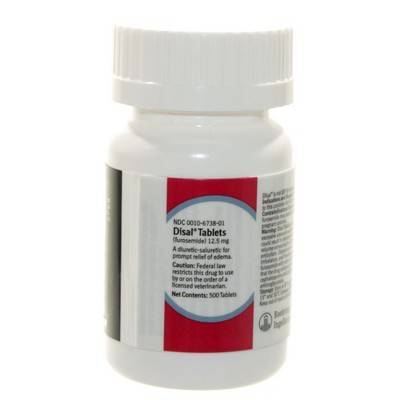
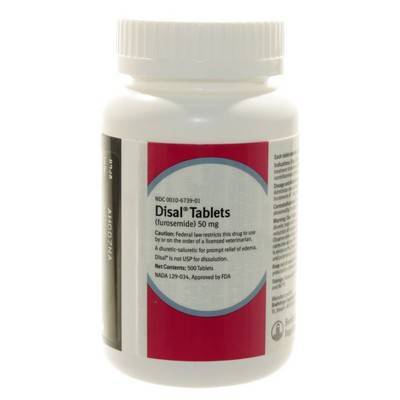
DISAL® TABLETS

Boehringer Ingelheim

(furosemide)

A diuretic-saluretic for prompt relief of edema

Disal® is not USP for dissolution.

For use in dogs only.

NADA 129-034, Approved by FDA

Caution: Federal (U.S.A.) law restricts this drug to use by or on the order of a licensed veterinarian.

Description: Disal (furosemide) is a potent loop diuretic which is a derivative of anthranilic acid. The structure is:

Chemical Name: 4-Chloro-N-furfuryl-5-sulfamoylanthranilic acid. Furosemide is pharmacodynamically characterized by the following:

1) It is administered orally. It is easily absorbed from the intestinal tract and begins to act in 30 to 60 minutes after oral administration.1 2

2) Is a loop diuretic which inhibits reabsorption of sodium and chloride at the ascending loop of Henle in the kidneys, enhancing water excretion.3

3) A dose-response relationship and a ratio of minimum to maximum effective dose range greater than tenfold.1

4) A high degree of efficacy, low inherent toxicity and a high therapeutic index.

Actions: The therapeutic efficacy of Disal Tablets is from the activity of the intact and unaltered molecule throughout the nephron, inhibiting the reabsorption of sodium not only in the proximal and distal tubule but also in the ascending limb of the loop of Henle. The prompt onset of action is a result of the drug’s rapid absorption and a poor lipid solubility. The low lipid solubility and a rapid renal excretion minimize the possibility of its accumulation in tissues and organs or crystalluria. Disal Tablets have no inhibitory effect on carbonic anhydrase or aldosterone activity in the distal tubule. The drug possesses diuretic activity either in the presence of acidosis or alkalosis.1 2 4 5 6

Indications: Dogs-Disal Tablets are indicated for the treatment of edema (pulmonary congestion, ascites) associated with cardiac insufficiency and acute noninflammatory tissue edema. In cases of edema involving cardiac insufficiency, the continued use of heart stimulants such as digitalis or its glycosides is indicated. The rationale for efficacious use of diuretic therapy is determined by the clinical pathology producing the edema.

Contraindications: Animal reproductive studies have shown that furosemide may cause fetal abnormality and the drug is contraindicated in pregnant animals. Furosemide is contraindicated in anuria, furosemide hypersensitivity, hepatic coma, or during electrolytic imbalances. Monitor serum electrolytes, BUN and CO2 frequently. Monitor serum potassium levels and watch for signs of hypocalcemia.

Corticosteroids cause an additive potassium-depletion effect.

Precautions: Disal Tablets are a highly effective diuretic-saluretic which, if given in excessive amounts, may result in dehydration and electrolyte imbalance. Therefore, the dosage and schedule may have to be adjusted to the patient’s needs. The animal should be observed for early signs of electrolyte imbalance, and corrective measures administered. Early signs of electrolyte imbalance are increased thirst, lethargy, drowsiness or restlessness, fatigue, oliguria, gastro-intestinal disturbances and tachycardia. Special attention should be given to potassium levels. Disal Tablets may lower serum calcium levels and cause tetany in rare cases of animals having an existing hypocalcemic tendency.7 8 9 10 11

Disal Tablets are contraindicated in anuria. Therapy should be discontinued in cases of progressive renal disease if increasing azotemia and oliguria occur during the treatment. Sudden alterations of fluid and electrolyte imbalance in an animal with cirrhosis may precipitate hepatic coma, therefore observation during period of therapy is necessary. In hepatic coma and in states of electrolyte depletion, therapy should not be instituted until the basic condition is improved or corrected. Potassium supplementation may be necessary in cases routinely treated with potassium-depleting steroids. Active or latent diabetes may on rare occasions be exacerbated by furosemide. Transient loss of auditory capacity has been experimentally produced in cats following intravenous injections of excessive doses of furosemide at a very rapid rate.12 13 14

Warnings: Disal Tablets are a highly effective diuretic and, if given in excessive amounts, as with any diuretic, may lead to excessive diuresis which could result in electrolyte imbalance, dehydration and reduction of plasma volume, enhancing the risk of circulatory collapse, thrombosis and embolism. Therefore, the animal should be observed for early signs of fluid depletion with electrolyte imbalance, and corrective measures administered. Excessive loss of potassium in patients receiving digitalis or its glycosides may precipitate digitalis toxicity. Caution should be exercised in animals administered potassium-depleting steroids. Correct potassium deficiency with proper dietary supplementation. If animal needs potassium supplements, use oral liquid form, do not use enteric-coated potassium tablets.

The concurrent use of furosemide with some antibiotics may be inadvisable. There is evidence that the drug enhances the nephrotoxic potential of aminoglycosides, cephalosporins and polymyxins and increases the ototoxic effects of all aminoglycosides.

Sulfonamide diuretics have been reported to decrease arterial responsiveness to pressor amines and to enhance the effect of tubocurarine. Caution should be exercised in administering curare or its derivatives to patients undergoing therapy with Disal Tablets and it is advisable to discontinue Disal Tablets for one day prior to any elective surgery.

Dosage and Administration: The usual oral dosage of Disal Tablets is 1 to 2 mg/lb body weight (approximately 2.5 to 5 mg/kg). A prompt diuresis usually ensues from the initial treatment.

Administer orally once or twice daily at 6 to 8 hour intervals. The dosage should be adjusted to the individual’s response. In severe edematous or refractory cases, the dose may be doubled or increased by increments of 1.0 mg per pound of body weight. The established effective dose should be administered once or twice daily. The daily schedule of administration can be timed to control the period of micturition for the convenience of the client or veterinarian. Mobilization of the edema may be most efficiently and safely accomplished by utilizing an intermittent daily dose schedule, i.e., every other day or 2 to 4 consecutive days weekly.

Diuretic therapy should be discontinued after reduction of the edema, or maintained after determining a carefully programmed dosage schedule to prevent recurrence of edema. For long-term treatment, the dose can generally be lowered after the edema has once been reduced. Re-examination and consultations with the client will enhance the establishment of a satisfactory dosage schedule. Clinical examination and serum BUN, CO2 and electrolyte determinations should be performed during the early period of therapy and periodically thereafter, especially in refractory cases. Abnormalities should be corrected or the drug temporarily withdrawn.

Dosage: Oral

Dog: One-half to one 50 mg scored tablet per 25 pounds body weight. One 12.5 mg scored tablet per 5 to 10 pounds body weight.

Administer once or twice daily, permitting a 6- to 8-hour interval between treatments. In refractory or severe edematous cases, the dosage may be doubled or increased by increments of 1 mg per pound body weight as recommended in preceding paragraphs, “Dosage and Administration.”

How Supplied:

Oral: Tablets

12.5 mg Tablets - Each tablet contains 12.5 mg of furosemide

50 mg Tablets - Each tablet contains 50 mg of furosemide

Available in bottles of 500 tablets

Toxicology: Furosemide demonstrates a very low order of either acute or chronic toxicity. The drug is rapidly absorbed and excreted by both glomerular filtration and tubular secretion. The rates of excretion are of such a magnitude that cumulation of furosemide does not occur despite repeated administrations.15

The main effect observed in clinical toxicity is an abnormality of fluid and electrolyte imbalances. Ototoxicity resulting in transient loss of hearing has been reported with furosemide.15

A safety study was performed in dogs to determine the effects of Disal Tablets at increasing dosages and time elements. The dosage levels were 2 mg/lb body weight (upper recommended dosage), 6 mg/lb body weight (3X upper recommended dosage) and 10 mg/lb body weight (5X upper recommended dosage). The treatment period ranged up to nine days in length. Results demonstrate a mild dehydration at the 5X level with a slight elevation of hemoglobin and hematocrit levels. Serum levels of potassium and chloride were slightly lowered in the higher dosage groups. Cumulative evaluation of the data demonstrates that Disal Tablets are safe when administered at the upper level of the recommended dosage for a duration of nine consecutive days.

Note: Store at controlled room temperature 59-86°F.

References:

1. Timmerman, R.J., F.R. Springman and R.K. Thoms, 1964. Evaluation of Furosemide, a New Diuretic Agent. Current Therapeutic Research, 6(2): 88-94.

2. Martindale, The Extra Pharmacopoeia, 27th ed. June 1977, The Pharmaceutical Press, London, 556.

3. Suki, W., F.C. Rector, Jr. and D.W. Seldin, 1965. The Site of Action of Furosemide and Other Sulfonamide Diuretics in the Dog. Journal of Clinical Investigation, 44(9):1458-1469.

4. Berman, L.B. and A. Ebrahimi. February 1965. Experiences with Furosemide in Renal Disease. Proceedings in the Society for Experimental Biology and Medicine, 118:333-336.

5. Schmidt, H.A.E. Animal Experiments with S35 Tagged Lasix® in Canine and Ovine. Radio-chemical Pharmacological Laboratory, Farbwerke Hoechst, Frankfurt, West Germany.

6. Haussler, A. and P. Hajdu. Methods Biological Identification and Results of Studies on Absorption, Elimination and Metabolism. Research Laboratories, Farbwerke Hoechst, Frankfurt, West Germany.

7. Antoniou, L.D., G.M. Eisner, L.M. Slotkoff and L.S. Lilienfield. December 1967. Sodium and Calcium Transport in the Kidney. Clinical Research, 15(4):476.

8. Duarte, C.G. April 1967. Effects of Furosemide (F) and Ethacrynic Acid (ETA) on the Renal Clearance of Phosphate (Cp), Ultrafilterable Calcium (CUfCa) and Magnesium (CUfMg). Clinical Research, 15(2):357.

9. Duarte, C.G. October 1968. Effects of Ethacrynic Acid and Furosemide on Urinary Calcium, Phosphate and Magnesium. Metabolism, 17:867-876.

10. Nielsen, S.P., O. Andersen and K.E. Steven, 1969. Magnesium and Calcium Metabolism during Prolonged Furosemide (Lasix®) Administration to Normal Rats. Acta Pharmacol, et. Toxicol., 27:469-479.

11. Reimold, E.W. July 1972. The Effect of Furosemide on Hypercalcemia Due to Dihydrotachysterol, Metabolism, 21(7).

12. Brown, R.D. and T.W. McElwee, Jr. Effects of Intra-Arterially and Intravenously Administered Ethacrynic Acid and Furosemide on Cochlear N1 in Cats. Toxicology and Applied Pharmacology, 22:589-594, 1972.

13. Mathog, R.H., W.G. Thomas and W.R. Hudson: Ototoxicity of New and Potent Diuretics. Archives of Otolaryngology, 92(1):7-13, July 1970.

14. Mathog, R.H. and G.J. Matz: Ototoxic Effects of Ethacrynic Acid. Annals of Otolaryngology, Vol. 81, 1972.

15. Gilman, A.G., L.S. Goodman and A. Gilman, 1980. The Pharmacological Basis of Therapeutics, Sixth ed., MacMillan Publishing Co., Inc., New York, NY, 903-907.

Keep out of reach of children.

Boehringer Ingelheim Vetmedica, Inc., St. Joseph, MO 64506 U.S.A.

Code


Net Contents:


673835

12.5 mg

500 Tablets

673803L-03-0702

673935

50 mg

500 Tablets

673903L-03-0702