Call us today! 1-866-761-6578 Sign In To Your Account    0 Items
Items Unit Price Qty Total
Order Sub-total $0.00
Checkout
Cefa-Drops (cefadroxil)

Cefa-Drops (cefadroxil) Rx

50mg/mL, 15mL When Mixed

Save $11.48!
$39.47 $27.99

In Stock FREE Shipping Eligible Price Match Guarantee

Cefa-Drops® (cefadroxil) Cephalosporin Antibiotic Suspension for Pets


Why has my veterinarian prescribed Cefa-Drops®?

Cephalosporins are a group of antibiotics prescribed for treating infections caused by gram positive and gram-negative bacteria. Cephalosporins are usually used to treat respiratory, skeletal, urinary, skin, and soft tissue infections.


How do I give Cefa-Drops®?

First, READ THE LABEL CAREFULLY.


Give Cephalosporins to your pet as directed by your veterinarian.


If Cephalosporins is prescribed as a liquid, shake the medicine well, then measure the dose carefully.


Give this medication to your pet for as long as prescribed by your veterinarian, even if your pet seems to be feeling better. This will help to ensure the infection is completely cleared up.


DO NOT give your pet more medicine than directed.


DO NOT give your pet medicine more often than prescribed.


Try not to miss giving any doses.


If I miss a dose, what do I do?

If you miss a dose, give it to your pet as soon as possible. If it is almost time for the next dose, skip the missed dose, then continue with the regular dosing schedule. Do not give your pet two doses at once.


How do I store Cefa-Drops®?

Keep this medicine out of reach of children.


Store capsules and tablets at room temperature in a dry, cool place. Keep this medicine away from heat and direct sunlight.


Do not store this medicine in damp places, in the bathroom, or near the kitchen sink. This medication can break down when exposed to moisture or heat.


The liquid form of Cephalosporins should preferably be stored in the refrigerator. Keep the liquid medicine from freezing and throw away any unused liquid once it’s outdated.


What are the potential side effects of Cefa-Drops®?

Cephalosporins may cause your pet to experience stomach upset, vomiting, and diarrhea. If stomach upset occurs, try giving the medication to your pet with food. These symptoms may go away during treatment. If they persist, contact your veterinarian.


Adverse effects from Cephalosporins are infrequent and usually not serious.


Other side effects may occur. If you notice anything unusual, contact your veterinarian.


What about possible drug interactions?

Be sure to tell your veterinarian about any other medications or supplements you are giving your pet.


It’s not uncommon for your veterinarian to prescribe two different medications, which may cause a drug interaction to occur. If this happens, your veterinarian may change the dose and/or monitor your pet more closely.


Cephalosporins may interact with the following medicines: aminoglycosides, penicillin, chloramphenicol, probenecid, and oral anticoagulants.


Contact your veterinarian if your pet experiences any unusual reactions when different medications are given together.

Cefadroxil (Rx) Antibiotic Suspension for Pets

Trade Names:

Cefa-Drops®
Duri-Cef® General Description:

An oral cephalosporin antibiotic used to treat many common bacterial infections in dogs and cats (ex. urinary tract infections, skin and soft tissue infections). Cefadroxil is available as capsules, tablets or as an oral suspension.

What is this drug?
  • 1st generation cephalosporin; an antibiotic
  • Given by mouth
Reasons for prescribing:
  • Useful broad spectrum antibiotic most often prescribed for common and uncomplicated infections
  • Especially useful against skin, soft tissue and genitourinary tract infections in dogs and cats
What dogs/cats should not take this medication?
  • Use with caution in pets with kidney failure or a history of seizures
  • Use with caution in pregnant animals
  • Pets whom have had previous allergic reactions to penicillin, other cephalosporins or antibiotics
Directions:

Give medication as directed by your veterinarian. It is usually given one or two times a day.

Missed doses reduce the effectiveness of therapy.

Read and follow the label carefully.

Give the exact amount prescribed and only as often as directed.

Give this medication for as long as your veterinarian directs. Call ahead for refills.

For liquids, shake well before accurately measuring the dose.

May be given with food especially if stomach upset occurs.

Ideally, give the medication at the same time daily.

What if a dose is missed?

If a dose is missed, give it as soon as you can. If it is time already for the next dose, skip the missed dose and go back to the normal schedule. Do not give two doses at the same time.

What to tell/ask veterinarian before giving medication?

Talk to your veterinarian about:

  • When will your pet need to be rechecked
  • What tests may need to be performed prior to and during treatment with this drug
  • Risks and benefits of using this drug

Tell your veterinarian about:

  • If your pet has experienced side-effects on other drugs/products
  • If your pet has experienced digestive upset now or ever
  • If your pet has experienced kidney disease now or ever
  • If your pet has experienced any other medical problems or allergies now or ever
  • All medicines and supplements that you are giving your pet or plan to give your pet, including those you can get without a prescription. Your veterinarian may want to check that all of your pet's medicines can be given together.
  • If your pet is pregnant or nursing or if you plan to breed your pet
Storage and Warnings:

Store capsules and powder in a tight, light resistant, childproof container in a cool, dry place at room temperature away from heat and direct sunlight.

Once reconstituted, the oral suspension is stable for two weeks (refrigeration is recommended). Shake well before using.

Keep this and all medication out of reach of children and pets.

Call your physician immediately if you accidentally take this product.

Pet owners who are allergic to penicillin and/or other antibiotics should avoid handling this drug.

Potential side effects:
  • This medication is usually well tolerated by dogs and cats
  • Loss of appetite, vomiting and diarrhea may be experienced, but is alleviated by giving medication with food
  • Potential for fatigue or skin rashes in some pets
  • May increase blood levels if used with probenicid
  • If you notice anything unusual, contact your veterinarian
Can this drug be given with other drugs?
  • These drugs may interact with cefadroxil: aminoglycosides (gentamicin, neomycin), amphotericin B, chloramphenicol, penicillin and probenecid.
Overdosing?

Unlikely to cause significant problems, but stomach upset is likely.

Contact your veterinarian if pet eats more than the prescribed amount.

What else should I know?

Cefadroxil normally has a strong sulfurous odor which may smell like cat urine.

As with all prescribed medicines, cefadroxil should only be given to the dog/cat for which it was prescribed. It should be given only for the condition for which it was prescribed.

Notify your veterinarian if your animal's condition does not improve or worsens despite this treatment.

This is just a summary of information about cefadroxil. If you have any questions or concerns about cefadroxil or the condition it was prescribed for, contact your veterinarian.
Every effort has been made to ensure the accuracy of the information published. However, it remains the responsibility of the readers to familiarize themselves with the product information contained on the USA product label or package insert.

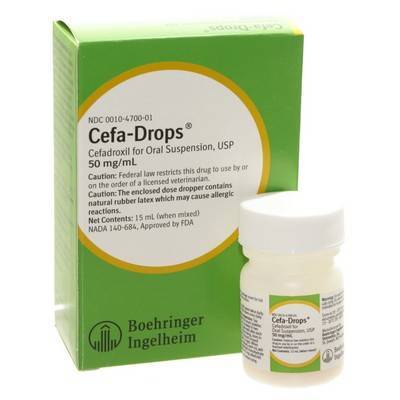
CEFA-DROPS®

Boehringer Ingelheim

Cefadroxil for Oral Suspension, USP

50 mg/mL

NADA 140-684, Approved by FDA

DESCRIPTION

Cefa-Drops (cefadroxil) contain a semi-synthetic cephalosporin antibiotic intended for oral administration. Cefa-Drops has an orange-pineapple flavor.

Cefadroxil is a member of a group of semi-synthetic derivatives of cephalosporin C, found among the metabolic products of the fungus Cephalosporium acremonium. The cephalosporins are structurally related to the penicillins in that both contain a 4-member beta-lactam ring. Cefadroxil is a 7-amino cephalosporanic acid substituted at the 7 position to form a molecule designated chemically as (6R, 7R)-7- [(R)-2-amino-2-(p-hydroxyphenyl) acetamido]-3-methyl-8-oxo-5-thia-1-azabicyclo [4.2.0] oct-2-ene-2-carboxylic acid monohydrate:

CAUTION

Federal law restricts this drug to use by or on the order of a licensed veterinarian.

CAUTION

The enclosed dose dropper in Cefa Drops contains natural rubber latex which may cause allergic reactions.

INDICATIONS

Cefa-Drops (cefadroxil) are indicated for the treatment of the following conditions:

Dogs: Genitourinary tract infections (cystitis) caused by susceptible strains of Escherichia coli, Proteus mirabilis and Staphylococcus aureus.

Skin and soft tissue infections including cellulitis, pyoderma, dermatitis, wound infections and abscesses caused by susceptible strains ofStaphylococcus aureus.

Cats: Skin and soft tissue infections including abscesses, wound infections, cellulitis and dermatitis caused by susceptible strains of Pasteurella multocida, Staphylococcus aureus, Staphylococcus epidermidis and Streptococcus spp.

DOSAGE

Dogs: Cefa-Drops, 50 mg, should be administered orally at a dosage of 10 mg/lb of body weight twice daily. Dogs with skin or soft tissue infections should be treated for a minimum of three days. Genitourinary tract infections should be treated for a minimum of seven days with cefadroxil. Maximum duration of therapy should not exceed 30 days.

Cats: Cefa-Drops, 50 mg, should be administered orally at a dosage of 10 mg/lb of body weight once daily. Maximum duration of therapy should not exceed 21 days.

In both species, drug treatment should continue for at least 48 hours after the animal is afebrile or asymptomatic. If no response is observed after three days of treatment, therapy should be discontinued and the case should be re-evaluated.

TO PREPARE SUSPENSION

Tap bottle lightly to loosen powder. For 15 mL bottle, add 10.4 mL of water in two portions. For 50 mL bottle, add 34 mL of water in two portions. Shake well after each addition. After mixing, store in refrigerator. Shake well before use. Discard unused portion after 14 days.

Droppers supplied with Cefa-Drops are calibrated in mL increments. When mixed as directed, each mL contains cefadroxil monohydrate equivalent to 50 mg cefadroxil.

CONTRAINDICATIONS

Cefa-Drops should not be administered to dogs or cats with a known allergy to cephalosporins. In penicillin-allergic animals, Cefa-Drops should be used with caution.

WARNINGS

For use in dogs and cats only. Not to be used in animals intended for human consumption. Safety for use in pregnant female dogs and cats or in breeding males has not been determined (see Animal Safety).

ADVERSE REACTIONS

Occasional nausea and vomiting have been reported following cefadroxil therapy. Administration with food appears to decrease nausea. Diarrhea and lethargy have been occasionally reported.

To report suspected adverse reactions, to obtain a Material Safety Data Sheet (MSDS) or for technical assistance, call 1-866-638-2226.

CLINICAL PHARMACOLOGY

ACTION

Cefadroxil, like other beta-lactam antibiotics, is a bactericidal agent that causes death of bacterial cells through a diversity of biological and biochemical effects on the cell wall. The spectrum of antibacterial activity includes many gram-negative organisms since cefadroxil, like other cephalosporins, has the ability to penetrate the outer envelope of gram-negative bacilli, thereby gaining access to cell wall target sites. Cefadroxil is generally not broken down by penicillinases such as those produced by penicillin-resistant staphylococci, although cephalosporinases have been identified that can inactivate the molecule.

MICROBIOLOGY

The effectiveness of Cefa-Drops in skin and soft tissue infections caused by Staphylococcus aureus, (including penicillin-resistant strains) and in urinary tract infections caused by Staphylococcus aureus, Escherichia coli and Proteus mirabilis, has been demonstrated clinically in the dog. In cats, the effectiveness of cefadroxil in skin and soft tissue infections caused by susceptible pathogens such as Pasteurella multocida, Staphylococcus aureus, Staphylococcus epidermidis and Streptococcus spp. has also been demonstrated. In addition, cefadroxil has a broad spectrum of activity against both gram-positive and gram-negative human isolates. Although the clinical significance of in vitro data is unknown in the target species, the following human isolates are generally susceptible to cefadroxil at the indicated concentrations1.

Organism

No. of Isolates

Minimum Inhibitory Concentration
(mcg/mL)

Range

MIC90*

Streptococcus pyogenes

(24)

0.063-0.125

0.11

Streptococcus agalactiae

(27)

0.25-1

0.92

Streptococcus pneumoniae

(29)

0.5-2

1.2

Staphylococcus aureus, penicillin sensitive

(16)

2-16

3.2

Staphylococcus aureus, penicillin resistant

(63)

1-32

6.2

Staphylococcus epidermidis

(28)

0.125-4

2.13

Escherichia coli

(59)

4->125

16.0

Proteus mirabilis

(62)

4->125

15.6

Klebsiella pneumoniae

(61)

4-16

7.85

Salmonella spp.

(22)

4-8

7.19

Shigella spp.

(12)

2-8

6.98

Pasteurella multocida

(2)


1.4

*Concentration at which 90% of the isolates are susceptible.

The susceptibility of organisms to cefadroxil should be determined using the cephalosporin class disc, 30mcg. Specimens for susceptibility testing should be collected prior to the initiation of antibiotic therapy.

PHARMACOKINETICS

Cefadroxil is stable in gastric acid and only moderately bound to serum proteins (approximately 20%). Cefadroxil is well absorbed from the gastrointestinal tract even when administered with food. The drug is excreted largely unchanged by the kidney. In humans, high concentrations of cefadroxil activity are found in urine within three hours after oral dosage2. The concurrent administration of probenecid retards the elimination rate.

In dogs, oral administration of cefadroxil at a dosage of 10 mg/lb results in mean peak serum concentrations averaging 18.6 mcg/mL within 1 to 2 hours after treatment3. The serum half-life (T1/2) following oral administration is approximately 2 hours. Over 50% of an orally administered dose is excreted unchanged in the urine of dogs within 24 hours. Serum concentration time profiles in dogs following oral administration are illustrated graphically in Figure 1.

Figure 1: Cefadroxil Serum Concentration Curves in Dogs3

In cats, oral administration of cefadroxil at a dosage of 10 mg/lb results in mean peak serum concentrations of 17.4 mcg/mL within 1 to 2 hours after treatment. The serum half-life (T1/2) following oral administration to cats is 2 1/2 to 3 hours. Serum concentration time profiles in cats following oral administration are illustrated graphically in Figure 2.

Figure 2: Cefadroxil Serum Concentration Curves in Cats

ANIMAL SAFETY

In subacute studies, dogs administered 100, 200 or 400 mg/kg/day for 13 weeks showed no consistent or distinct treatment-related histopathologic changes. In chronic toxicity studies, dogs receiving doses as high as 600 mg/kg/day for six months showed no discernible treatment-related effects, with the exception of emesis in dogs receiving a 400 mg/kg/day dose at one time. No distinct or consistent meaningful drug-related changes in the hematologic, coagulation or urinalysis test results or in histologic examination of tissues were observed when compared to controls.

No teratogenic or antifertility effects were seen in reproductive studies done in mice and rats receiving dosages as high as nine times the maximum recommended canine dosage.

In cats, oral administration of cefadroxil at a dosage of 240 mg/kg/day divided into two equal doses (ten times the recommended daily dosage) for 21 consecutive days produced no clinical chemistry, pathological or other signs of toxicity other than reduced food consumption, vomiting and diarrhea.

STORAGE

Store at 20 - 25°C (68 - 77°F), excursions permitted between 15 - 30°C (59 - 86°F).

HOW SUPPLIED

Cefa-Drops (Cefadroxil for Oral Suspension, USP) equivalent to:

NDC 0010-4700-01 - 750 mg cefadroxil per 15 mL dropper bottle

NDC 0010-4700-02 - 2500 mg cefadroxil per 50 mL dropper bottle

REFERENCES

1. Leitner, F., et al: “Comparative antibacterial spectrum of cefadroxil.” J. Antimicrob. Chemother. 10, Suppl. B, 1 (1982).

2. Harstein, A.L., et al: “Comparison of pharmacological and antimicrobial properties of cefadroxil and cephalexin.” Antimicrob. Agents Chemother. 12, 93 (1977).

3. Gingerich, D. A.: “Clinical pharmacology of the cephalosporins and their present use in veterinary medicine.” College of Veterinary Medicine Review, Mississippi State University, 2, 93 (1982).

© 2010 Boehringer Ingelheim Vetmedica, Inc. All Rights Reserved.

Cefa-Drops is a registered trademark of Boehringer Ingelheim Vetmedica, Inc.

Made in India

Manufactured for: Boehringer Ingelheim Vetmedica, Inc., St. Joseph, MO 64506 U.S.A.

D4230B 11660 P1503133