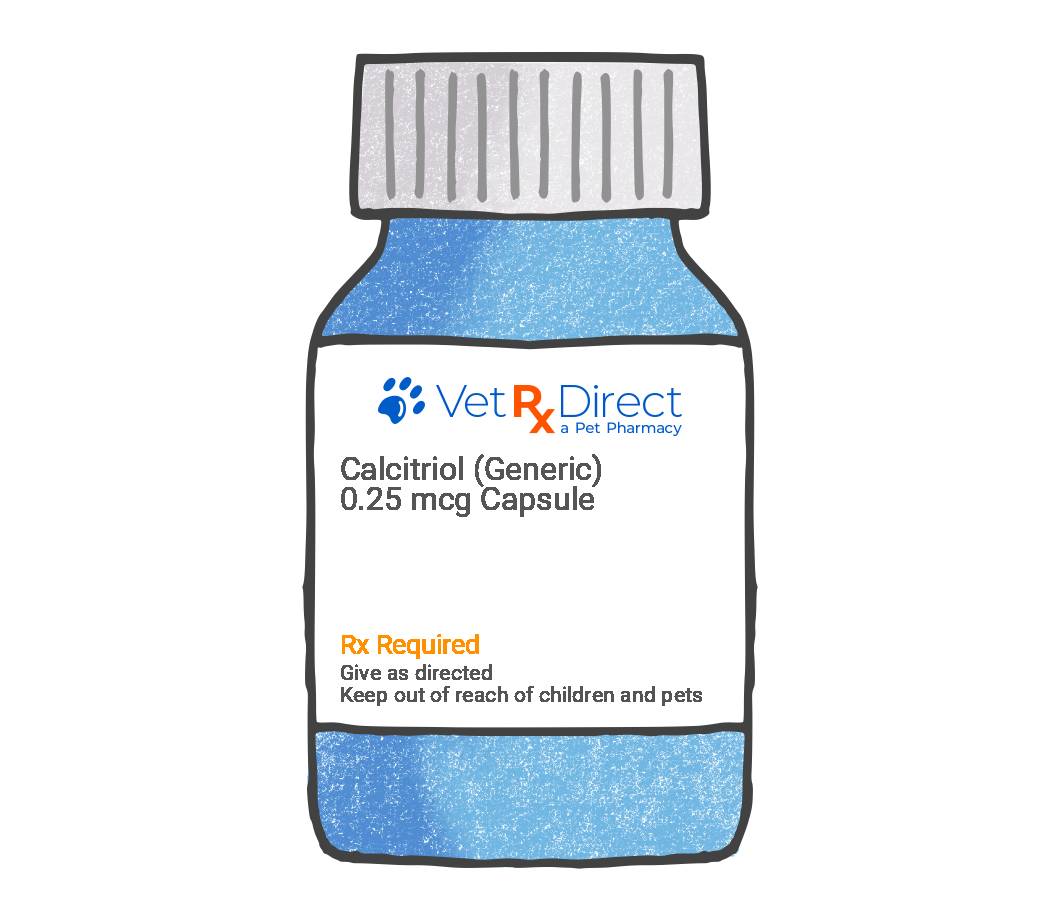

Calcitriol (Generic) Rx
Starting At
$0.93
per capsule
Calcitriol (Generic) Rx
$0.93
per capsule
Or save an extra 5% on your first order (up to $20) with Autoship*
$0.89
-
Usually ships the same weekday before 2pm CT with veterinary approval.
-
Requires veterinary authorization.
-
Your pet's veterinarian will provide directions for use.
What is Calcitriol for Dogs and Cats?
- Calcitriol is a prescription medication commonly used in the treatment of conditions caused by high or low parathyroid levels.
- Calcitriol works by maintaining blood calcium levels by promoting the absorption and use of calcium in the body.
Why do cats and dogs use Calcitriol?
- If your pet has been diagnosed with chronic kidney disease, parathyroid disorder, or an associated disease, your veterinarian may prescribe a medication such as Calcitriol.
What else should I know about Calcitriol?
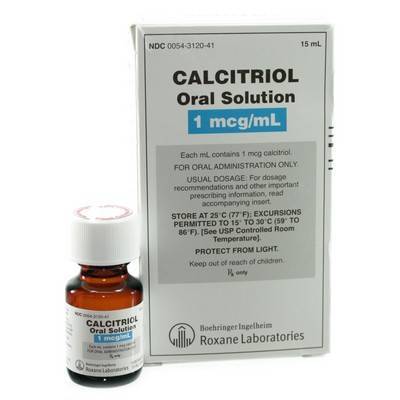
- Calcitriol Oral Solution may help dose cats and dogs that will not take capsules.
- The oral solution can also be used if the dose is less than a full capsules as capsules cannot be split.
What problems could my dog or cat have with Calcitriol?
- Your cat or dog may experience high blood calcium levels while taking Calcitriol. Symptoms include greater thirst and need to urinate, reduced appetite, or lack of appetite. Contact your veterinarian immediately if you see these signs.
- Your cat or dog may have low blood calcium levels while on Calcitriol. Symptoms may include muscle tremors, twitching, stiffness, weakness, stiff gait, unsteadiness, facial itching, behavioral changes, or seizures. Contact your veterinarian immediately if you see these signs.
- Do not give your dog or cat calcium supplements or antacids with calcium, like Tums, except under the direction of your veterinarian.
How do you use Calcitriol?
- It is best to give Calcitriol on an empty stomach. Always follow your veterinarian's directions.
What is in Calcitriol?
- Calcitriol is a Vitamin D analog that helps treat low blood calcium (hypocalcemia).
Will I get what I see in the picture?
- Calcitriol is sold as an FDA approved generic drug. Brand may vary from order to order and variation to variation. We are unable to guarantee which brand will be available at the time of order shipment.
Is it important for my dog or cat to finish all of the Calcitriol?
- Dogs and cats may use Calcitriol for different lengths of time. Please consult your veterinarian if you have any questions.
Review Summary
14 total reviews
Rated 5.00 out of 5 stars
100% of respondents would recommend this to a friend
Ratings Distribution
14 5 star reviews
0 4 star reviews
0 3 star reviews
0 2 star reviews
0 1 star reviews
Reviews
-
This medication helps to control the low calcium level
From UndisclosedComments about Calcitriol (Generic) Oral Solution, 1mcg/mL, 15mL BottleShe got problems with low calcium but this medication helps her to have her levels on control-
![This medication helps to control the low calcium level]()
V
-
-
This medication helps my Butters live longer
From UndisclosedComments about Calcitriol (Generic) Oral Solution, 1mcg/mL, 15mL BottleThank you so much for providing these medications to help my Princess Buttercup live longer with her kidney disease. She eats the medicine in a tuna feast wet food. She is a sweet girl that has been with me 13 years and we are hoping for more. She is my daughter.-
![This medication helps my Butters live longer]()
Princess Buttercup's sweet face
-
-
Calcitriol - and convenience of shipping - lifesavers!
From UndisclosedComments about Calcitriol (Generic) 0.25 mcg CapsuleLily has an uncommon condition called PLE - protein losing enteropathy. Her body doesn't absorb protein, and she was so sick, she was in doggy ER for 3 days. Once they figured out the condition, they came up with a mix of medications that help her body retain protein. Calcitriol has been a critical part of that solution. We almost lost Lily, but now 9 months later, she is doing very well.-
![Calcitriol - and convenience of shipping - lifesavers!]()
Lily
-
-
Great customer service!
From UndisclosedComments about Calcitriol (Generic) Oral Solution, 1mcg/mL, 15mL BottleZara needs Calcitriol to maintain her calcium levels. Customer service was great and shipping was fast!-
![Great customer service!]()
She loves kayaking!
-
-
Calcitriol Oral Solution is helping Indiana Jones kidney.
From UndisclosedComments about Calcitriol (Generic) Oral Solution, 1mcg/mL, 15mL BottleThis company is very good for the Calcitriol Oral Solution I need for one of my cats. They contacted the vet (another company ignored that request) and it was shipped very fast. This will last one more year, the size for my cat is 0.01 so yes it lasts a long time.-
![Calcitriol Oral Solution is helping Indiana Jones kidney.]()
Indiana Jones loved being on my son-in-laws back.
-
-
This medication keeps our dog with a healthy calcium level.
From UndisclosedComments about Calcitriol (Generic) Oral Solution, 1mcg/mL, 15mL BottleOur mini golden doodle Misiek is prescribed Calcitriol Oral Solution to maintain an adequate ionized calcium level secondary to primary hypoparathyroidism.We were filling this RX at a local specialty pharmacy for significantly more $ than Vet RX Direct.We received the order promptly and in excellent condition.We had a small issue that was promptly corrected with a call received from Vet RX Direct pharmacist.We are happy with the service and will continue to use for our pet's medication needs.-
![This medication keeps our dog with a healthy calcium level.]()
Misiek,the napping Golden Doodle.
-
-
Quality is better than our local pharmacy!!!
From UndisclosedComments about Calcitriol (Generic) Oral Solution, 1mcg/mL, 15mL BottleOur little girl was recently diagnosed with hyperparathyroidism and needs this medication to survive. I was hesitant to order it online because this medicine's potency has a tendency to degrade over time and I was worried about shipping conditions (heat/cold). We learned the hard way that the medication degrades when we purchased a bottle at our local pharmacy (the only place in town that we can get this medication), I assume we received an older or poorly cared-for bottle and we ended up at the Emergency Vet (also the Vet's opinion). We opted to try VetRX, surprisingly about $40 cheaper, super convenient and most importantly she is doing great! We are about 1.5 months into the bottle and are hoping for at least 2-3 months before potency is lost and we have to discard (we have a 9lb dog = small dose). I would recommend VetRXDirect for Calcitriol Solution.-
![Quality is better than our local pharmacy!!!]()
Our little girl enjoying the sun
-
-
Excellent customer service
From UndisclosedComments about Calcitriol (Generic) Oral Solution, 1mcg/mL, 15mL BottleThis medication is necessary for Buster's condition, hypoparathyroid. All I need to do is order the medicine, give vetrxdirect my dog's veterinarian information. Vetrxdirect does the rest for me. They contact Buster's vet for Rx and mail it to us. So easy for the consumer. Plus Buster gets a special treat included in his box with his medicine.-
![Excellent customer service]()
Happy Holidays from Buster!
-
-
Saved my pet's life
From UndisclosedComments about Calcitriol (Generic)This was recommended by my dog's internist. He had tumors and had to have his thyroid and all parathyroid tissue removed. That was over a year ago and he is doing great thanks to this medicine! Vet RX Direct is so easy to use and they ship really fast! -
-
Two years of Vet prescribed medicine
From UndisclosedComments about Calcitriol (Generic)Since hypo thyroid surgery, this maintains his calcium levels correctly-
![Two years of Vet prescribed medicine]()
He's all ears!!!
-


Displaying Reviews 1 - 10
Q & A
-
We currently have 2 cats on this med. we get the pill from the local pharmacy- one cat can swallow the pill while eating and with Churu. The other cat due to how big the pill is tries to chew it and won't swallow it. It is a thicker rubbery texture. Can you send a pic of your pill? Also, is the liquid equivalent you sell the same dosage? I may need to try a liquid in her food? She's not easy to give meds too.?
-
The dosage of Calcitriol oral solution is currently available as 1mcg/ml. The dosage of Calcitriol capsules available on our website are available as 0.25 mcg. If you have specific questions about our current inventory, please contact us at [email protected]. Calcitriol is sold and dispensed as a human-labeled, generic drug. The brand of this medication may vary from order and variation. The size, shape and color of generic medications often varies between the brands. We are unable to guarantee which brand will be available at the time of order shipment.
Verified Answer
-
-
Does the oral solution or capsules contain propylene glycol??
-
Calcitriol is the active ingredient in this medication. Inactive ingredients may vary between different generic manufacturers. Calcitriol is sold and dispensed as a human-labeled generic drug. As a pet pharmacy, VetRxDirect only dispenses this medication with a veterinarian’s prescription for use in animals. If you have specific concerns about a particular product before you order, you can contact our pharmacy via email at [email protected].
Verified Answer
-
-
What is the full ingredient list of this product? Also, what is done (what stabilizers are used) to protect the calcitriol from oxidation by the polyunsaturated oils used to dilute the calcitriol? What is the shelf life of this product? Thanks.?
-
Calcitriol is the active ingredient in this medication. Calcitriol is sold and dispensed as an FDA-approved generic drug. As a pet pharmacy, VetRxDirect only dispenses this medication with a veterinarian’s prescription for use in animals. Inactive ingredients may vary between different generic manufacturers. Our stock generally turns over fairly rapidly. We are unable to guarantee which brand will be available at the time of order shipment. The expiration date of prescription orders is double-checked by pharmacy staff. If you have specific concerns about a particular product before you order, you can contact our pharmacy via email at [email protected].
Verified Answer
-
-
My 3 pound dog takes Calcitriol for his sever calcium deficiency.. it is chicken flavoured and costs $250 for 30 ml bottle..is there a substitute for it??
-
Will the calcitriol still be absorbed normally if the oral solution is dropped onto food? In other words, can a client put the oral solution onto a cracker or treat and then feed the treat to them and the mediation still absorb properly? Thank you.?
-
According to Plumb’s Veterinary Drug Handbook, calcitriol is best given on an empty stomach. Foods that are oily or high in fat promote the absorption of calcitriol and increase calcium levels. Depending on your pet’s condition it may be appropriate to administer this medication with food, but it is recommended that you speak with your veterinarian as they will be able to determine if giving this medication with food is safe and effective for your pet. Please consult your veterinarian if you have any further questions or concerns regarding this medication.
Verified Answer
-
-
Hi there, how do i order a custom solution? My dogs current prescription is 100 ngm/ml SOL 30 ml Chicken. Thank you Kevin Johnson (2067025764)?
-
A chicken flavored calcitriol solution would need to be customized or compounded by a compounding pharmacy. VetRxDirect does not offer a compounded calcitriol solution at this time. Please consult your veterinarian with any further questions or concerns regarding this medication.
Verified Answer
-
-
what is the flavor of the calcitriol 1mcg/ml oral solution? can a flavor be added??
-
According to the manufacturer, calcitriol 1mcg/ml oral solution does not contain a flavor. A flavored calcitriol solution would need to be customized or compounded by a compounding pharmacy. VetRxDirect does not offer a compounded calcitriol solution at this time. Please consult your veterinarian with any further questions or concerns regarding this medication.
Verified Answer
-
-
A .25 mcg capsule would be equivalent to how many IU's of vitamin D3??
-
Calcitriol and vitamin D3 (cholecalciferol) are not interchangeable products as calcitriol is notably more potent than cholecalciferol. Calcitriol is an analog of vitamin D3 that is primarily used in dogs and cats to treat hypocalcemia associated with hypoparathyroidism or chronic kidney disease. Calcitriol is dosed in micrograms rather than international units (IU). Therefore, doses of calcitriol cannot be directly converted to international units. VetRxDirect sells cholecalciferol containing products, Rx D3 and Rx D3 Forte. Rx D3 contains 100 IU of Vitamin D3 per drop. Rx D3 Forte contains 500 IU of Vitamin D3 per drop. Please consult your veterinarian to discuss appropriate treatment options for your pet.
Verified Answer
-
-
is the dropper for the calicitriol marked with calibrations? I need 200ng/ml which would be .2ml, I think.?
-
Calcitriol 1mcg/ml Oral Solution contains 1ml syringes that are marked in 0.1mL increments. The stated concentration of 1mcg/ml is equivalent to 1000ng/ml. A measurement of 0.2ml on the syringe would give a calcitriol dose of 200ng. If you have further questions or concerns, please speak to your veterinarian to ensure your pet receives the proper dose of medication.
Verified Answer
-
-
My dog has been diagnosed with kidney failure. Several blood and urine test have been taken already. Is it necessary to take a specific test for the introduction of taking Calcitriol ??
-
Calcitriol is a medication used to commonly treat low blood calcium levels and hyperparathyroidism. Your veterinarian would be best to discuss what specific laboratory tests are necessary for your pet dog before initiating this medication.
Verified Answer
-
Displaying Questions 1 - 10
x
Sign Up and Save 10%!
Plus enjoy insider offers and be the first to learn about our new products and promotions.
*10% off valid on your next order. Must apply code at checkout.
Your 10% off gift is coming your way.
But first, tell us more about your pet and only get content that is special to them.


and welcome to our family and !