Aquadrops
Why has my veterinarian prescribed Antirobe®?
Clindamycin is an antibiotic prescribed to treat bacterial infections in dogs and cats including wounds, abscesses, and inflammation of the bone marrow and adjacent bone. Your veterinarian may also prescribe this medicine to treat protozoal infections including toxoplasmosis.
How do I give Antirobe®?
First, READ THE LABEL CAREFULLY.
Give Clindamycin to your pet as directed by your veterinarian.
If Clindamycin is prescribed as a liquid, shake the medicine well, then measure the dose carefully.
Give this medication to your pet for as long as prescribed by your veterinarian, even if your pet seems to be feeling better. This will help to ensure the infection is completely cleared up.
DO NOT give your pet more medicine than directed.
DO NOT give your pet medicine more often than prescribed.
Try not to miss giving any doses.
If I miss a dose, what do I do?
If you miss a dose, give it to your pet as soon as possible. If it is almost time for the next dose, skip the missed dose, then continue with the regular dosing schedule. Do not give your pet two doses at once.
How do I store Antirobe®?
Keep this medicine out of reach of children.
Store capsules and tablets at room temperature in a dry, cool place. Keep this medicine away from heat and direct sunlight.
The liquid form of this medicine should be stored in the refrigerator. Keep the liquid from freezing and discard any unused liquid after 14 days.
Do not store this medicine in damp places, in the bathroom, or near the kitchen sink. This medication can break down when exposed to moisture or heat.
What are the potential side effects of Antirobe®?
Clindamycin may cause stomach upset, vomiting, and diarrhea.
If your pet has severe, prolonged or bloody diarrhea, contact your veterinarian immediately.
Other side effects may occur. If you notice anything unusual, contact your veterinarian.
What about possible drug interactions?
Be sure to tell your veterinarian about any other medications or supplements you are giving your pet.
It’s not uncommon for your veterinarian to prescribe two different medications, which may cause a drug interaction to occur. If this happens, your veterinarian may change the dose and/or monitor your pet more closely.
Clindamycin may interact with: neuromuscular blocking agents, chloramphenicol, erythromycin, diphenoxylate, and opiates.
Contact your veterinarian if your pet experiences any unusual reactions when different medications are given together.
Trade Names:
Antirobe Aquadrops® Liquid
Clinda-Guard™ Liquid
ClindaCure™ Capsules
ClindaCure™ Liquid
Clindamycin Hydrochloride Drops
Clindamycin Hydrochloride Oral Drops
ClindaRobe™ Capsules
ClinDrops
Clinsol® Liquid
Clintabs® Tablets
General Description:
This drug is an antibiotic that fights bacterial infections. Clindamycin is available in tablets, capsules, and as a liquid.
What is this drug?
Reasons for prescribing:
What dogs/cats should not take this medication?
Directions:
Read and follow the prescription label carefully.
Give the exact amount prescribed and only as often as directed.
Discuss with your veterinarian if this medication is to be given with food.
Give this medication for as long as your veterinarian directs. Do not skip doses or stop giving the medication without consulting your veterinarian.
Your veterinarian may recommend periodic blood work to assess the kidneys and liver if this medication is given for longer than 30 days.
Dose adjustments may be made based upon these results and an assessment of how your dog or cat is responding clinically.
Call ahead for refills.
Ideally, give medication at the same time(s) daily.
What if a dose is missed?
If a dose is missed, give it as soon as you can. If it is time already for the next dose, skip the missed dose and go back to the normal schedule. Do not give two doses at the same time.
What to tell/ask a veterinarian before giving medication?
Talk to your veterinarian about:
Tell your veterinarian about:
Storage and Warnings:
Clindamycin hydrochloride should be stored in a childproof container in a cool, dry place at room temperature away from heat and direct sunlight.
Keep this and all medication out of reach of children and pets.
Call your physician immediately if you accidentally take this product.
Potential side effects:
Can this drug be given with other drugs?
Overdosing?
Contact your veterinarian immediately if your pet receives more than the prescribed amount.
What else should I know?
Notify your veterinarian if your animal's condition does not improve or worsens despite this treatment.
As with all prescribed medicines, clindamycin hydrochloride should only be given to the pet for which it was prescribed.
It should be given only for the condition for which it was prescribed.
This is just a summary of information about clindamycin hydrochloride. If you have any questions or concerns about clindamycin hydrochloride or the condition it was prescribed for, please contact your veterinarian.
| Every effort has been made to ensure the accuracy of the information published. However, it remains the responsibility of the readers to familiarize themselves with the product information contained on the USA product label or package insert. |
ANTIROBE® / ANTIROBE AQUADROPS®
Pharmacia & Upjohn
clindamycin hydrochloride capsules, USP
clindamycin hydrochloride liquid
Caution: Federal (USA) law restricts this drug to use by or on the order of a licensed veterinarian.
DESCRIPTION
ANTIROBE Capsules and ANTIROBE AQUADROPS Liquid contain clindamycin hydrochloride which is the hydrated salt of clindamycin. Clindamycin is a semisynthetic antibiotic produced by a 7(S)-chlorosubstitution of the 7(R)-hydroxyl group of a naturally produced antibiotic produced by Streptomyces lincolnensis var. lincolnensis.
ANTIROBE Capsules (For Use in Dogs Only):
25 mg Capsule, each yellow and white capsule contains clindamycin hydrochloride equivalent to 25 mg of clindamycin.
75 mg Capsule, each green capsule contains clindamycin hydrochloride equivalent to 75 mg of clindamycin.
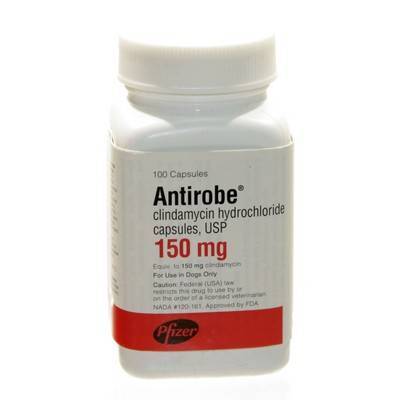
150 mg Capsule, each light blue and green capsule contains clindamycin hydrochloride equivalent to 150 mg of clindamycin.
300 mg Capsule, each light blue capsule contains clindamycin hydrochloride equivalent to 300 mg of clindamycin.
ANTIROBE AQUADROPS Liquid (For Use in Dogs and Cats) is a palatable formulation intended for oral administration. Each mL of ANTIROBE AQUADROPS Liquid contains clindamycin hydrochloride equivalent to 25 mg clindamycin; and ethyl alcohol, 8.64%.
CLINICAL PHARMACOLOGY
Absorption
Clindamycin hydrochloride is rapidly absorbed from the canine and feline gastrointestinal tract.
Dog Serum Levels
Serum levels at or above 0.5 µg/mL can be maintained by oral dosing at a rate of 2.5 mg/lb of clindamycin hydrochloride every 12 hours. This same study revealed that average peak serum concentrations of clindamycin occur 1 hour and 15 minutes after oral dosing. The elimination half-life for clindamycin in dog serum was approximately 5 hours. There was no bioactivity accumulation after a regimen of multiple oral doses in healthy dogs.
Clindamycin Serum Concentrations 2.5 mg/lb (5.5 mg/kg) After B.I.D. Oral Dose of Antirobe Capsules to Dogs
Cat Serum Levels
Serum levels at or above 0.5 µg/mL can be maintained by oral dosing at a rate of 5 mg/lb of clindamycin hydrochloride liquid every 24 hours. The average peak serum concentration of clindamycin occurs approximately 1 hour after oral dosing. The elimination half-life of clindamycin in feline serum is approximately 7.5 hours. In healthy cats, minimal accumulation occurs after multiple oral doses of clindamycin hydrochloride, and steady-state should be achieved by the third dose.
Clindamycin Serum Concentrations 5 mg/lb (11 mg/kg) After Single Oral Dose of Antirobe Aquadrops to Cats
Metabolism and Excretion
Extensive studies of the metabolism and excretion of clindamycin hydrochloride administered orally in animals and humans have shown that unchanged drug and bioactive and bioinactive metabolites are excreted in urine and feces. Almost all of the bioactivity detected in serum after ANTIROBE product administration is due to the parent molecule (clindamycin). Urine bioactivity, however, reflects a mixture of clindamycin and active metabolites, especially N-demethyl clindamycin and clindamycin sulfoxide.
Site and Mode of Action
Clindamycin is an inhibitor of protein synthesis in the bacterial cell. The site of binding appears to be in the 5OS sub-unit of the ribosome. Binding occurs to the soluble RNA fraction of certain ribosomes, thereby inhibiting the binding of amino acids to those ribosomes. Clindamycin differs from cell wall inhibitors in that it causes irreversible modification of the protein-synthesizing subcellular elements at the ribosomal level.
Microbiology
Clindamycin is a lincosaminide antimicrobial agent with activity against a wide variety of aerobic and anaerobic bacterial pathogens. Clindamycin is a bacteriostatic compound that inhibits bacterial protein synthesis by binding to the 5OS ribosomal sub-unit. The minimum inhibitory concentrations (MICs) of Gram-positive and obligate anaerobic pathogens isolated from dogs and cats in the United States are presented in Table 1 and Table 2. Bacteria were isolated in 1998-1999. All MICs were performed in accordance with the Clinical and Laboratory Standards Institute (CLSI).
Table 1. Clindamycin MIC Values (µg/mL) from Diagnostic Laboratory Survey Data Evaluating Canine Pathogens in the U.S. during 1998-99*
|
Organism |
Number of Isolates |
MIC50 |
MIC85 |
MIC90 |
Range |
|
Soft Tissue/Wound1 |
|||||
|
Staphylococcus aureus |
17 |
0.5 |
0.5 |
≥4.0 |
0.25-≥4.0 |
|
Staphylococcus intermedius |
28 |
0.25 |
0.5 |
≥4.0 |
0.125-≥4.0 |
|
Staphylococcus spp. |
18 |
0.5 |
0.5 |
≥4.0 |
0.25-≥4.0 |
|
Beta-hemolytic streptococci |
46 |
0.5 |
0.5 |
≥4.0 |
0.25-≥4.0 |
|
Streptococcus spp. |
11 |
0.5 |
≥4.0 |
≥4.0 |
0.25-≥4.0 |
|
Osteomyelitis/Bone2 |
|||||
|
Staphylococcus aureus |
20 |
0.5 |
0.5 |
0.5 |
0.53 |
|
Staphylococcus intermedius |
15 |
0.5 |
≥4.0 |
≥4.0 |
0.25-≥4.0 |
|
Staphylococcus spp. |
18 |
0.5 |
≥4.0 |
≥4.0 |
0.25-≥4.0 |
|
Beta-hemolytic streptococci |
21 |
0.5 |
2.0 |
2.0 |
0.25-≥4.0 |
|
Streptococcus spp. |
21 |
≥4.0 |
≥4.0 |
≥4.0 |
0.25-≥4.0 |
|
Dermal/Skin4 |
|||||
|
Staphylococcus aureus |
25 |
0.5 |
≥4.0 |
≥4.0 |
0.25-≥4.0 |
|
Staphylococcus intermedius |
48 |
0.5 |
≥4.0 |
≥4.0 |
0.125-≥4.0 |
|
Staphylococcus spp. |
32 |
0.5 |
≥4.0 |
≥4.0 |
0.25-≥4.0 |
|
Beta-hemolytic streptococci |
17 |
0.5 |
0.5 |
0.5 |
0.25-0.5 |
*The correlation between the in vitro susceptibility data and clinical response has not been determined.
1Soft Tissue/Wound: includes samples labeled wound, abscess, aspirate, exudates, draining tract, lesion, and mass
2Osteomyelitis/Bone: includes samples labeled bone, fracture, joint, tendon
3No range, all isolates yielded the same value
4Dermal/Skin: includes samples labeled skin, skin swab, biopsy, incision, lip
Table 2. Clindamycin MIC Values (µg/mL) from Diagnostic Laboratory Survey Data Evaluating Feline Pathogens from Wound and Abscess Samples in the U.S. during 1998*
|
Organism |
Number of Isolates |
MIC50 |
MIC90 |
Range |
|
Bacteroides/Prevotella |
30 |
0.06 |
4.0 |
≤0.015-4.0 |
|
Fusobacterium spp. |
17 |
0.25 |
0.25 |
≤0.015-0.5 |
|
Peptostreptococcus spp. |
18 |
0.13 |
0.5 |
≤0.015-8.0 |
|
Porphyromonas spp. |
13 |
0.06 |
0.25 |
≤0.015-8.0 |
*The correlation between the in vitro susceptibility data and clinical response has not been determined.
INDICATIONS
ANTIROBE (brand of clindamycin hydrochloride) Capsules (for use in dogs only) and AQUADROPS Liquid (for use in dogs and cats) are indicated for the treatment of infections caused by susceptible strains of the designated microorganisms in the specific conditions listed below:
Dogs: Skin infections (wounds and abscesses) due to coagulase positive staphylococci (Staphylococcus aureus or Staphylococcus intermedius).Deep wounds and abscesses due to Bacteroides fragilis, Prevotella melaninogenicus, Fusobacterium necrophorum and Clostridium perfringens.
Dental infections due to Staphylococcus aureus, Bacteroides fragilis, Prevotella melaninogenicus, Fusobacterium necrophorum and Clostridium perfringens. Osteomyelitis due to Staphylococcus aureus, Bacteroides fragilis, Prevotella melaninogenicus, Fusobacterium necrophorum andClostridium perfringens.
Cats: Skin infections (wounds and abscesses) due to Staphylococcus aureus, Staphylococcus intermedius, Streptococcus spp. Deep wounds and infections due to Clostridium perfringens and Bacteroides fragilis.
Dental infections due to Staphylococcus aureus, Staphylococcus intermedius, Streptococcus spp., Clostridium perfringens and Bacteroides fragilis.
CONTRAINDICATIONS
ANTIROBE Capsules and ANTIROBE AQUADROPS Liquid are contraindicated in animals with a history of hypersensitivity to preparations containing clindamycin or lincomycin.
Because of potential adverse gastrointestinal effects, do not administer to rabbits, hamsters, guinea pigs, horses, chinchillas or ruminating animals.
WARNINGS
Keep out of reach of children. Not for human use.
PRECAUTIONS
During prolonged therapy of one month or greater, periodic liver and kidney function tests and blood counts should be performed.
The use of ANTIROBE occasionally results in overgrowth of non-susceptible organisms such as clostridia and yeasts. Therefore, the administration of ANTIROBE should be avoided in those species sensitive to the gastrointestinal effects of clindamycin (see CONTRAINDICATIONS). Should superinfections occur, appropriate measures should be taken as indicated by the clinical situation.
Patients with very severe renal disease and/or very severe hepatic disease accompanied by severe metabolic aberrations should be dosed with caution, and serum clindamycin levels monitored during high-dose therapy. Clindamycin hydrochloride has been shown to have neuromuscular blocking properties that may enhance the action of other neuromuscular blocking agents. Therefore, ANTIROBE should be used with caution in animals receiving such agents.
Safety in gestating bitches and queens or breeding male dogs and cats has not been established.
ADVERSE REACTIONS
Side effects occasionally observed in either clinical trials or during clinical use were vomiting and diarrhea. To report a suspected adverse reaction call 1-800-366-5288.
DOSAGE AND ADMINISTRATION
Dogs
Infected Wounds, Abscesses, and Dental Infections
Oral
2.5-15.0 mg/lb body weight every 12 hours.
Duration
Treatment with ANTIROBE products may be continued up to a maximum of 28 days if clinical judgment indicates. Treatment of acute infections should not be continued for more than three or four days if no response to therapy is seen.
Dosage Schedule
Capsules
ANTIROBE 25 mg, administer 1-6 capsules every 12 hours for each 10 pounds of body weight.
ANTIROBE 75 mg, administer 1-6 capsules every 12 hours for each 30 pounds of body weight.
ANTIROBE 150 mg, administer 1-6 capsules every 12 hours for each 60 pounds of body weight.
ANTIROBE 300 mg, administer 1-6 capsules every 12 hours for each 120 pounds of body weight.
Liquid
ANTIROBE AQUADROPS, administer 1-6 mL/10 lbs body weight every 12 hours.
Dogs
Osteomyelitis
Oral
5.0-15.0 mg/lb body weight every 12 hours.
Duration
Treatment with ANTIROBE is recommended for a minimum of 28 days. Treatment should not be continued for longer than 28 days if no response to therapy is seen.
Dosage Schedule
Capsules
ANTIROBE 25 mg, administer 2-6 capsules every 12 hours for each 10 pounds of body weight.
ANTIROBE 75 mg, administer 2-6 capsules every 12 hours for each 30 pounds of body weight.
ANTIROBE 150 mg, administer 2-6 capsules every 12 hours for each 60 pounds of body weight.
ANTIROBE 300 mg, administer 2-6 capsules every 12 hours for each 120 pounds of body weight.
Liquid
ANTIROBE AQUADROPS, administer 2-6 mL/10 lbs body weight every 12 hours.
Cats
Infected Wounds, Abscesses, and Dental Infections
5.0 - 15.0 mg/lb body weight once every 24 hours depending on the severity of the condition.
Duration
Treatment with ANTIROBE AQUADROPS Liquid may be continued up to a maximum of 14 days if clinical judgment indicates. Treatment of acute infections should not be continued for more than three to four days if no clinical response to therapy is seen.
Dosage Schedule
ANTIROBE AQUADROPS, to provide 5.0 mg/lb, administer 1 mL/5 lbs body weight once every 24 hours; to provide 15.0 mg/lb, administer 3 mL/5 lbs body weight once every 24 hours.
ANIMAL SAFETY SUMMARY
Rat and Dog Data
One year oral toxicity studies in rats and dogs at doses of 30, 100 and 300 mg/kg/day (13.6, 45.5 and 136.4 mg/lb/day) have shown clindamycin hydrochloride capsules to be well tolerated. Differences did not occur in the parameters evaluated to assess toxicity when comparing groups of treated animals with contemporary controls. Rats administered clindamycin hydrochloride at 600 mg/kg/day (272.7 mg/lb/day) for six months tolerated the drug well; however, dogs orally dosed at 600 mg/kg/day (272.7 mg/lb/day) vomited, had anorexia, and subsequently lost weight. At necropsy these dogs had erosive gastritis and focal areas of necrosis of the mucosa of the gallbladder.
Safety in gestating bitches or breeding males has not been established.
Cat Data
The recommended daily therapeutic dose range for clindamycin hydrochloride (ANTIROBE AQUADROPS Liquid) is 11 to 33 mg/kg/day (5 to 15 mg/lb/day) depending on the severity of the condition. Clindamycin hydrochloride (ANTIROBE AQUADROPS Liquid) was tolerated with little evidence of toxicity in domestic shorthair cats when administered orally at 10X the minimum recommended therapeutic daily dose (11 mg/kg; 5 mg/lb) for 15 days, and at doses up to 5X the minimum recommended therapeutic dose for 42 days. Gastrointestinal tract upset (soft feces to diarrhea) occurred in control and treated cats with emesis occurring at doses 3X or greater than the minimum recommended therapeutic dose (11 mg/kg/day; 5 mg/lb/day). Lymphocytic inflammation of the gallbladder was noted in a greater number of treated cats at the 110 mg/kg/day (50 mg/lb/day) dose level than for control cats. No other effects were noted. Safety in gestating queens or breeding male cats has not been established.
STORAGE
Store at controlled room temperature 20° to 25°C (68° to 77°F).
HOW SUPPLIED
ANTIROBE Capsules are available as:
|
25 mg - bottles of 600 |
NDC 0009-3043-01 |
|
75 mg - bottles of 200 |
NDC 0009-3044-01 |
|
150 mg - bottles of 100 |
NDC 0009-3045-01 |
|
150 mg - blister packages of 100 |
NDC 0009-3045-08 |
|
300 mg - blister packages of 100 |
NDC 0009-5015-01 |
NADA #120-161, Approved by FDA
|
ANTIROBE AQUADROPS Liquid is available as 20 mL filled in 30 mL bottles (25 mg/mL) supplied in packers containing 12 cartoned bottles with direction labels and calibrated dosing droppers. |
NDC 0009-3179-01. |
NADA #135-940, Approved by FDA
To request a material safety data sheet (MSDS), call 1-800-733-5500.
ANTIROBE AQUADROPS
Distributed by: Pharmacia & Upjohn Company, Division of Pfizer Inc, New York, NY 10017
ANTIROBE Capsules
Made in Canada
Distributed by: Pharmacia & Upjohn Company, Division of Pfizer Inc, New York, NY 10017
Revised March 2010
11104900