
Animax Ointment Rx
-
Guaranteed lowest authorized price. Learn more.
-
Guaranteed lowest authorized price. Learn more.
-
Guaranteed lowest authorized price. Learn more.
-
Usually ships the same weekday before 2pm CT with veterinary approval.
-
Requires veterinary authorization.
-
Your pet's veterinarian will provide directions for use.
-
We are unable to ship this product to Louisiana.
What is Animax Ointment for Dogs and Cats?
- Animax Ointment is a prescription topical used to treat a variety of ear and skin disorders in dogs and cats.
Why do cats and dogs use Animax Ointment?
- Animax, generic for Panalog, is effective against a wide range of bacteria, fungi, and yeast.
What else should I know about Animax Ointment?
- Animax contains four different drugs: nystatin, neomycin, thiostrepton, and triamcinolone.
What problems could my dog or cat have with Animax Ointment?
- Do no use in the ears of animals with a ruptured typanic membrane.
- Do not allow Animax ointment to get into your cat's or dog's eyes.
How do you use Animax Ointment?
- Clean and dry the infected area before application and remove excessive hair.
- Prevent your dog or cat from licking the affected areas for 20 to 30 minutes after applying the ointment.
- Wear gloves when applying the ointment, or wash your hands immediately after handling the medication.
What is in Animax Ointment?
- Animax contains four different drugs.
- Animax has nystatin, an antifungal.
- It also includes the antibiotics neomycin and thiostrepton.
- Animax also has triamcinolone, a corticosteroid.
Will I get what I see in the picture?
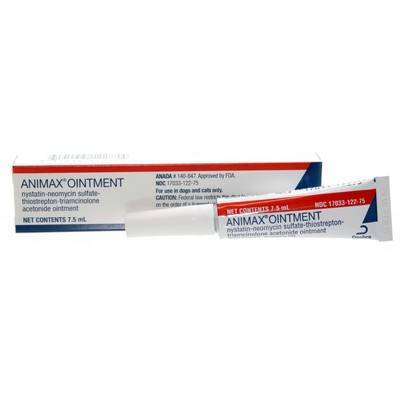
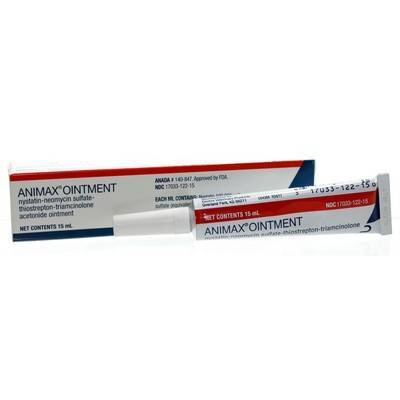
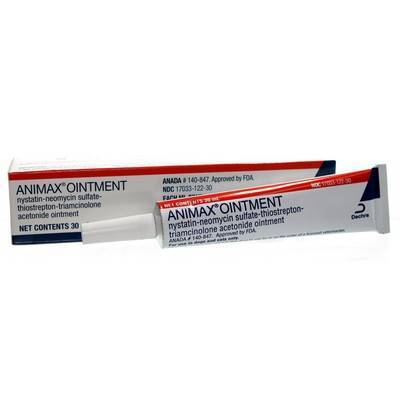
- Animax Ointment is a brand name. You will receive the exact brand that you request.
Is it important for my dog or cat to finish all of the Animax Ointment?
- Dogs and cats may use Animax Ointment for different lengths of time. Please consult your veterinarian if you have any questions.
- Animax Ointment contains two antibiotics. Resistance is a major concern when using antibiotics. To help avoid resistance, it is important for you to use this for as long as your veterinarian has prescribed, even if you dog or cat is looking and feeling better.
Review Summary
Ratings Distribution
Reviews
-
Works Great!
From UndisclosedComments about Animax Ointment 30mL TubeEasy to use and works great!-
![Works Great!]()
Feeling better thanks to Animax!
-
-
Recommend this topical cream
From UndisclosedComments about Animax Ointment 7.5mL TubeIt always helps my pup with his rush between his legs-
![Recommend this topical cream]()
Dallas
-
-
helped heal sores
From UndisclosedComments about Animax Ointment 30mL Tubeprescribed by vet for interdigital cysts. -
-
helpful
From UndisclosedComments about Animax Ointment 15mL Tubevet prescribed for irritated interdigital cysts. Helped heal them when irritated -
-
Animax
From UndisclosedComments about Animax Ointment 30mL TubeAbsolutely love this product. Use it for everything! -
This medication helped my dog
From UndisclosedComments about Animax Ointment 30mL TubeThis is a very effective treatment for an ear infection, helps to control the itching. I would recommend this product.-
![This medication helped my dog]()
I can watch the world from up here.
-
-
For itching
From UndisclosedComments about Animax Ointment 30mL TubeEasy to order fast shipping-
![For itching]()
Olive
-
-
Great medicine!
From UndisclosedComments about Animax Ointment 7.5mL TubeThe ointment is great. Calming my pups dermatitis. Causing my pet to be somewhat stinky. -
This medicine helped out dog.
From UndisclosedComments about Animax Ointment 30mL TubeThe best medicine. Our dog looks 100% better than she did!!! She a different dog. Now she play a little bit with our other dog. -
-
VetRxDirect had good prices for these essentials
From UndisclosedComments about Animax Ointment 15mL TubeMy vet recommended these at a much higher mark-up so I was very grateful to use your fairly easy website and get both scripts fairly promptly.-
![VetRxDirect had good prices for these essentials]()
Louie the girl cat -
![VetRxDirect had good prices for these essentials]()
Merle-girl -
![VetRxDirect had good prices for these essentials]()
B.B. Fleet
-


Q & A
-
If the expiration is September 2024 is it still effective and safe to use in my dogs ears??
-
It is not recommended to use medication past its expiration date. The manufacturer’s expiration date indicates how long the medication’s strength, quality, and purity are guaranteed until when stored under the recommended conditions. Using expired medications may not be as effective and may not adequately treat your dog’s condition. Please consult your veterinarian if you believe your dog still needs to continue using this medication or reach out to our customer service at [email protected] if you need assistance with ordering a refill.
Verified Answer
-
-
My vet told me over the phone to use this ointment for ear infection without actually seeing his ear, Would it have any side effects DUE TO HIM NOT having an infection at all? Would it hurt him if his ear is just dirty and not actually infected ??
-
Animax contains four active ingredients that treat a variety of ear and skin disorders in dogs and cats. Two of the drugs in this medication are antibiotics and resistance can be a major concern when using them. To reduce the risk of antibiotic resistance, please consult your veterinarian regarding how long to use the Animax Ointment. Otherwise, this medication is typically well tolerated, but may cause some redness or discomfort at the application site .
Verified Answer
-
-
Can this be used on humans??
-
Animax Ointment is a prescription topical indicated to treat a variety of ear and skin disorders in dogs and cats. This medication is labeled for animal use only, and should not be used in humans.
Verified Answer
-
-
Is this medication okay for a 10 week old puppy??
-
According to the manufacturer’s product label, Animax is indicated for use in dogs and cats to treat certain types of skin infections, ear infections, and anal gland infections. There is no information available regarding the use of this medication specifically for 10 week old puppies. It is recommended that you consult your veterinarian with any questions or concerns regarding the use of this medication for your dog,
Verified Answer
-
-
This was prescription was given to my dog for an ear infection. Once daily it has to be put in his ears. Should I be cleaning his ears out between use??
-
According to the manufacturer’s package insert, it is recommended that the ears be cleaned before using Animax ointment. Please consult your veterinarian with any further questions or concerns regarding this medication and your dog.
Verified Answer
-
-
We applied a small amount of Animax on our dog's paw. About 20 minutes later (her cone was off briefly), she briefly licked her paw. Should we be concerned? What should we look for??
-
According to the manufacturer and package insert, try to avoid oral ingestion. General side effects of this medication include vomiting, diarrhea, and loss of appetite. An accidental, single ingestion of a small amount that may have been licked off a paw should not be a concern, assuming the pet is not allergic or hypersensitive to any of the ingredients in Animax. If you witness or suspect an overdose, please contact your veterinarian immediately.
Verified Answer
-
-
I've been using this product on my cats ears since Saturday March 2 " prescribed by my vet" Sunday till now my cats been throwing up every time he eats can this be a reaction to this medication??
-
The manufacturer states that vomiting may be a potential side effect if there has been accidental ingestion of the medication. Please consult or see your veterinarian as soon as possible to determine the cause for your cats vomiting.
Verified Answer
-
-
I was told to use Animax Ointment on my dogs rear (anus) area. If she licks some of it, is that a hazard to her??
-
According to the manufacturer and package insert, try to avoid oral ingestion. Please contact your veterinarian with additional questions or concerns.
Verified Answer
-
-
Does ordering Animax Ointment for dogs require a prescription??
-
Yes, Animax Ointment requires a prescription from your veterinarian.
Verified Answer -
My vet will not use this I have used before still would like to order if I can
Community Answer
-
-
can this be used in cats ears. There is a lot of brown stuff in my cats ears?
-
Animax is a prescription ointment used to treat ear infections in dogs and cats. We recommend talking with your veterinarian about your pet before using this product.
Verified Answer
-
Sign Up and Save 10%!
Plus enjoy insider offers and be the first to learn about our new products and promotions.
*10% off valid on your next order. Must apply code at checkout.
Your 10% off gift is coming your way.
But first, tell us more about your pet and only get content that is special to them.


and welcome to our family and !