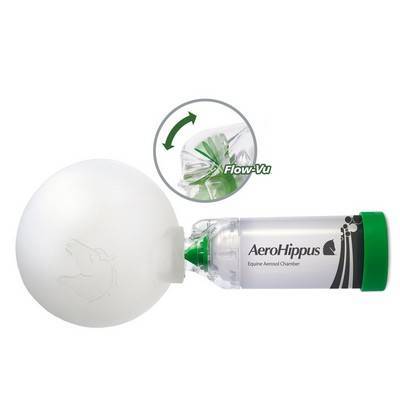
AeroHippus Equine Aerosol Chamber usually ships same day with quick delivery if ordered from VetRxDirect by 3PM CST.
The AeroHippus Equine Aerosol Chamber by Trudell is designed to be used along with a Metered Dose Inhaler to deliver aerosol medication, such as Fluticasone (Flovent) or albuterol (ProAir), to treat horses with respiratory disease. Metered Dose Inhalers, used to treat human respiratory conditions, can be prescribed by your veterinarian and purchased from VetRxDirect. This device should be used only on the recommendation of your veterinarian. Consult with your veterinarian for advice and instructions.
Product ships from Iowa. Free ground shipping option in 5-9 Days.
Free Ground Shipping on AeroHippus!
Trudell Medical’s AeroKat and AeroDawg are also available at VetRxDirect!
A E RO S O L D RU G D E L I V E RY for EQUINE RESPIRATORY DISEASE
The AeroHippus* Equine Aerosol Chamber (EAC) is designed to be used along with a Metered Dose Inhaler (MDI) to deliver aerosol medication to horses with equine respiratory diseases such as Inflammatory Airway Disease or Recurrent Airway Obstruction. Since 1990, inhaled aerosol medications have been used to treat horses with respiratory disease. Traditionally, horses were administered inhaled aerosol medications via aerosol mask chambers. However, these chambers are bulky and can be difficult to use. The revolutionary new AeroHippus* EAC is a lightweight product that is designed to simplify the aerosol delivery process.
Flow-Vu* Indicator is a valuable feedback tool that moves with respiration, allowing owners to count the number of breaths taken by the horse, ensure there is a secure seal and to coordinate actuation of the MDI with inhalation
One Size Fits All – from foals to warmbloods
Low Price – significantly lower than mask equine systems currently on the market
Anti-Static Chamber – improves aerosol suspension time and increases drug availability allowing the horse more time to inhale
Convenient and Portable Chamber
Simple to Use and Easy to Clean
Radiolabelled studies show a mean lung deposition of 18.2%1 with researchers stating, “this is an extremely efficient device.” High deposition may result in fewer doses required for medication to be effective and for potential cost-savings.
GUIDELINES FOR USING INHALED MEDICATION TO TREAT EQUINE RESPIRATORY DISEASE
Main types of Equine Respiratory Disease:
Inflammatory Airway Disease (IAD): Chronic, intermittent cough, increased mucoid airway secretions, and decreased performance. Can affect horses of any age and clinical signs at rest are usually subtle. Lack of labored breathing or severe exercise intolerance in IAD provides differentiation from RAO.
Recurrent Airway Obstruction (RAO): Disease of the lower airways, resulting in coughing and exercise intolerance. Tends to affect mature to older animals (commonly referred to as heaves).2
Treatment:
Environmental Change: Limit exposure of environmental irritants, such as molds and dust, present in feed and bedding and provide adequate ventilation
Vaccinations: Lower the incidence of viral infections by vaccination
Inhaled Corticosteroids: Help control airway inflammation and prevent reoccurrences. Administered by Metered Dose Inhaler via devices such as AeroHippus* Equine Aerosol Chamber
Inhaled Bronchodilators: Open air passages and give immediate relief. Administered by Metered Dose Inhaler on an as needed basis via devices such as AeroHippus* Equine Aerosol Chamber
The exact combination of drugs and their doses depends on a number of factors, such as the results of lung function tests, type of inflammation, duration of the problem, presence of cough, size/body weight of the horse and horse’s occupation.
Inhalation Therapy – Treatment of Horses with Mild to Moderate Disease
Drug
Corticosteroids
Beclomethasone 1,500 – 3,500 μg bid
Fluticasone 2 mg bid
Bronchodilators
Albuterol 360 – 900 μg q4-6h Powerful, rapid onset (5 min); duration of action: 1h
Fenoterol 1000 – 1500 μg q4-6h
Dosage Notes
Source: Rush B, Grady JA. Recurrent Airway Obstruction (Heaves). Compendium Equine, May 2008, 198–205.
Note: This page contains a list of MDI medications and some selected information about each MDI medication. Trudell Medical International does not endorse the use of any specific MDI medication.